
The Montreux Document
The Montreux Document is the first international document to reaffirm the international legal obligations of States regarding the activities of private military and security companies (PMSCs). It also contains a series of good practices designed to help States take appropriate measures to comply with their obligations under international law.
.png?w=1024&auto=format)
What's it about?
The Montreux Document expresses the consensus that international law also applies to PMSCs and that these do not operate in a legal vacuum. It is a practical and realistic contribution intended to promote compliance with international humanitarian law and human rights. It answers the legal questions raised by the use of PMSCs without creating new obligations.
Content
The first part of the Montreux Document distinguishes between Contracting States, Territorial States and Home States. It gives an overview of the pertinent international obligations arising from international humanitarian law and human rights law for each category. It also addresses a Contracting State's liability under customary international law for the conduct of private individuals. In this section, the pertinent international legal obligations of PMSCs and their employees, as well as the responsibility of their superiors, are also set out.
The second part of the Montreux Document highlights good practices for the regulation of PMSCs, such as introducing transparent regulations, licensing, and measures to improve supervision and liability. The aim of this section is to, inter alia, support States in implementing their obligations under international humanitarian law.
Background
The Montreux Document is the result of an initiative launched by Switzerland and the ICRC in early 2006. A first draft of the Montreux Document was prepared during four intergovernmental meetings that took place between January 2006 and September 2008. The final document was adopted by consensus of the participating states at the fourth and last meeting, which took place in Montreux from 15 to 17 September 2008.
The Montreux Document Forum (MDF) was established in December 2014. It provides a platform for informal exchange among the participants of the Montreux Document, with the aim of supporting its implementation at the national level and encouraging other states and international organizations to endorse its content. To this end, the MDF has established a network for national supervisory authorities, open to the participating states of the Montreux Document. This initiative offers a dedicated platform to discuss regulatory challenges in the supervision of PMSCs and to address technical issues.
Index
Links
Documents
Cinese蒙特勒文件 (Chinese)
Documento de Montreux (Spanish)
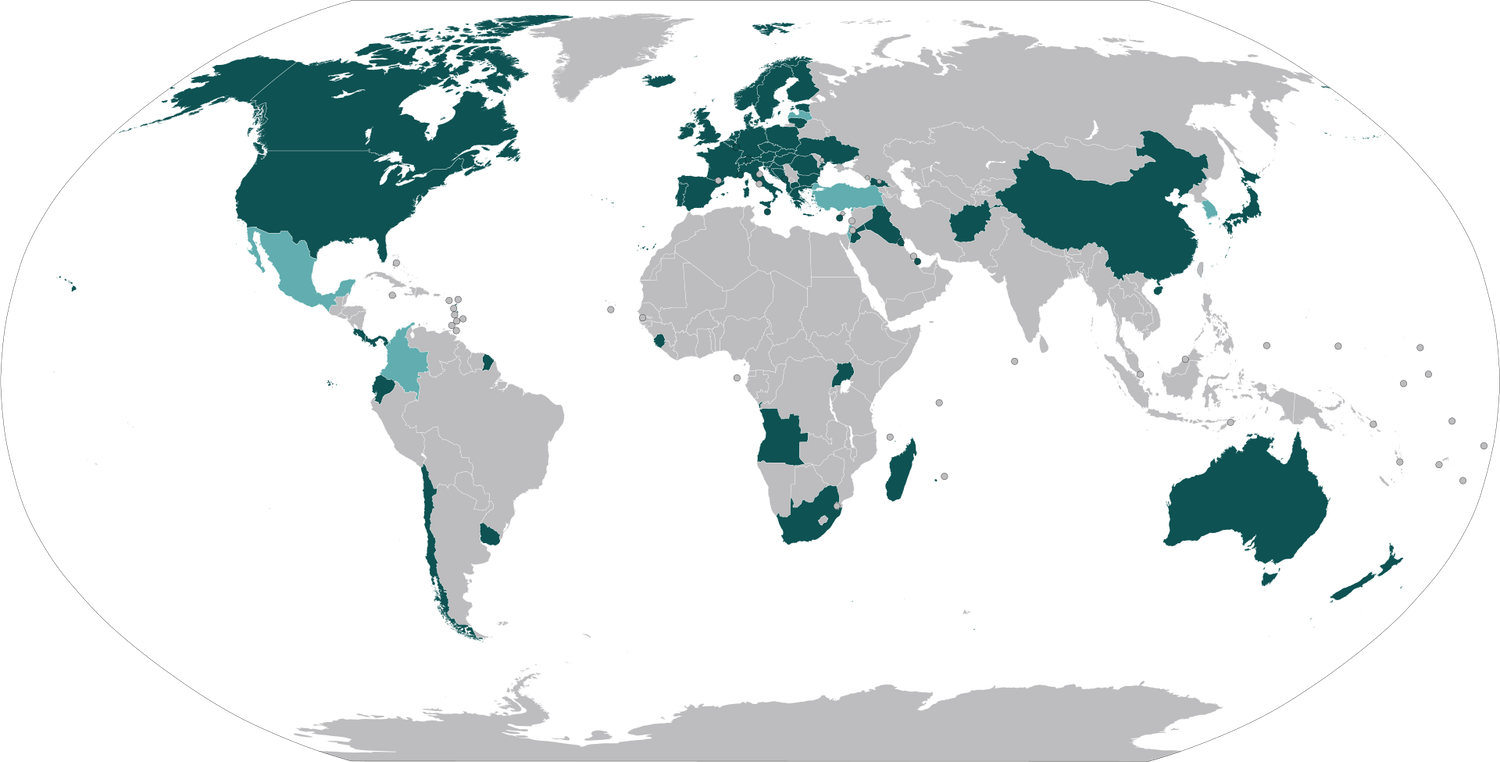
Map of Montreux Document Participating States and International Organizations
Das Montreux-Dokument ist offen für alle Staaten und internationalen Organisationen. Gegenwärtig unterstützen 61 Staaten und drei Internationale Organisationen das Montreux-Dokument.
Montreux+5 Conference: Chair’s Conclusions
Regulación de empresas militares y de seguridad privada (Spanish)
Regulamentação das empresas militares e de segurança privada (Portugese)
Regulating private military and security companies
The Montreux Document
Монрёский документ (Russian)
والأمنية الخاصة تنظيم الشركات العسكرية (Arabic)
وثيقة مونترو (Arabic)
.png)
Kontakt
Kochergasse 10
3003 Bern