
Geneva International Discussions: dialogue for security and stability in the South Caucasus
During his visit to Georgia on 16 October 2026, OSCE chairman-in-office Federal Councillor Ignazio Cassis underlined the importance of dialogue for security and stability in the South Caucasus. The Geneva International Discussions (GID) play a key role in this regard. Since the 2008 war, they have provided a diplomatic framework for reducing tensions, fostering trust and preventing further escalation, despite differing positions. Switzerland supports the dialogue as part of its good offices.

During his visit to Georgia on 16 October 2026, the Organization for Security and Co-operation in Europe (OSCE) chairman-in-office and FDFA head Federal Councillor Ignazio Cassis met with Foreign Minister Maka Botchorishvili. The discussions focused on regional developments, the importance of ongoing dialogue and the OSCE's contribution to security and stability in the South Caucasus. Mr Cassis also visited conflict-affected areas along the administrative boundary line with the regions of Abkhazia and South Ossetia. While there, he was briefed on the current security and humanitarian situation.
Dialogue in Geneva despite differing positions
Since the two wars of the early 1990s, the two self-proclaimed republics of Abkhazia and South Ossetia have been outside the control of the Georgian government. In August 2008, Russia and Georgia went to war once again over South Ossetia. The ceasefire agreed in 2008 provides, among other things, for talks on security in the region. The Geneva International Discussions (GID) provide the diplomatic framework for this. Three times a year, representatives from Moscow, Tbilisi, Tskhinvali and Sukhumi, as well as Washington, meet to discuss issues relating to the implementation of the ceasefire. The Geneva talks are therefore the only forum in which the consequences of the 2008 conflict are discussed jointly, with the involvement of all stakeholders.
The GID are co-chaired by the OSCE, the EU and the UN. The talks take place at the UN in Geneva, where Switzerland supports the dialogue as part of its good offices. This regular exchange of views helps to address tensions, thereby enhancing predictability and stability.
Dialogue remains essential: although it does not bring about peace immediately, it does prevent escalation, gradually opens up opportunities for trust and cooperation, and thus contributes to peace.
“Dialogue remains essential:although it does not bring about peace immediately, it does prevent escalation, gradually opens up opportunities for trust and cooperation, and thus contributes to peace. This benefits not only the people on both sides of the conflict line, but also security in Europe as a whole,” emphasises Ambassador Christoph Späti, the OSCE chairman-in-office's special representative for the South Caucasus. Mr Späti co-chairs the GID in Geneva together with the UN and EU.
Everyday life also key to security
Besides the Geneva talks, Mr Späti's OSCE mandate also sees him take part in regular meetings of the Incident Prevention and Response Mechanism (IPRM) along the administrative boundary line with South Ossetia. These are co-facilitated by the OSCE and the EU Monitoring Mission in Georgia (EUMM). The meetings focus on specific security issues and matters concerning the local population affected by the conflict: security incidents, arrests, restrictions on freedom of movement or problems with the irrigation of agricultural land. These IPRM meetings make a tangible contribution to security on the ground and help to alleviate the impact of the conflict on local people.
It is particularly important to engage with the local population so that their concerns are taken into account in the work of international actors. The experiences of women, young people and other directly affected communities help in identifying specific challenges and developing viable solutions.

Swiss chairpersonship of the OSCE for 2026
From 14 to 16 October 2026, the head of the FDFA and OSCE chairman-in-office, Ignazio Cassis, visits Armenia and Georgia. The talks focus on the situation in the South Caucasus and the role of the OSCE.

Switzerland's good offices – mediation as a bridge to peace
How Switzerland acts with its good offices as an impartial mediator on the world stage and contributes to peace.
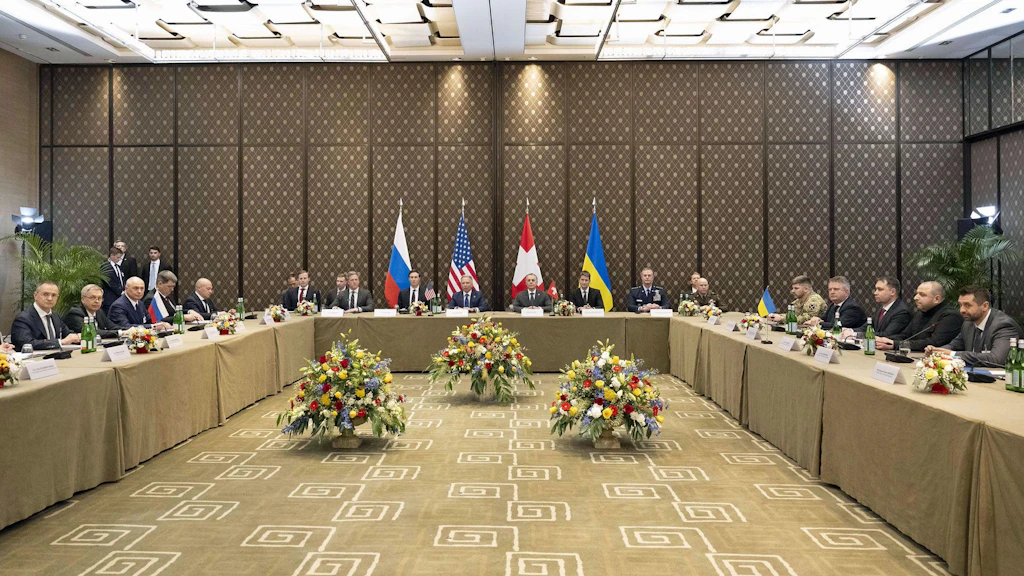
Trilateral talks in Geneva
Federal Councillor Ignazio Cassis personally welcomed the delegations from the United States, Ukraine and Russia in Geneva and officially opened the talks.
Contact
General Secretariat GS-FDFA
Federal Palace West
3003 Bern