
A journey into cyberspace guided by the Council of Europe
On 21 May 2021, 47 foreign ministers met online for the 131st Session of the Council of Europe Committee of Ministers. They work as a team, also in the digital sphere. It is precisely the digital sphere that presents the Council of Europe with both a challenge and an opportunity to safeguard human rights, democracy and the rule of law not only in the physical world but also in cyberspace. Four Swiss experts working in the Council of Europe share their experiences.
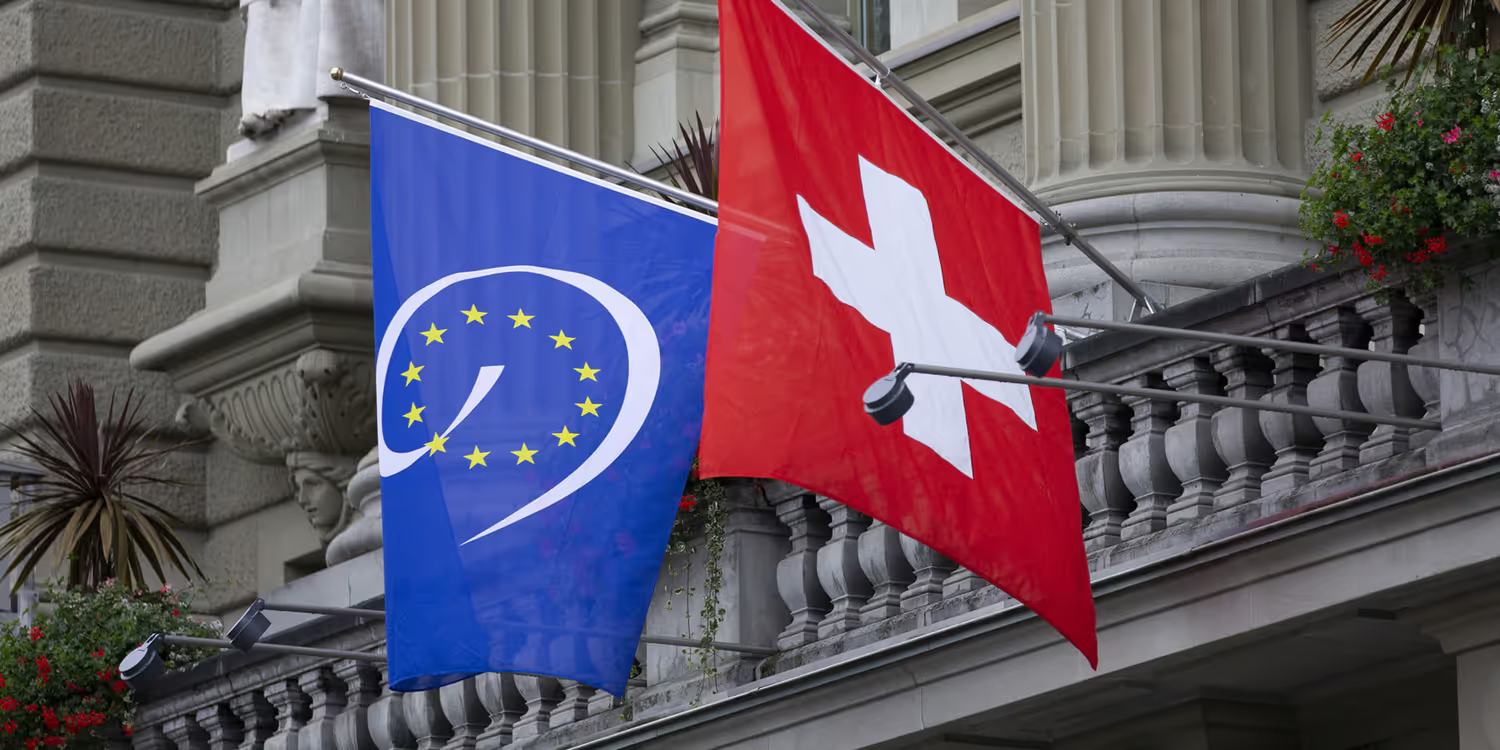
Since its founding 72 years ago after the Second World War, the Council of Europe has held 131 ministerial sessions. These two figures might lead one to suppose that the Council of Europe proceeds at a slow pace set by treaties and conventions. Quite the opposite: the Council of Europe is very much in step with the times and is meeting the challenges that digital technology is bringing to our daily lives. Data protection, artificial intelligence, the fight against cybercrime and hate speech on social networks are just some examples.
For Switzerland, the Council of Europe is a platform for exchange to which it can contribute on an equal footing with the other member states to tackle today's global challenges – including digitalisation. «It is our common duty to prevent the risks of digitisation without impeding progress,» said Mr Cassis, the head of the Federal Department of Foreign Affairs, on the occasion of the ministerial meeting. Digitalisation is likewise one of the priorities of Switzerland's Foreign Policy Strategy 2020–23.
Four Swiss experts working at the Council of Europe talk about how its activities impact our daily lives.
Expert Andrea Candrian on cybercrime
I get an email from my employer with this warning: «Beware of emails from unknown senders. Don't click on links, or reply to emails from suspicious or unknown senders. They may be attempts to take control of your account or access your data.»
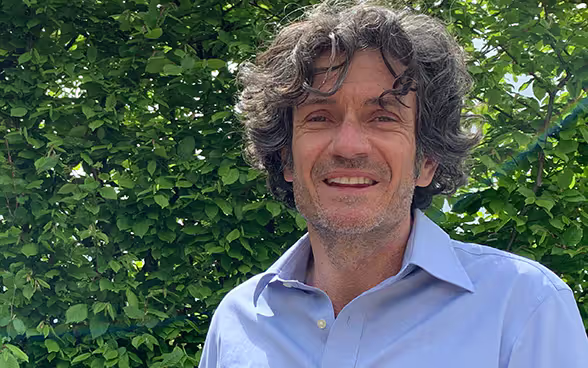
Andrea Candrian represents Switzerland in the Council of Europe's expert group on cybercrime. «Unfortunately, we're still getting emails or phone calls from people who've been victims of internet crimes like blackmail involving cash or bitcoin,» explains Candrian. Cooperation between states is essential if we are to find a swift solution, and the Council of Europe is the ideal platform to respond to this challenge effectively. This is why the Council of Europe's Convention on Cybercrime, known as the Budapest Convention, was adopted in 2001. Sixty-six states, including Switzerland, harmonised their criminal law and established common rules for international cooperation.
Andrea Candrian has worked for many years at the Council of Europe as an expert in criminal law and has also represented Switzerland in the field of counterterrorism. He believes that Switzerland's participation in the Council of Europe is vital because it allows «regular exchanges among experts and judicial authorities in the field of criminal law and the fight against crime. Such exchanges always result in a transfer of knowledge. They also strengthen mutual trust in many areas, for example in the fight against domestic violence, terrorism or cybercrime,» he concludes.
Combating hate speech online: Dominique Steiger Leuba in ad hoc committee
Instagram, Facebook, TikTok, Snapchat: social media are part of our daily lives, and with just a few clicks we can ‹like› or ‹share› or leave a comment. Moments later, however, racist comments from third parties may also appear on the page.
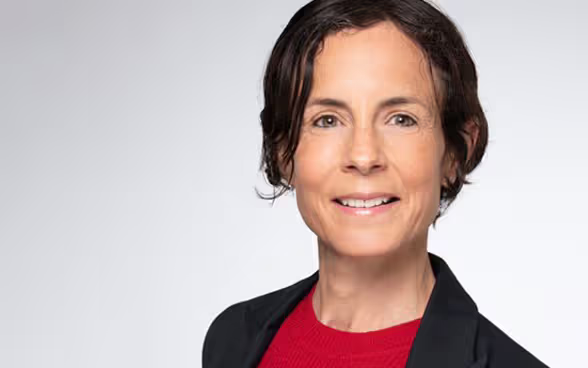
Since 2002, Dominique Steiger Leuba has been working as a specialist in the International Human Rights Unit of the Federal Office of Justice (FOJ). She represents Switzerland at the Council of Europe on the Committee of Experts on Combating Hate Speech. The Council of Europe has adopted a number of treaties and recommendations containing guidelines to help member states combat hate speech, both online and offline, and to support victims. The committee is currently working on a recommendation for a comprehensive approach to combating hate speech online. «These instruments require all member states to develop legal frameworks to address the problem,» explains Steiger Leuba.
According to Dominique Steiger Leuba, Switzerland's participation in the Council of Europe is crucial. «These discussions lead, among other things, to the drafting of legal instruments, whether binding or not, which then make it possible to anchor these fundamental principles in the legal systems and practices of all the member states,» she concludes.
Personal data protection: Commissioner Jean-Philippe Walter's experience
I click on a news portal. One of the articles is about measures to trace potential COVID-19 carriers and the introduction of a COVID-19 certificate. I'm concerned about some aspects and leave a comment: is my personal data protected? Will my freedom of movement still be guaranteed?

Jean-Philippe Walter has addressed this and many similar concerns since he became the Council of Europe's Data Protection Commissioner in 2019. He has been particularly involved in the modernisation of Convention 108, adopted in 1980. This internationally binding instrument is aimed at protecting individuals against improper automated processing of their personal data. Its modernisation, begun on 28 January 2011, is a fundamental step towards strengthening data protection rights in Europe and worldwide. Convention 108+ was therefore a response to current social and technological developments.
Before taking on the mantle of Council of Europe Data Protection Commissioner following his retirement at the beginning of 2019, Walter represented Switzerland in various Council of Europe committees and working groups involved in data protection. He considers Switzerland's presence in the Council of Europe important because "Switzerland is not a member of the European Union. Its participation in the Council of Europe in the field of data protection is therefore all the more important, not only to contribute to the development of this fundamental right in the digital age, but also to strengthen international cooperation in this cross-sectoral and globalised field”.
Guidelines for artificial intelligence: the work of Thomas Schneider
Some airports are testing the use of facial recognition: so no more printed paper tickets or documents – just a face scan and off you go! In a matter of seconds, they can see who I am, where I'm going and whether I've had a COVID-19 test. What other data do they have access to? And where does my personal information go?
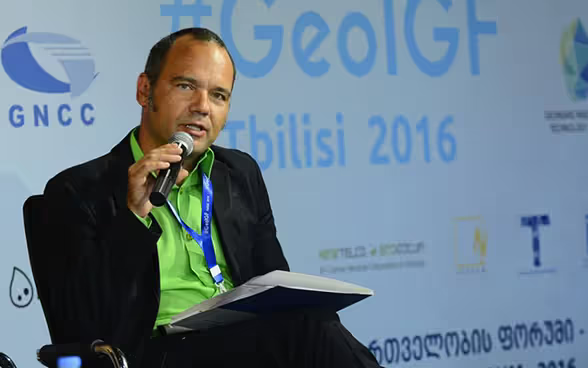
Artificial intelligence (AI) is a key part of Thomas Schneider's work, also at the Council of Europe. He has represented Switzerland on the Steering Committee on Media and Information Society (CDMSI) since 2005 and, since 2019, he has been a member of the governing body of the Ad Hoc Committee on Artificial Intelligence (CAHAI). «We are tasked with developing a feasibility study for a legal framework for AI by the end of 2021, which should contain the foundations and concrete elements of a binding agreement,» says Schneider. Through binding and non-binding rules, the Council of Europe provides the framework within which individual states should strive to protect the fundamental rights of their citizens when using AI. The Council of Europe has also developed a number of guidelines, such as the 2019 guidelines on AI and data protection, aimed at helping policymakers, AI developers, manufacturers and service providers ensure that AI applications do not compromise privacy rights.
The Council of Europe is often a pioneer in various fields, and Switzerland is playing its part at the forefront in this context. «The Council of Europe sets the basic principles and milestones for future regulation at national and European levels – often beyond Europe too. It has a unique, global and coherent system of values and organisation that allows it to take on new challenges and develop a coherent set of rules for the long term,» says Schneider.
Links
- Press release - Human rights in the digital age: Ignazio Cassis underlines Council of Europe's key role, 21.5.2021
- Council of Europe, FDFA
- Foreign Policy Strategy 2020–23, FDFA
Documents
Contact
General Secretariat GS-FDFA
Federal Palace West
3003 Bern