
Conventional weapons
International humanitarian law aims to limit the effects of armed conflicts. It therefore prohibits or restricts the use of weapons that cause excessive suffering or have indiscriminate effects. The Convention on Certain Conventional Weapons plays a central role in this regard. The use of autonomous weapon systems must also be assessed in accordance with the provisions of international law and international humanitarian law.
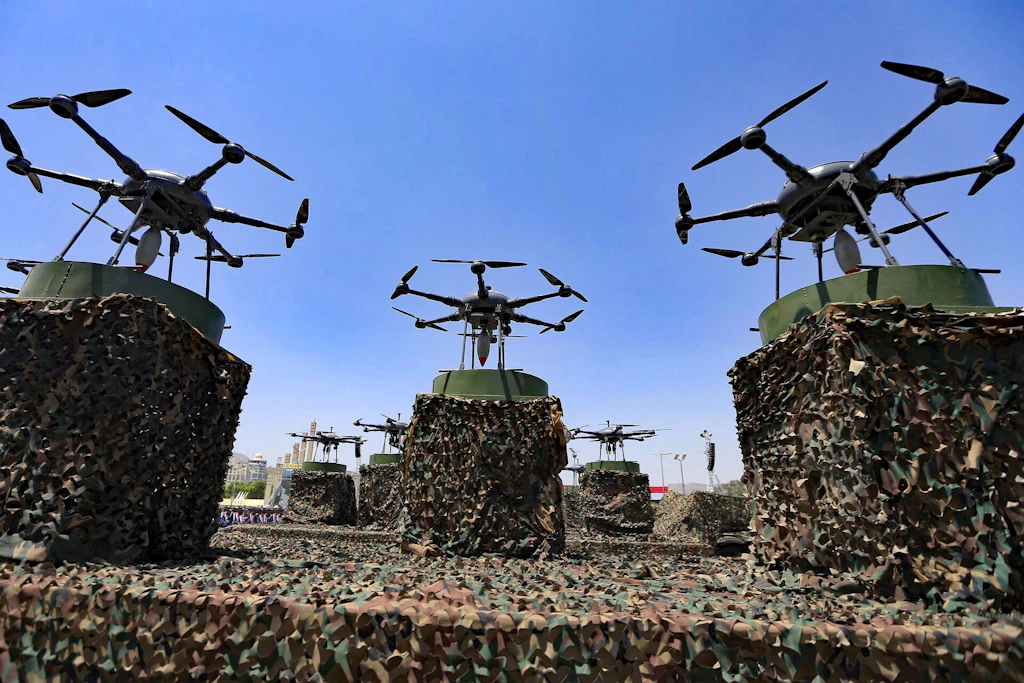
International humanitarian law restricts or prohibits the use of certain conventional weapons. Switzerland is committed to complying with international humanitarian law and, against the backdrop of technological progress, works to ensure that existing standards remain relevant and respected, thereby guaranteeing their effectiveness.
Convention on Certain Conventional Weapons
The Convention on Prohibitions or Restrictions on the Use of Certain Conventional Weapons (CCW) is a cornerstone of conventional arms control and IHL. Its goal is to balance military and humanitarian interests at all times. This gives it broad international support with all of the major military powers party to the treaty. Revisions to the CCW, which take account of various aspects of the rapid development of weapons technology and methods of warfare, are set out in a number of additional protocols.
Restricting the use of anti-vehicle mines is currently under discussion, with Switzerland supporting negotiations for an additional protocol in this regard. These types of conventional weaponry have grave humanitarian consequences, mainly for civilians. As part of its humanitarian policy, Switzerland is also engaged in efforts to regulate small arms and light weapons as well as mines and cluster munitions.
Autonomous weapons systems
The integration of artificial intelligence (AI) and robotics is resulting in weapons systems that have increasingly autonomous capabilities. This has military advantages, but should also improve compliance with international law. However, a number of (international) legal, political and ethical issues in this context are still pending.
For Switzerland, compliance with international (humanitarian) law is the key starting point for evaluating AWS. In particular need of clarification at global level is the issue of human control and what is necessary both in terms of type and quality. Autonomy must not be unlimited.
Switzerland's contributions
What kind and degree of human control over AWS is necessary in legal and ethical terms? The International Committee of the Red Cross (ICRC) and Stockholm International Peace Research Institute (SIPRI) are using contributions from Switzerland to address this issue.
- Switzerland has issued a widely read working paper placing compliance with IHL at the heart of the current debate.
- It has also submitted contributions to the UN Group of Governmental Experts on lethal autonomous weapons systems (LAWS) setting out its position on compliance with international law and the need to ensure human control.
- Switzerland is also supporting the development of standardised methodology and test protocols to check whether weapons systems conform to international law.
Swiss working paper on LAWS, UN Geneva
Limits on Autonomy in Weapon Systems: Identifying Practical Elements of Human Control, SIPRI
It is also continuing efforts to clarify this need for regulation in the CCW. Switzerland is calling for the prohibition under the CCW of AWS:
- the effects of which cannot be reasonably predicted,
- the impact of which cannot be limited in accordance with IHL,
- which cannot otherwise be used in accordance with IHL,
- the repercussions of which cannot be attributed to a responsible commander.
Links
- Convention on Prohibitions or Restrictions on the Use of Certain Conventional Weapons which may be deemed to be Excessively Injurious or to have Indiscriminate Effects
- Background on LAWS in the CCW, UN Geneva
- AVIS28 – inspiring Switzerland to be ready for the future
- Securing our common future – An agenda for disarmament, UN
- Security and technology, UN Institute for Disarmament Research (UNIDIR)
- The Militarization of Artificial Intelligence, Henry L. Stimson Center
- Swiss working paper on LAWS, UN Geneva
- Switzerland’s commentary on operationalizing the guiding principles at a national level, as requested by the Chair of the 2020 Group of Governmental Experts (GGE) on Emerging Technologies in the Area of Lethal Autonomous Weapons Systems (LAWS) within the Convention on Certain Conventional Weapons (CCW)
- Limits on Autonomy in Weapon Systems: Identifying Practical Elements of Human Control, SIPRI
Documents
Views of Switzerland Autonomous Weapons ODA-2024-00019LAWS (24.05.2024)
Statement Switzerland GGE AWS General Debate (26.08.2024)
multilingual: French, English
Intervention by Switzerland on behalf of 23 States on joint submission of a sign post paper on autonomous weapons systems
Joint Statement by Switzerland at the CCWUN Review Conference (17.12.2021)