
International cooperation: the FDFA is mitigating the impact of COVID-19 around the world
The consequences of the coronavirus pandemic are particularly severe in developing countries. The FDFA has taken immediate action to mitigate the economic and health effects of the crisis there. It is providing emergency humanitarian aid, supporting international action, and focusing on the management of COVID-19 in ongoing bilateral and global development programs. Furthermore, Switzerland also provides assistance in the area of peace policy.
SDC and PHRD projects in various countries: the SDC and the PHRD have adjusted various ongoing bilateral projects and programmes and also initiated efforts in response to the global COVID-19 pandemic (Karte, Zoom mit Doppelklick). The FDFA is also involved in internationally active organisations and undertakes work at regional level. © FDFA
The coronavirus pandemic is not only a health crisis. It is also an economic crisis and will develop into a financial and social crisis. The consequences are particularly serious for developing countries. Many people there have already lost their jobs. Without jobs, social networks and savings, their livelihoods are quickly threatened and poverty, instability and migration are likely to increase. The education of children and young people is also at risk, as thousands of schools have had to close because of COVID-19 and over 1.6 billion pupils and students worldwide are affected.
The FDFA's response is aimed at taking effective measures to counter the health, economic and social consequences of the pandemic in developing countries. This is also in line with the thrust of the 2021-2024 international cooperation strategy, which is designed to be flexible and allows for a targeted response to needs.
The FDFA has adapted ongoing projects and programmes within the framework of existing budgets and are supporting organizations and institutions in the fight against the pandemic. Communicable diseases and their consequences do not stop at borders, and it is therefore important for Switzerland's security to counter global health risks across borders and to strengthen the health and economic systems in developing countries. With its open and globalised economy, Switzerland is dependent on a stable international order. The following examples and tables provide an overview of the FDFA’s measures.
Africa
COVID-19 poses major problems for many African countries. The pandemic is not only an additional challenge in terms of health, but also in terms of the economy, food safety, access to education and security. In many countries, the authorities have therefore taken restrictive measures ranging from travel bans to school closures. However, African health systems are fragile and the economic consequences of a «lockdown» for the population are severe. After all, work is often not registered by the state. Education institutions are striving to maintain minimal access to education via television or radio despite school closures, but in many places the necessary infrastructure is lacking. Even if schools are now partially reopening, massive learning deficits are evident, and child labour and sexual violence against girls have increased.
To reduce the collateral damage of the pandemic in Africa and prevent millions of people from falling back into extreme poverty and to prevent lack of access to education from having long-term social and economic consequences, the FDFA is implementing various medium and long-term measures. If these measures improve prospects on location, they will also reduce the pressure of migration.
Support for Africa
Asia
In addition to the general population, migrant workers are particularly affected by the border closures and lockdowns in South and Southeast Asia.
Thousands have lost their jobs and are often stranded in transit and destination countries. The FDFA has adapted its commitment in the area of migration accordingly and implemented emergency aid measures. For example, various partners of the Swiss Agency for Development and Cooperation (SDC) provide migrants with food, water, hygiene articles and protective material, offer medical and psychosocial assistance, and help them to maintain contact with their families.
Consideration is also being given to medium-term strategies for reintegrating them into the economy. For not only do labour migrants risk slipping into extreme poverty without a social insurance network. But their remittances to their families, if they fail to be sent, put their home countries under further pressure. In some countries remittances account for up to a third of the gross domestic product.
Without these financial resources, combating COVID-19 in the Asian region will be even more difficult. Not only is unemployment rising there, pushing millions of people back into poverty. Many people also have no access to basic needs, such as food. In addition, there is often a lack of medical infrastructure, and in many densely populated areas «social distancing» is not possible.
Support for Asia
Europe, South Caucasus and Central Asia
The COVID-19 crisis is having a profound impact on all the countries of Eastern Europe, hitting economies hard and raising poverty levels. High unemployment rates in the Balkans, especially among young people, are expected to increase. Minorities, such as the Roma, are particularly badly hit by the pandemic. In Ukraine, Moldova, the South Caucasus and Central Asia, many communities are reliant on direct aid. Because of the crisis in Europe and Russia, around one million migrant workers have returned to their home countries, or are stranded without work. Remittance levels, which account for up to 40% of GDP in certain countries, are declining sharply. The crisis may also stoke social tensions.
Switzerland is committed to strengthening community structures, promoting economic development and improving access to healthcare and water in priority countries. This work will become even more important in strengthening the resilience of communities. Digital technologies provide opportunities for developing solutions for public services, healthcare systems and education.
Support for Europe, the South Caucasus and Central Asia
The Near and Middle East
In countries torn by years of conflict, upholding human rights, peacebuilding and security are difficult to maintain even in normal circumstances. This is certainly the case with Syria. According to UN Special Envoy Geir Pedersen, Syria is at serious risk of being unable to contain the COVID-19 pandemic. In the last decade, almost half of the population has been displaced, around 11 million people rely on humanitarian aid and the healthcare and education systems are on the brink of collapse following 10 years of war. The FDFA is involved in a project to raise awareness of the consequences of COVID-19 for the Syrian population. Although Syria is deeply divided because of the conflict, the FDFA is working to promote cooperation between the various factions to help them cope with the pandemic.
Support for the Near and Middle East
Latin America and the Caribbean
According to official statistics, COVID-19 has already claimed the lives of more than 20,000 people in Latin America and the Caribbean (as at 11 May). To protect public health, the majority of countries have imposed border closures and quarantine measures which are still in effect. The crisis has grave consequences for the economy and society. International organisations estimate that the region's economy is set to decline by approximately 5% this year, causing millions of people to slide from the ranks of the middle class back into poverty.
Support for Latin America
The COVID-19 crisis calls for global and regional responses
The global challenges posed by the pandemic require global responses. The SDC is working to achieve this with multilateral partner organisations, such as the UN, and financial institutions, such as the World Bank. Its involvement allows UN and World Bank projects to draw on Swiss expertise amongst others in public health. Furthermore, Switzerland always insists that projects are planned in close cooperation with international organisations, thus avoiding duplication of efforts and ensuring that international support has maximum impact.
Global cooperation enables the SDC to support, for example, the Geneva-based Foundation for Innovative New Diagnostics (FIND). FIND is working closely with the World Health Organization (WHO) on delivering training and technical assistance to ensure that people in developing countries have access to accurate and high-quality testing for the virus that causes COVID-19.
This enables Switzerland to indirectly support low and middle-income countries in their fight against the spread of communicable diseases such as COVID-19. Through its regional programmes, the SDC is also influencing the prevention and containment of the pandemic. After all, working across national borders is an important factor in view of the spread of the new coronavirus.
SDC support for internationally active organisations
Fight against COVID-19 through SDC regional programs
Peace, security and human rights in the digital domain and at regional level
Alongside its initiatives on the ground, the FDFA via the Peace and Human Rights Division (PHRD) also supports peace and security projects at regional level and in the digital domain. The HSD is working with the Arab Institute for Human Rights, for example, which is drawing on its advocacy expertise to conduct an information campaign on social media with a view to ensuring that national strategies for tackling COVID-19 include migrants and refugees more effectively. The purpose of the measures is to facilitate access to clear and reliable information and create a narrative of solidarity, inclusion and non-discrimination.
Digital and regional projects in the fields of peace, security and human rights
The figures in this article are taken from international cooperation projects undertaken by the FDFA which may be effective in helping Switzerland's priority and partner countries tackle the COVID-19 crisis. The funds indicated are from current budgets, including budgets for ongoing projects that have been adjusted in line with new requirements. The total funding amounts are therefore greater than the figures previously indicated for specific international cooperation activities by Switzerland in response to the COVID 19 crisis.
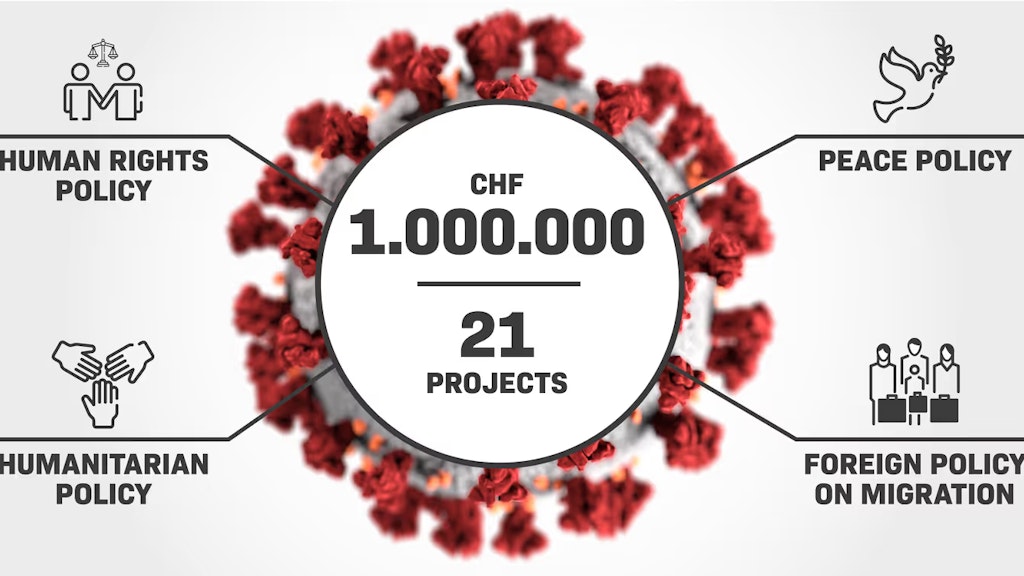
COVID-19, peace and human rights: history is accelerating
As part of Switzerland's international cooperation activities, the HSD took quick, effective action to tackle head-on the COVID-19 pandemic, among other things by providing CHF 1 million in rapid response funding
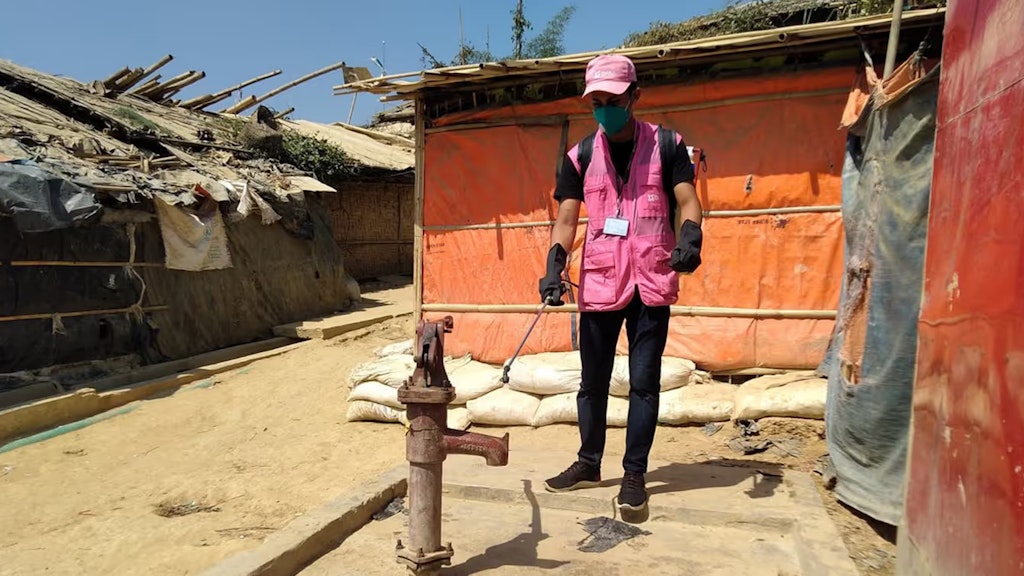
COVID-19: Switzerland strengthens international cooperation
The COVID-19 pandemic is having an especially severe impact on developing countries. Switzerland is responding quickly and effectively through its international cooperation in the spirit of solidarity.
Contact
General Secretariat GS-FDFA
Federal Palace West
3003 Bern