Nuclear disarmament remains a priority for Switzerland
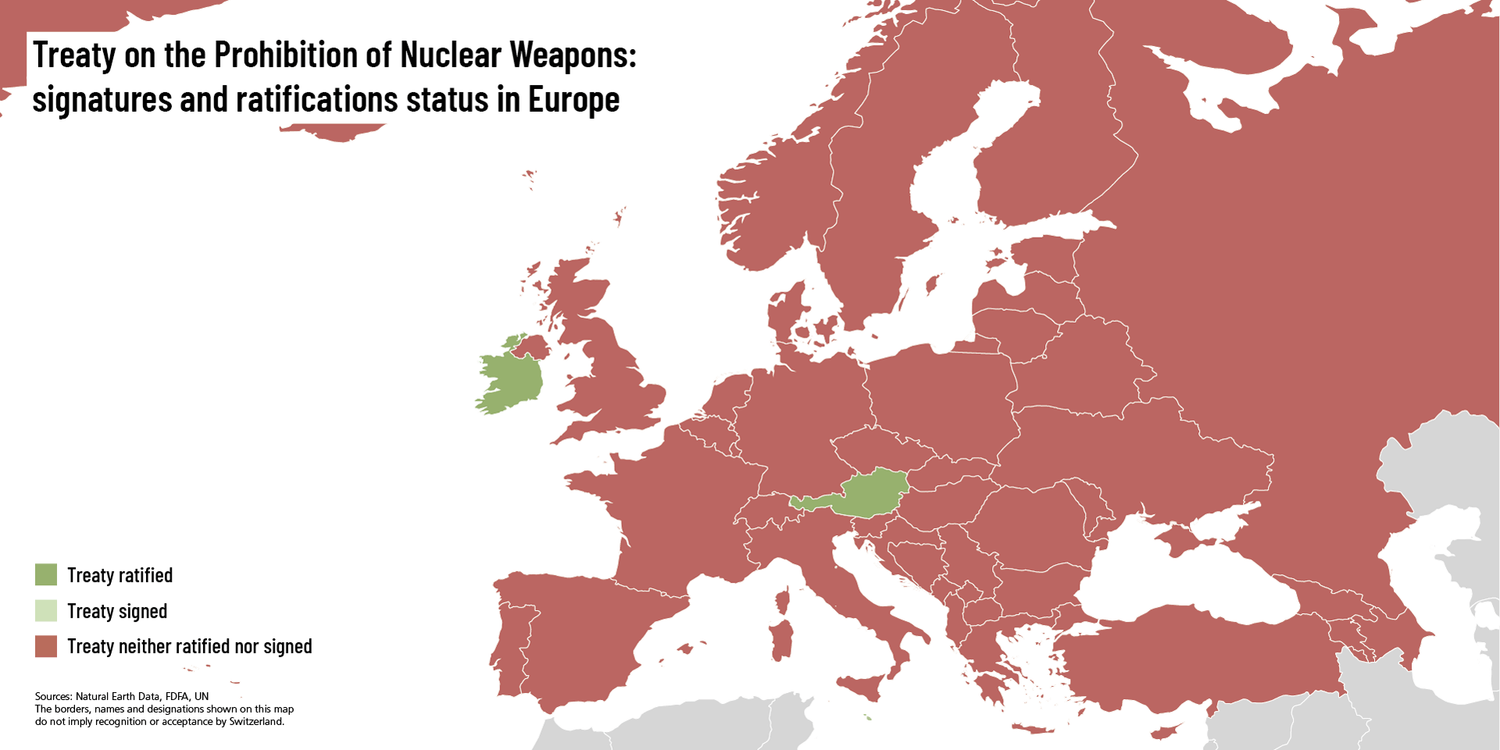
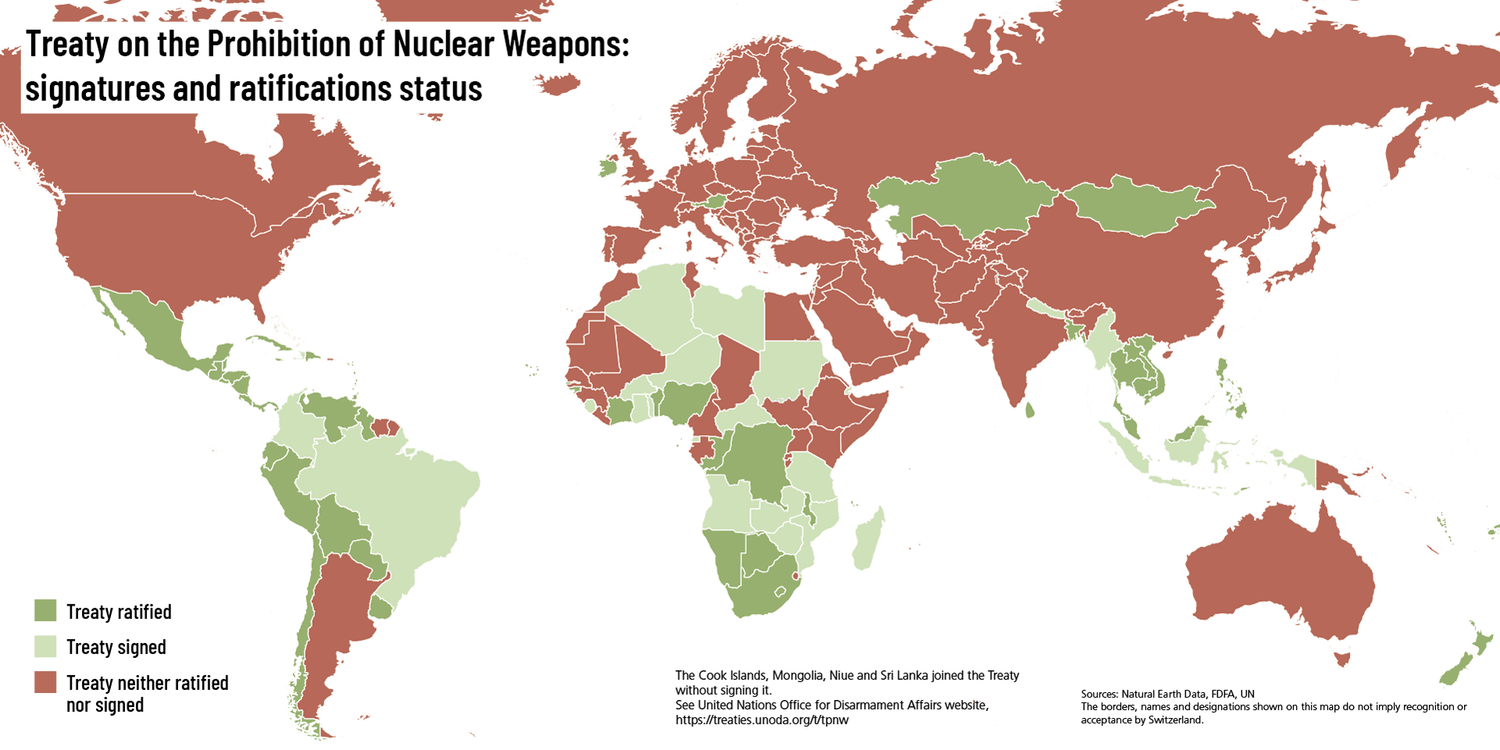
Switzerland is committed to worldwide nuclear disarmament under the Treaty on the Non Proliferation of Nuclear Weapons (NPT). The Treaty on the Prohibition of Nuclear Weapons (TPNW), in contrast, seeks a universal ban of nuclear weapons, a goal that Switzerland shares in principle. Nevertheless, the Federal Council currently sees no need for repositioning and takes the view that the TPNW has limited impact, both because it was negotiated without the participation of the nuclear-weapon states and because it still lacks the support it would need to be effective. Key stakeholders in the international community, including the majority of European states, do not consider this treaty fit for purpose. Facts, figures and answers to the most important questions.
The Treaty on the Prohibition of Nuclear Weapons (TPNW) and the Treaty on the Non-Proliferation of Nuclear Weapons (NPT) are international instruments that address nuclear disarmament and nonproliferation. Although both treaties pursue the same goal – a world without nuclear weapons – they differ significantly in their approach, scope and impact.
The Nuclear Non-Proliferation Treaty (NPT)
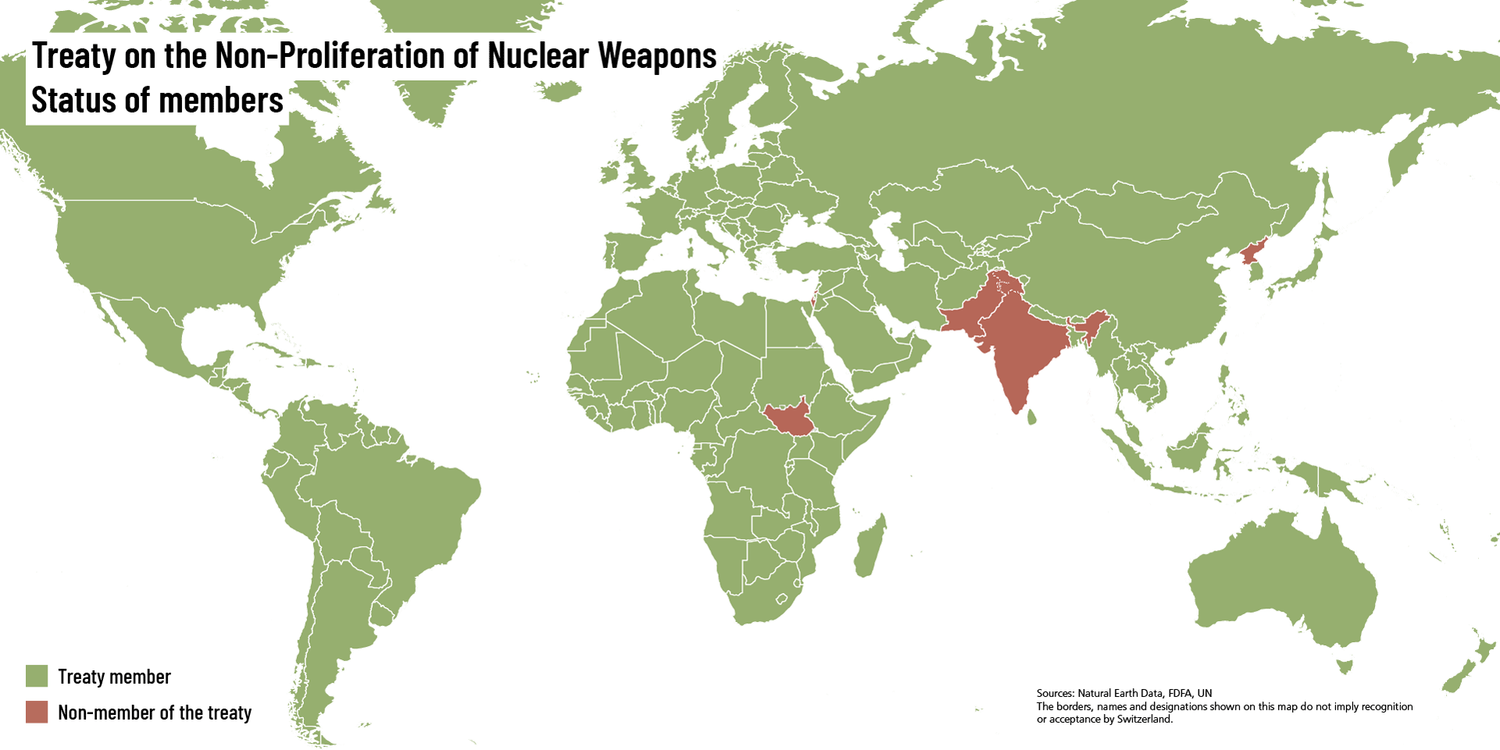
The NPT was negotiated in 1968 and entered into force in 1970. It consists of three pillars: nuclear disarmament, non-proliferation of nuclear weapons and the peaceful use of nuclear energy. The five nuclear-weapon states recognised in the NPT have undertaken not to transfer nuclear weapons to other states, while the non-nuclear weapons states are prohibited from developing nuclear weapons and required to allow international inspections by the International Atomic Energy Agency (IAEA) to ensure that their nuclear activities are exclusively for peaceful purposes.
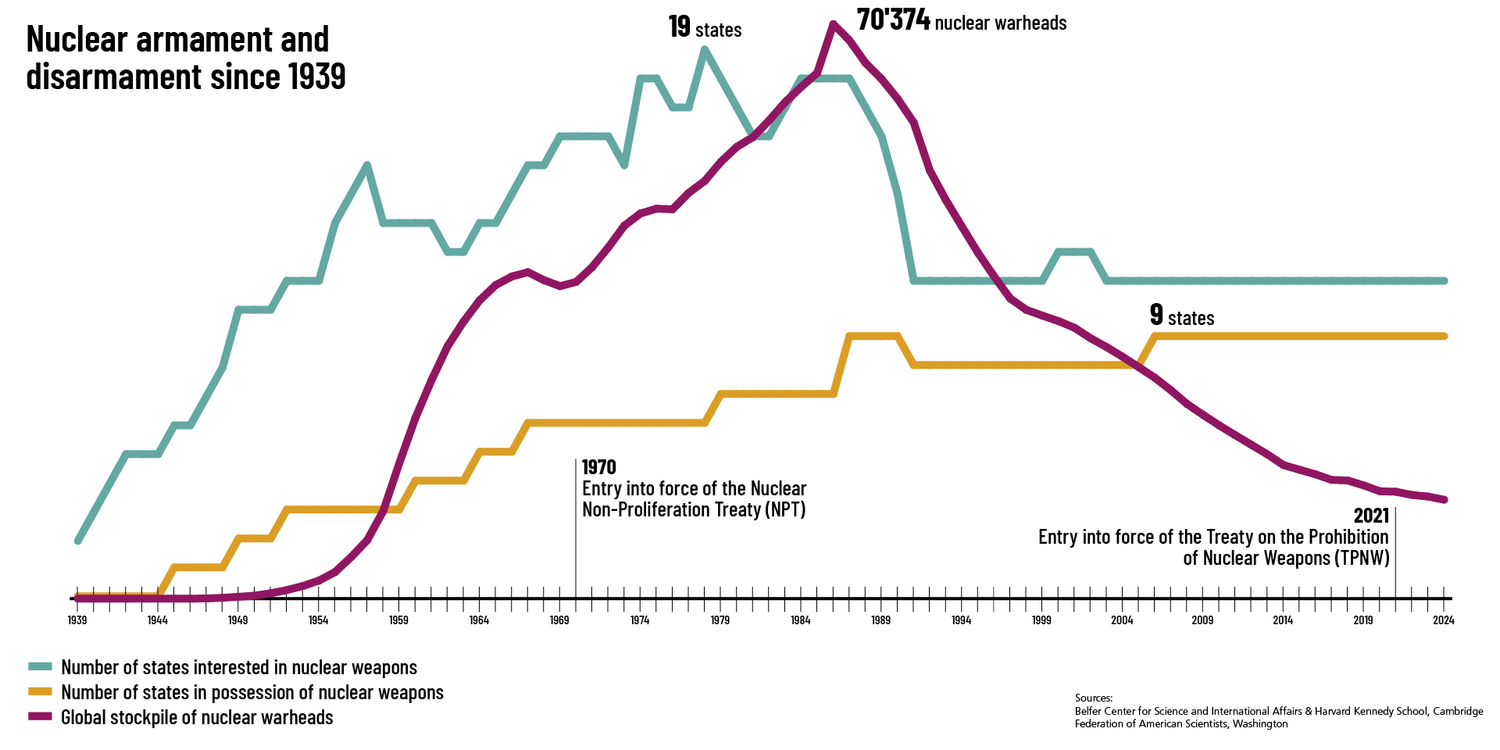
The NPT has clearly achieved its main objective of preventing the nightmare scenario feared in 1960 that more than 20 countries would become nuclear-weapon states. The peaceful use of nuclear energy in the fields of energy, research, medicine and agriculture guaranteed by the NPT is also a success story.
Treaty on the Prohibition of Nuclear Weapons (TPNW)
Unlike the NPT, the TPNW, which was adopted in 2017 and entered into force in 2021, aims to achieve the universal prohibition and elimination of nuclear weapons. The TPNW prohibits all states parties from developing, testing, producing, acquiring, possessing or deploying nuclear weapons within their territories. However, the TPNW does not impose disarmament obligations on nuclear-weapon states that have not joined the treaty.
What are the differences between the TPNW and the NPT?
A major difference between the two treaties is the way they were negotiated and whether the existing and officially recognised nuclear-weapon states have ratified them. The NPT was born out of negotiations between the two superpowers of the time, the United States and the USSR. It recognises five countries – the United States, Russia, China, France and the United Kingdom – as legitimate nuclear-weapon states and requires them to pursue gradual disarmament. It also prohibits all other nations from developing or acquiring nuclear weapons. Following the end of the Cold War, there was progress in disarmament, but this has stalled in recent years.
The TPNW, in contrast, was championed by states without nuclear weapons. These states have voiced criticism over the slow progress in implementing the NPT and seek to exert greater pressure for disarmament. However, without the support of nuclear-weapon states and their allies, the TPNW's effectiveness remains uncertain.
Another key difference concerns the implementation and enforcement of the two treaties. The NPT provides for mechanisms for verification and enforcement by the IAEA, which carries out regular inspections to ensure that the states parties meet their obligations. The TPNW currently lacks a similar monitoring mechanism and only provides for states parties to review its implementation at conferences.
Switzerland's position on the TPNW
Switzerland has not yet acceded to the TPNW. At its meeting on 27 March 2024, the Federal Council decided that there is still no need for a repositioning. Despite this decision, Switzerland remains committed to achieving a world without nuclear weapons under the NPT. It ratified the NPT in 1977 and firmly believes that nuclear disarmament can only be achieved in cooperation with the officially recognised nuclear-weapon states. In light of this, Switzerland is monitoring and continually evaluating developments in the implementation of the TPNW. As an observer state to the TPNW, it is committed to constructive coexistence and the leveraging of synergies between the two treaties.
Q&As
Switzerland continues to prioritise nuclear disarmament, as evidenced by its Arms Control and Disarmament Strategy 2022–25. The NPT, with its 191 states parties – including the nuclear-weapon states of the United States, Russia, China, France, and the United Kingdom – is the cornerstone of nuclear arms control and the global security architecture. Switzerland actively works to strengthen this framework. Its observer status in TPNW meetings enables Switzerland to serve as a bridge between the TPNW and NPT, facilitating constructive dialogue between the two treaties. Furthermore, Switzerland has championed nuclear disarmament within the Security Council and believes that disarmament is most effectively achieved with rather than against nuclear-weapon states.
Switzerland's humanitarian tradition is not contingent on signing this particular treaty. The TPNW lacks widespread global support, and its impact is currently not evident. Switzerland continues to prioritise the humanitarian consequences of nuclear weapons and will defend humanitarian concerns in the context of nuclear disarmament, particularly within the framework of the NPT. It also reiterates its position that, in its view, it is hard to imagine how nuclear weapons could be used in accordance with the requirements of international law, in particular international humanitarian law. Many other states with strong humanitarian commitments have also decided not to join the TPNW.
Switzerland remains committed to disarmament, regardless of its decision on the TPNW. Under the NPT, Switzerland maintains its commitment to a world without nuclear weapons. As set out in the Arms Control and Disarmament Strategy 2022–25, Switzerland's commitment to nuclear disarmament is a key priority. Switzerland's humanitarian tradition will be continued: it advocates for the recognition and support of victims of the consequences of nuclear explosions and considers victim assistance and environmental remediation to be crucial priorities. It also remains committed to reducing nuclear risks. Switzerland maintains its observer status in the TPNW and will participate in future TPNW conferences. Switzerland will continue to serve as a bridge-builder between nuclearweapon states and non-nuclear-weapon states, working with all nations to achieve a world free of nuclear weapons. Furthermore, as an active member of the Stockholm Initiative, Switzerland contributes to the development and verification of nuclear disarmament plans. It also works closely with the IAEA to strengthen nuclear security.
The Russian aggression against Ukraine on 24 February 2022 marks a turning point, particularly in Europe, where armed conflict is suddenly raging once more. Security policy issues have consequently risen to the forefront. Only a few years ago, the resurgence of armed conflict in Europe would have been unthinkable. The disarmament debate has also reached a turning point. Switzerland faces a challenging international context marked by intensifying power politics and deepening geopolitical fault lines. What we are seeing is a shift from disarmament to an arms build-up. Nuclear weapons have also returned to the centre of global politics. The 2018 assessment that the long-standing Swiss goal of a world without nuclear weapons has receded into the distance is becoming even more valid in the current environment.
While Switzerland remains committed to nuclear disarmament and the goal of a world free of nuclear weapons, substantial progress towards this end seems unrealistic in these circumstances.
Switzerland made this decision independently after careful consideration. Our assessment was made in light of the global political reality, specifically the fact that none of the 32 NATO member states support the TPNW. Considerations regarding strengthening cooperation with our partners also factored into the decision. Furthermore, joining the TPNW would be contrary to Switzerland's aim of strengthening security and political cooperation with European and transatlantic partners. This opinion was also endorsed by Parliament through its adoption of Dittli postulate 22.3800. Switzerland must recognise that it is its principal Western partners – specifically the nuclear-weapon states the United States, France and the United Kingdom, along with the EU – that are helping Ukraine to stand up to Russia's aggression and are thereby also contributing to its own security.
Parliament and the Federal Council hold differing views on this matter. The possibility of joining the TPNW was revisited because Parliament was in favour of it. The Federal Council believes the reasons against membership outweigh those in favour. A decision of this kind must be made by the executive branch of government based on its overall responsibility for national policy. That's why the Federal Council instructed the Federal Administration to analyse the matter thoroughly. Today's security policy environment is very different to that of 2018 (Carlo Sommaruga's motion 17.4241). The Council of States recognised this and called on the Federal Council to examine the foreign and security policy implications of joining the TPNW in light of the war in Ukraine (Dittli postulate). Considerations of peace policy, humanitarian issues, and international law were all included in the deliberations. A report was drawn up in fulfilment of the Dittli postulate. As things stand, foreign and security policy considerations speak against joining the TPNW. At present, the Federal Council also sees no need for repositioning.
The FDFA has taken note of the announcement of a collection of signatures for a popular initiative. The Federal Council will closely monitor domestic political developments concerning this issue. One positive aspect is that this will provide an opportunity for a factbased debate with the population on the security policy and peace policy implications of the various arguments in favour and against.
While the Federal Council shares the concerns of the initiative's proponents about the risks of nuclear weapons and the goal of a world without them, it believes the treaty's impact and Switzerland's security interests do not currently support joining the TPNW. The Federal Council reserves the right to reassess its position as necessary should the situation change significantly.