
Sport as a diplomatic bridge-builder
Switzerland is not only home to numerous international sporting organisations, but also uses sport as an instrument of its foreign policy. A high-level meeting between Federal Councillor Ignazio Cassis and representatives of the authorities of the Confederation of Sahel States and Senegal in Lausanne on 9 September 2026 illustrated the potential of this approach. As part of a pilot project, an FDFA initiative in the Sahel region opened up new channels of political dialogue, built trust between parties in the region, and positioned Switzerland as a peace actor – and all within the space of a year. The question now is how even better use can be made of sport diplomacy in the future.
Lausanne is the Olympic capital and one of the primary centres of international sport. The International Olympic Committee (IOC) has its headquarters here, and numerous other international sport federations and organisations are also based in the broader canton of Vaud. This special position is of sporting and economic importance to Switzerland, but more than that it holds potential for the country's foreign policy. Switzerland's host state dispatch 2026–29 states that the international sport ecosystem in the country gives it a soft power that can open the door to major progress in areas such as diplomatic relations or respect for human rights.
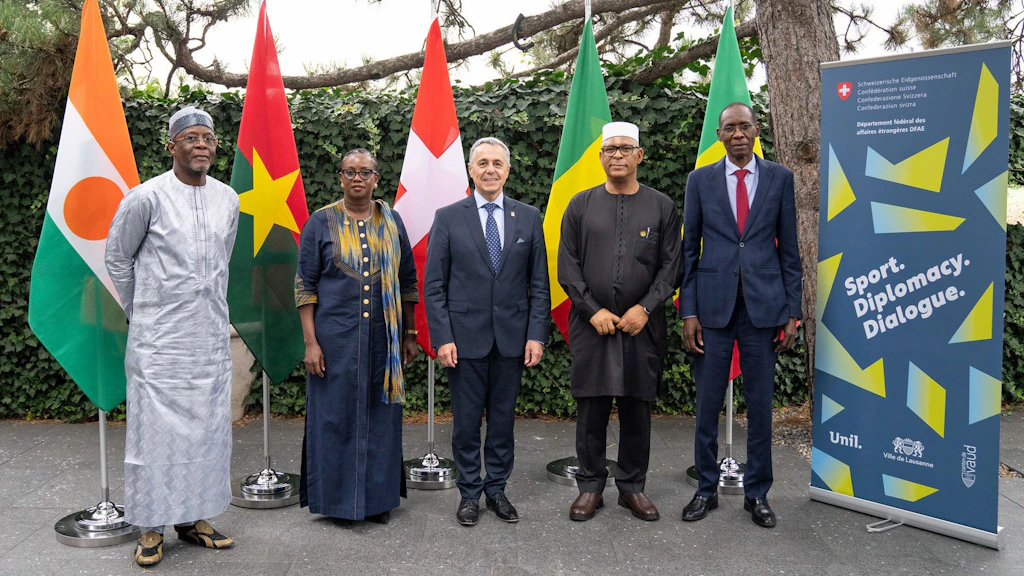
On 9 September 2026 this potential was the focus of high-level discussions organised by the Federal Department of Foreign Affairs (FDFA). The event was held on the fringes of the ‘Diplomacies, Diplomats, and Sports, 19th–21st Century’ symposium at the University of Lausanne, and brought together members of the political, sporting and scientific communities. Following the round table in Lausanne, Mr Cassis met with the Minister for Foreign Affairs of Niger, Bakary Yaou Sangaré, the Minister for Foreign Affairs of Senegal, Cheikh Niang, as well as Nadine Traoré Bazié, adviser at the Ministry of Foreign Affairs, Regional Cooperation and Burkinabè Abroad, and Sékou known as Gaoussou Cisse, Ambassador and Permanent Representative of Mali to the United Nations Office and other international organisations in Geneva.
The discussions focused on ways to strengthen dialogue with the countries of the Confederation of Sahel States (AES) and West Africa and to make better use of sport as a tool for building trust, diplomacy and peace.
Sport diplomacy as a new foreign policy initiative
‘Sport diplomacy’ refers to the conscious, strategic deployment of athletes and sporting events to achieve political and foreign policy objectives. The aim of the FDFA is not to use it as a substitute for conventional diplomacy, but as a complement to existing instruments that permits new approaches beyond the confines of political dialogue formats.
Sport diplomacy is of particular interest in the Sahel region, which is affected by political tensions, conflicts and a loss of trust between different governments and international actors. Switzerland is therefore seeking new ways of maintaining political dialogue and pursuing its peace policy in the region.
This led to the FDFA launching a pilot sport diplomacy and peace project in the summer of 2025. The idea is to leverage existing sporting networks and platforms strategically to achieve the objectives of Swiss peace policy, specifically dialogue, trust-building and conflict prevention.
Early results promising
Early outcomes from the pilot project in the Sahel are encouraging. In just a year Switzerland has attracted attention even from countries associated with particular challenges in regional cooperation. The dual topic of sport and peace has opened up new spaces for dialogue and helped to create a positive, unifying dynamic between governments in the region.
Led on the ground by Switzerland's special envoy for the Sahel and the Peace and Human Rights Division, the initiative has simultaneously strengthened and diversified high-level political dialogue with a number of countries, including Algeria, Benin, Burkina Faso, Côte d’Ivoire, Mali, Morocco, Niger and Senegal. In this context sport has proved to be an additional channel for dialogue that has deepened relations and brought new actors to the table. The initiative is also supporting dialogue on human rights. The pilot project offers Switzerland an opportunity to enhance its profile in Africa. In a difficult regional climate and at a time at which other international actors are beginning to withdraw from the Sahel, Switzerland wishes to highlight its continued presence and its embrace of new forms of cooperation. This also corresponds to one of the objectives of the Federal Council's Africa Strategy 2025–28.
From Women's EURO to West Africa
The pilot phase was consciously linked with major sporting events, starting with the UEFA Women's EURO 2025 in Switzerland. One of the events supported by the FDFA during the tournament was an immersion week for sport journalists from the five countries of the Sahel region.
The Africa Cup of Nations in Morocco in December 2025 marked a further step. It offered an opportunity for exchange between figures from the world of football and between political and sporting representatives of various countries, organised by the Confédération Africaine de Football (CAF). In parallel Switzerland further expanded its network of contacts in African and international sport, including those from IOC, FIFA and CAF circles.
High-level meeting in Lausanne
The meeting in Lausanne was the next stage in the emerging field of sport diplomacy. Senior figures from politics and sport discussed the potential of sport as an avenue to dialogue and peace.
The timing was carefully chosen. A few weeks from now Dakar will be hosting the 2026 Summer Youth Olympic Games – the first-ever Olympic event on the continent of Africa. For Switzerland this represents a further opportunity to take dialogue with actors from the Sahel and West Africa to a deeper level. With the support of Presence Switzerland, the Swiss embassy is organising a series of events in Dakar in association with the Games. The Olympics bring together figures from politics, business, the media, sport, the arts and society from around the world. The shared interest in sport breaks down barriers and encourages people to mix outside their usual political, cultural and social spheres. A medal win, an embassy reception or a youth grass-roots sporting event can spark conversations that extend far beyond the Olympics themselves.
Switzerland plans to use the international attention that comes with the Games to raise its visibility, strengthen its relationships and expand its network. This three-fold approach reaches a wide range of target groups, spanning decision-makers, media professionals, the local population, an international audience, and many in between.
On the right track
Switzerland wishes to pursue and strengthen dialogue with political and sporting actors from the region, as well as with international sporting organisations. Its goal remains to grasp real opportunities in which sport can help to promote trust and peace. At the same time sport diplomacy is about more than the Sahel region. The current initiative is delivering findings about which approaches work, and where their boundaries lie, so that these insights can be used as possible stepping stones in the next stages.
The meeting in Lausanne was therefore emblematic of a movement that reaches beyond a single project. With its credibility as an intermediary, its commitment to peace and human rights and its position as a centre of international sport, Switzerland is especially qualified to take that movement forward. Experience to date in the Sahel shows that sport can open new doors. Switzerland now has the chance to build on this initial experience to hone its sport diplomacy. In the future, it will be able to use one of its particular locational advantages even more fully in the service of peace and dialogue.
Contact
General Secretariat GS-FDFA
Federal Palace West
3003 Bern