
Swiss chairpersonship of the OSCE for 2026
In 2026, Switzerland assumes the chairpersonship of the Organization for Security and Co-operation in Europe (OSCE) for the third time, following its previous terms in 1996 and 2014. Switzerland was elected by the participating states of the organisation in a secret ballot on 30 December 2024. Switzerland has already gained the necessary experience for this role through its past OSCE chairpersonships.

More detailed information on Switzerland's OSCE Chairpersonship in 2026 can be found on the website of the Permanent Mission of Switzerland in Vienna.
05.10.2026 – Warsaw Human Dimension Conference opens with call to turn human rights commitments into action
More than 1,800 participants from across the OSCE region are taking part in the 2026 Warsaw Human Dimension Conference (WHDC), the largest annual human rights conference in Europe, which opened today.
Organized by the Swiss OSCE Chairpersonship with the support of the OSCE Office for Democratic Institutions and Human Rights (ODIHR), the conference provides a platform for participating States, OSCE institutions and structures, national human rights institutions and civil society to take stock of the implementation of OSCE human dimension commitments and discuss developments affecting democracy, human rights and the rule of law across the OSCE region.
“This conference is about two things: holding ourselves to the commitments that we have made and keeping alive a space for dialogue among all participating States, especially when dialogue has become difficult”, recalled OSCE Chairman-in-Office, Federal Councillor Ignazio Cassis in a video message. “As OSCE Chair this year, we want to turn existing commitments into concrete actions”.
At the margins of the conference, the Swiss Chairpersonship will present its Roadmap on the Prevention and Eradication of Torture, a practical tool to strengthen the implementation of existing commitments. In his opening remarks, State Secretary of the Swiss Federal Department of Foreign Affairs Alexandre Fasel said: “Torture prevention has long been a priority of Switzerland and was already a focus of our 2014 Chairpersonship. This year, we want to build on that foundation. The Roadmap on the Prevention and Eradication of Torture helps participating States translate existing international obligations and OSCE commitments into practice”.
The conference will continue until 15 October, providing opportunities for participants to exchange views and experiences on the implementation of human rights and fundamental freedoms across the OSCE region.
Speech of FDFA State Secretary Alexandre Fasel
01.10.2026 – The 33rd OSCE Ministerial Council will take place on 3 and 4 December in Lugano
The 33rd OSCE Ministerial Council in Lugano brings Switzerland's 2026 chairpersonship of the OSCE to its political high point. On 3 and 4 December, representatives of the 57 participating states will discuss matters relating to security in Europe, and how the OSCE can be further strengthened as a platform for dialogue, trust and cooperation.
The Ministerial Council is the highest political decision-making body in the OSCE and one of the principal platforms for discussions about security in Europe. The focus is on reinforcing political dialogue, cooperative security and cooperation between participating states.
Following on from 1996 and 2014, this is now the third time that Switzerland has served as chair and also hosted the Ministerial Council. The conference at the end of the year in Lugano marks the political highlight of Switzerland's 2026 chairpersonship. It offers an opportunity to take stock of the past year and to provide stimulus for the work of the organisation going forward.
33rd OSCE Ministerial Council in Lugano
29.09.2026 – OSCE conference in Zug: Switzerland emphasises prevention, dialogue and cooperation to counter escalation after cyber incidents
As part of its Organization for Security and Co-operation in Europe (OSCE) chairpersonship this year, on 29 September 2026 Switzerland brought together high-level representatives from the fields of politics, diplomacy and cybersecurity in order to discuss ways of preventing escalation following cyber incidents.
The malicious use of information and communication technologies poses a growing challenge to international security. Cyber incidents can undermine trust between states and increase the risk of misinformation and escalation. Switzerland is therefore committed to the security, stability and responsible use of cyberspace, both within the framework of its OSCE chairpersonship and beyond. Discussions on the first day of the conference focused on three approaches to preventing and managing cybercrises: preventive diplomacy, cybermediation and the inclusion of non-state actors.
Timely diplomatic outreach, quickly established channels of communication and OSCE confidence-building measures are all ways of helping to identify tensions at an early stage. In his opening address, Mr Pfister emphasised the importance of trust, dialogue and anticipating developments for ensuring stability in cyberspace. “We cannot prevent every cyber incident. But we can work together to prevent such incidents from escalating into major crises,” he noted.
In the subsequent keynote speech, Florian Schütz, head of the National Cyber Security Centre, emphasised the importance of dialogue, shared rules and international cooperation – particularly in an increasingly tense geopolitical environment – in order to share responsibility for the security and responsible use of cyberspace.
Technology cannot decide when to communicate rather than retaliate, when to de-escalate rather than escalate. That remains our responsibility. And this is where the OSCE matters.
Secure channels of communication and mediation – even across geographical distances – can help to resolve misunderstandings and defuse crises. Discussions focused on how existing conflict prevention tools could be adapted to cyberspace and built upon. In his closing address, Mr Cassis emphasised that the challenges in cyberspace are not only technological, but diplomatic and human in nature: “Technology can help us detect threats. Artificial intelligence can help us analyse them. But neither can decide when to communicate rather than retaliate, when to de-escalate rather than escalate. That remains our responsibility. And this is where the OSCE matters.”
Approximately 120 people from 48 countries took part in the two-day conference in Zug, entitled ‘De-escalation in cyberspace: mediation and preventive diplomacy’. This is the final thematic conference ahead of the OSCE Ministerial Council meeting on 3 and 4 December 2026 in Lugano.
Address by the OSCE Chairman-in-Office, Ignazio Cassis
18.09.2026 – OSCE Ministerial Council in Lugano: Armed Forces support mission and restricted use of airspace
At its meeting on 18 September 2026, the Federal Council approved the deployment of the Armed Forces in a support role to assist the civil authorities with security measures at the OSCE Ministerial Council in Lugano on 3 and 4 December 2026. This supplementary deployment complements the security measures planned by the civil authorities.
10.09.2026 – OSCE opens 32nd Economic and Environmental Forum in Prague
The 32nd Economic and Environmental Forum focuses on how the anticipation of technological developments and the strengthening of science-based diplomacy can contribute to security and stability across the OSCE area. The aim is to support participating States in better preparing for current and emerging challenges.
Organized by the Office of the Co-ordinator of OSCE Economic and Environmental Activities under the guidance of Switzerland’s 2026 OSCE Chairpersonship, the two-day conference brings together representatives of OSCE participating States, Partners for Co-operation, international organizations, academia, the private sector and civil society. Participants are examining how the OSCE can strengthen its ability to anticipate technological developments, assess their implications for security and stability, and better prepare for a rapidly changing economic and environmental landscape.
In his address to the EEF participants, OSCE Chairman-in-Office, Swiss Federal Councillor Ignazio Cassis, recalled that “Anticipation is a political necessity. This is why Switzerland has chosen Anticipating technologies as a priority of its Chairpersonship. We must anchor this approach in the OSCE, because technology already affects all three dimensions of the OSCE”.
During the opening session, the State Secretary of the Swiss Federal Department of Foreign Affairs, Alexandre Fasel, stated that “The OSCE was founded on a comprehensive approach to security. This common ground endures despite our current divisions: the fact that we were able to agree to hold this Forum is a clear demonstration of this”.
The OSCE has published a press release for the two-day 32nd Economic and Environmental Forum in Prague, organized by the Office of the Co-ordinator of OSCE Economic and Environmental Activities under the leadership of the 2026 Swiss OSCE Chairpersonship.
03.09.2026 – OSCE conference in Bern: “Cooperation requires the willingness to keep talking despite disagreement”
Fifty-one years after the Helsinki Final Act was adopted, the Swiss OSCE Chairpersonship brought together political leaders, diplomats, historians and experts in Bern to reflect on the origins of the Conference on Security and Co-operation in Europe (CSCE) – the predecessor organisation of today’s OSCE – and the relevance of its founding principles for European security today and tomorrow.
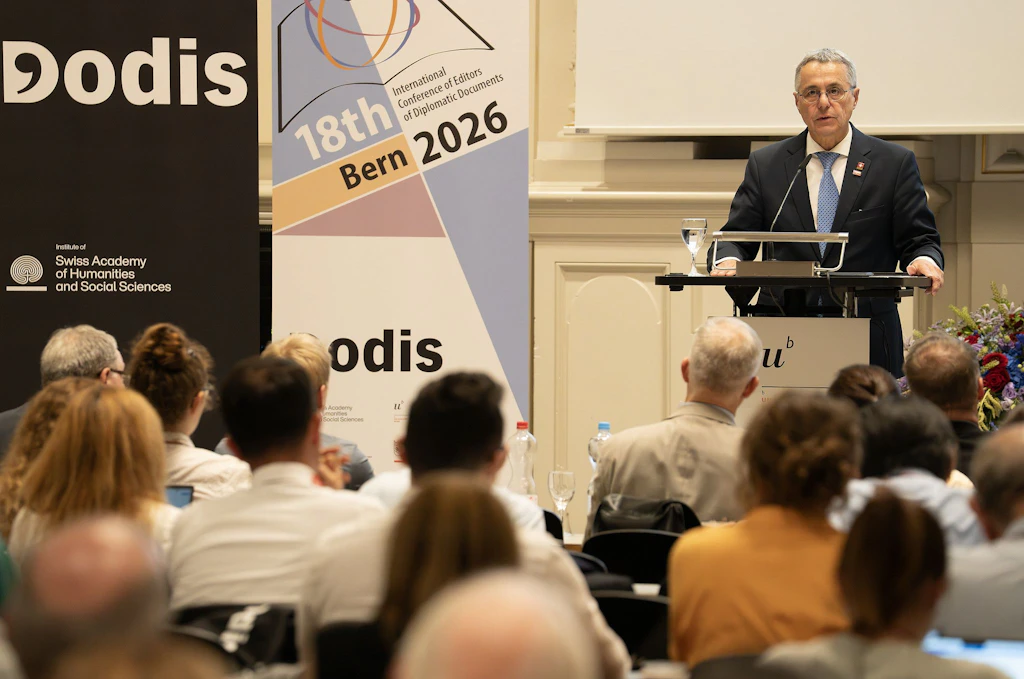
OSCE Chairman-in-Office Ignazio Cassis underlined in his address that the history of the Helsinki Process offers lessons that remain highly relevant in today’s fractured geopolitical environment: “Cooperation does not require agreement. It requires the willingness to keep talking despite disagreement. The Helsinki Final Act was not signed between friends. It was signed between adversaries. We do not know what European security will look like in five or ten years. Nor do we know when the next opportunity for diplomacy will come. But we can make sure that, when it comes, there is still a table around which everyone can sit. That is not nostalgia for Helsinki. It is preparation for what comes next”.
The discussions, drawing on the expertise of the Dodis research centre (Diplomatic Documents of Switzerland), revisited the diplomatic process that led from the preparatory consultations in Geneva to the adoption of the Helsinki Final Act in 1975. The conference explored the broader significance of the Helsinki Final Act, principles its enduring continued relevance of the OSCE’s comprehensive approach to security. Against the backdrop of today’s security challenges, participants also looked beyond the historical record, exploring how the Helsinki legacy continues to influence diplomacy, dialogue and co-operation in a changing European security landscape.
The high-level segment of the Chairpersonship’s conference, “From Geneva to Helsinki: Founding Process and Core Purpose of the OSCE”, was held today at the University of Bern as part of the conference of the International Committee of Editors of Diplomatic Documents (ICEDD). The event is the third of four thematic conferences organized by the Swiss OSCE Chairpersonship in 2026.
Address by the OSCE Chairman-in-Office, Ignazio Cassis
01.09.2026 – OSCE conference in Bern: Swiss chair-personship looks to the organisation's future
‘From Geneva to Helsinki: founding process and core purpose of the OSCE’ is the theme of the international conference that Switzerland is hosting on 3 and 4 September 2026. Organised in partnership with the Dodis (Diplomatic Documents of Switzerland) research centre, the conference is taking place under the country's chairpersonship of the OSCE. Senior representatives of OSCE participating states and of the political and academic worlds will be examining the founding principles of the organisation and its future role in a changing geopolitical landscape.
12.08.2026 – 2026 OSCE Ministerial Council in Lugano: Swiss federal funding for security costs
The annual OSCE Ministerial Council will take place in Lugano on 3 and 4 December 2026. A few weeks before Switzerland’s term as OSCE Chair comes to an end, the meeting will bring together numerous foreign ministers from around the world. To ensure security of the event and its participants, extensive measures will be put in place. At its meeting on 12 August 2026, the Federal Council decided to classify the conference as an extraordinary event. Federal funding will therefore be provided to cover most of the security costs incurred by the Canton of Ticino authorities.
05.08.2026 – The OSCE Chairman-in-Office Ignazio Cassis, has concluded his official visit to Turkmenistan
The OSCE Chairman-in-Office, Ignazio Cassis, has concluded his official visit to Turkmenistan, where he met with the country's leadership to reaffirm the OSCE's strong partnership with Turkmenistan and discuss ways to further deepen co-operation in support of comprehensive security. During the visit, Ignazio Cassis held meetings with the President of Turkmenistan, Serdar Berdimuhamedov and the Deputy Chairperson of the Cabinet of Ministers and Minister of Foreign Affairs, Rashid Meredov.
The discussions focused on the long-standing co-operation between the OSCE and Turkmenistan and explored opportunities to strengthen joint efforts across all three dimensions of security. Mr. Cassis also highlighted the important contribution of the OSCE Centre in Ashgabat towards a constructive and trust-based co-operation and dialogue with the host country. “Central Asia is of strategic importance to the OSCE, and Turkmenistan is a valued partner to promote dialogue, stability and co-operation. The growing geopolitical challenges strengthen the need for the OSCE as platform bringing together all participating States to foster trust across our region and beyond," he said.
Following his visits to Azerbaijan and Turkmenistan, the Chairman-in-Office will continue his regional engagement, with visits to Armenia and Georgia planned for later this autumn.
OSCE Press release, 5 August 2026
04.08.2026 – OSCE Chairman-in-Office highlights dialogue, co-operation and peace efforts during visit to Azerbaijan
The OSCE Chairman-in-Office Ignazio Cassis concluded his official visit to Azerbaijan today. During the visit, Chairman-in-Office Cassis met with Minister of Foreign Affairs Jeyhun Bayramov. Discussions focused on the OSCE’s long-standing partnership with Azerbaijan and opportunities to further strengthen co-operation across all three dimensions of security.
“I welcome the progress made towards a peace agreement between Azerbaijan and Armenia. A lasting peace is within reach, and I encourage the parties to take the necessary steps towards its signature and implementation. The OSCE stands ready, whenever useful and at the request of the parties, to support dialogue, confidence-building and efforts towards lasting peace and enhanced regional cooperation in the South Caucasus,” said Chairman-in-Office Cassis.
Press release, OSCE, 4 August 2026
04.07.2026 – OSCE Chairman-in-Office addressed the OSCE Parliamentary Assembly Annual Session
OSCE Chairman-in-Office, Federal Councillor Ignazio Cassis, presented Switzerland’s priorities and guiding principles for its Chairpersonship to the OSCE Parliamentary Assembly on the opening ceremony of its 33rd Annual Session in the The Hague, Netherlands.
In his opening remarks, the Head of the Federal Department of Foreign Affairs stressed that respect for the principles of the Helsinki Final Act and meaningful dialogue remain essential for addressing today's complex security environment. He underlined the important contribution of parliamentary diplomacy, particularly at a time of heightened geopolitical tensions and mistrust toward organisations and institutions.
Opening address by Ignazio Cassis, Chairman-in-Office of the OSCE
02.07.2026 –OSCE Parliamentary Assembly in The Hague
The chairman-in-office of the Organization for Security and Co-operation in Europe (OSCE) Ignazio Cassis is to visit the Kingdom of the Netherlands. The 33rd Annual Session of the OSCE Parliamentary Assembly is being held in The Hague from 4 to 8 July. Its theme is ‘International Law and Shared Principles: Foundations for Security and Co-operation in the OSCE Area’. The head of the FDFA will outline the key priorities of the Swiss OSCE Chairpersonship in a speech he will deliver at the opening session on 4 July.
Established in 1991, the OSCE Parliamentary Assembly gathers representatives of the parliaments of OSCE member states. It meets in a plenary session in early July each year, and also holds annual winter and autumn meetings. Switzerland is represented by a parliamentary delegation, currently led by Member of the Council of States Thierry Burkart (Aargau/FDP.The Liberals). As chairman-in-office of the OSCE, Mr Cassis will use his visit to hold discussions with the president and secretary general of the Parliamentary Assembly, as well as with the Swiss delegation.
17.06.2026 – Ignazio Cassis opens the OSCE Security Review Conference in Vienna
The OSCE Chairman-in-Office of the OSCE, Federal Councillor Ignazio Cassis, opened the OSCE’s Annual Security Review Conference (ASRC) on 17 June.
The security situation in Europe continues to escalate, primarily due to Russia's ongoing war against Ukraine. The ASRC has taken on a particular significance in this context. The conference, which was established in 2002 by the OSCE Ministerial Council, brings together high-level representatives from the 57 OSCE participating states in Vienna every year. It provides a key platform for security-policy exchanges within the organisation and ensures there is open dialogue, even in times of geopolitical tension.
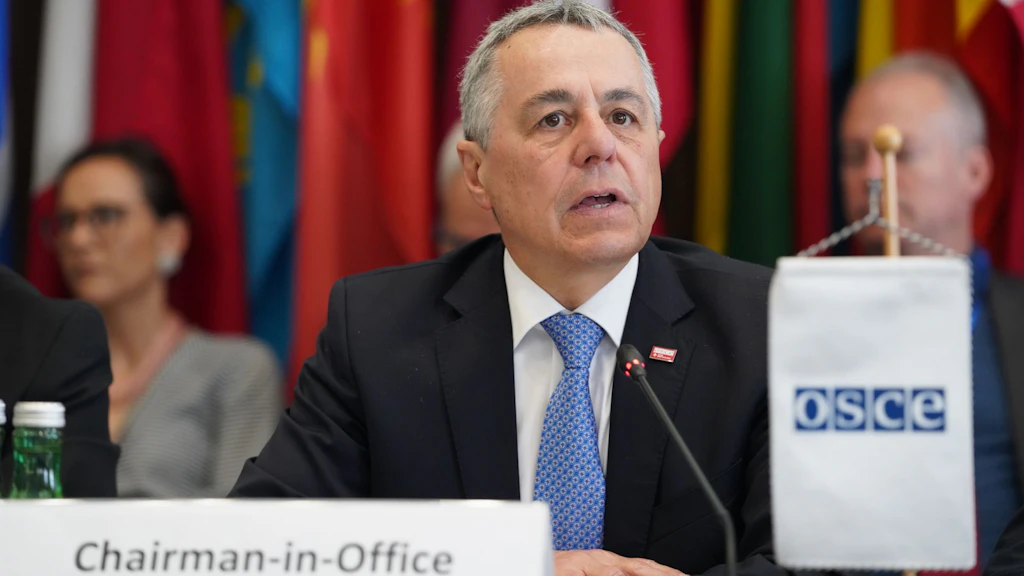
In his opening address, the Chairman-in-Office highlighted the current challenges to peace and security in Europe. Key topics included the commitment to a fair and lasting peace in Ukraine, how Europe can rethink and reshape its security beyond this war, and how channels of dialogue can be kept open. Anticipating new technologies and their impact on our collective security also plays a key role in this regard. “Naturally we must handle the crises of today, but we must also lay the groundwork for the security of tomorrow. At the same time, the world is changing faster than ever,” the OSCE Chairman stated in Vienna. Drones in warfare, hybrid attacks in cyberspace, artificial intelligence and quantum technologies are transforming the way conflicts are waged. In this context, Ignazio Cassis emphasised that the OSCE remains one of the few forums where European security can still be discussed by all. “Let's safeguard that achievement and let’s work together for our future security.”
Opening address by OSCE Chairman-in-Office Ignazio Cassis at the ASRC, 17 June 2026
OSCE press release, 17 June 2026
20.05.2026 – Chair’s Summary: Conference on Anticipating Technologies
The OSCE Chairmanship’s summary of the conference in Geneva sets out the key findings of the event held on 7 and 8 May 2026.
14.05.2026 – The OSCE and the Council of Europe emphasise the need for effective multilateralism
On 14 May 2026, the OSCE Chairman-in-Office, Federal Councillor Ignazio Cassis, the President of the Committee of Ministers of the Council of Europe, Mihai Popșoi, the OSCE Secretary General, Feridun H. Sinirlioğlu, and the Secretary General of the Council of Europe, Alain Berset, met in Chisinau. The promotion of effective multilateralism and the use of the respective and complementary strengths of the two organisations were at the centre of the discussions.
14.05.2026 – The OSCE Chairman-in-Office meets with political leaders in Transnistria
The Chairman-in-Office of the OSCE, Federal Councillor Ignazio Cassis, travelled to Bender in Transnistria as part of his visit to Moldova to hold talks with the political leadership. There, Ignazio Cassis highlighted the role of the OSCE Mission to Moldova in promoting dialogue and a peaceful resolution to the Transnistria conflict.
12.05.2026 – Chairman-in-Office of the OSCE Ignazio Cassis in Moldova
Federal Councillor Ignazio Cassis will visit the Republic of Moldova from 13 to 15 May. As Chairman-in-Office of the OSCE, he will hold a series of meetings in which he will address the organisation’s role in the settlement process of the Transdniestrian conflict.
08.05.2026 – OSCE conference in Geneva: Anticipating technologies – for a safe and humane future
As part of its term as chair of the OSCE in 2026, Switzerland organised an international conference on 7 and 8 May 2026 in Geneva on the anticipation of new technologies and their significance for peace and security in the OSCE region.
Rapid technological progress – from AI to quantum technologies – is permanently changing the foundations of security and international cooperation, including in the OSCE region. New technologies bring great opportunities, but they also harbour risks that can exacerbate existing tensions. The aim of the conference was to show ways in which trust can be strengthened through anticipation, dialogue and cooperative approaches. Especially in an increasingly complex geopolitical environment, such efforts are crucial in order to reduce misunderstandings, defuse conflicts over the use of resources, and build the basis for sustainable security and cooperation.
The conference in Geneva was the first of its kind on this topic within the OSCE framework. For years, Switzerland has been pursuing an approach that combines scientific and technological anticipation with concrete political action. At Switzerland's initiative, the UN Security Council recognised the link between scientific and technological developments and international peace and security for the first time in 2024. Building on this, Switzerland has made the anticipation of technologies a priority for its 2026 term as chair of the OSCE. It thus underscores the key role of trust and transparency for cooperative security.
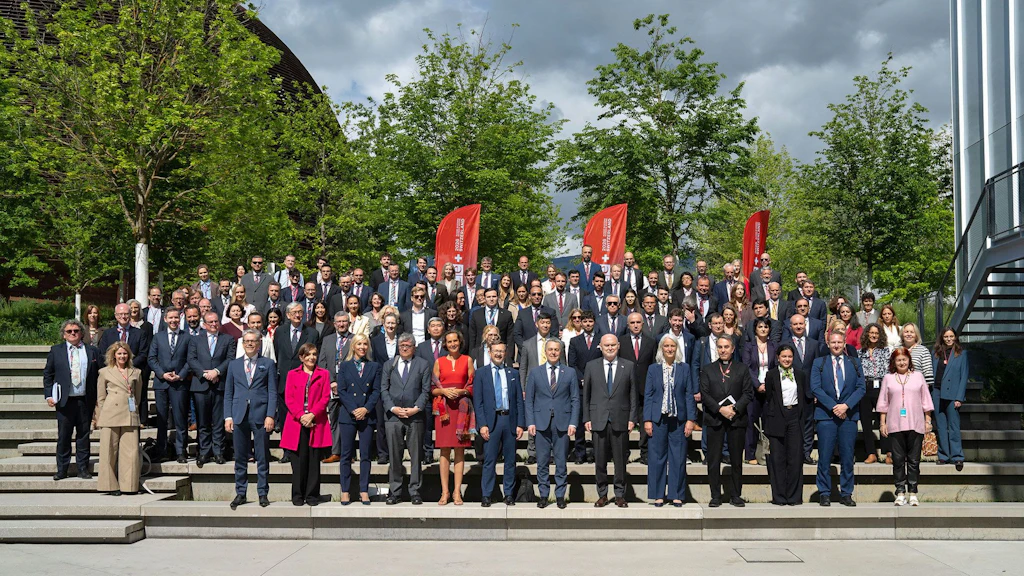
The conference was opened by the OSCE chairman-in-office, Federal Councillor Ignazio Cassis, in the presence of the OSCE's secretary general, Feridun H. Sinirlioğlu, UNESCO's director general, Khaled El-Enany, and the director of stakeholder relations at CERN, Ursula Bassler. The event brought together around 200 participants and around 50 delegations. The conference was also attended by representatives from international organisations, academia and the private sector.
08.05.2026 – Anticipating technologies in practice – for a safe and humane future
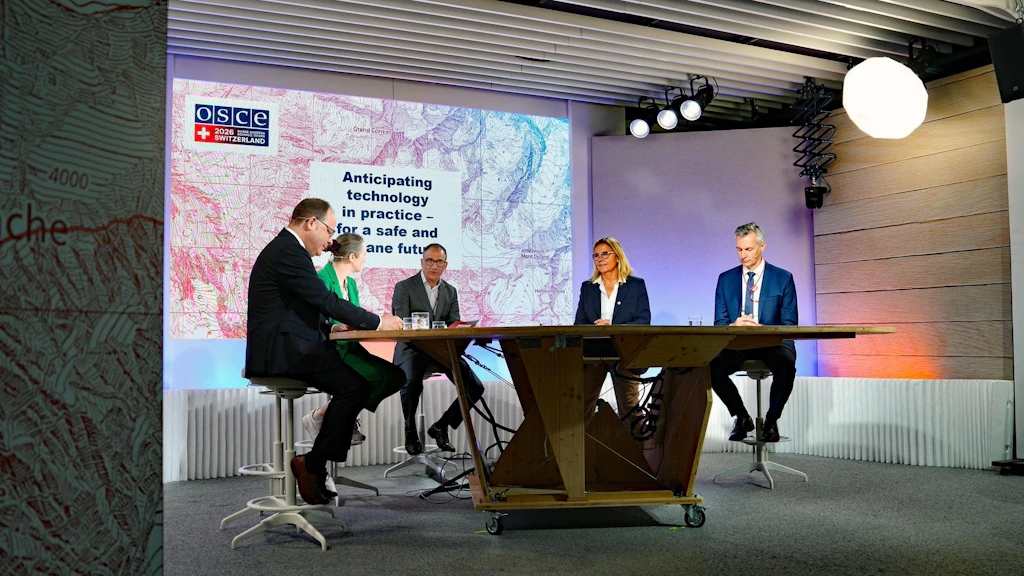
During the fourth and final panel at the OSCE conference ‘Anticipating Technologies – for a safe and humane future’ in Geneva, panellists exchanged practical experiences and insights gained from applying forward-looking approaches to new technologies. The discussion focused on insights relevant to strengthening security and cooperation across the entire OSCE region.
07.05.2026 – Artificial Intelligence and Conflict Prevention
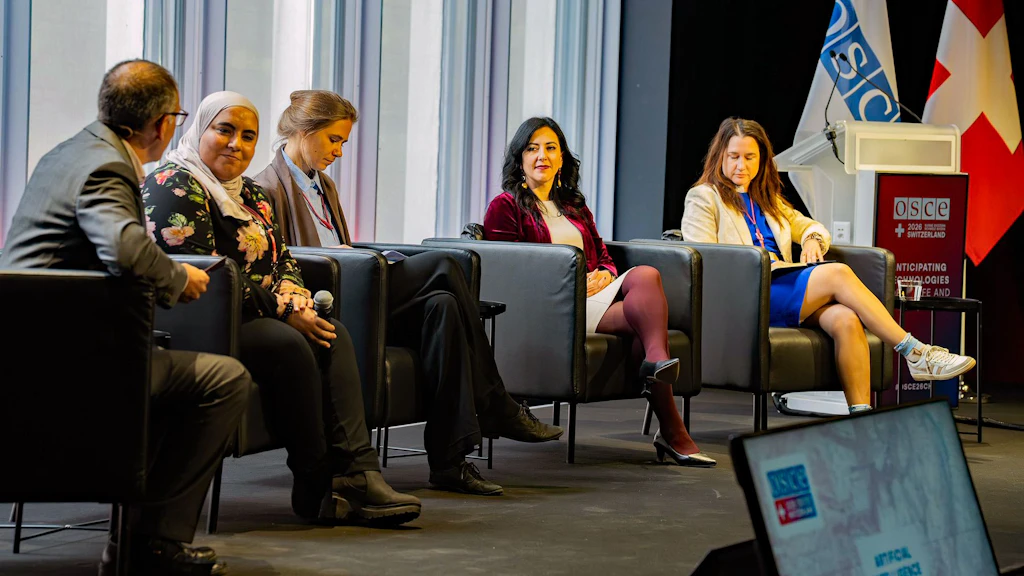
The question of how artificial intelligence can be used responsibly to support conflict prevention whilst upholding human rights, transparency and international standards was the focus of the third panel. The discussion highlighted both the opportunities and the risks for the OSCE’s security environment and examined practical implications for policy and cooperation.
07.05.2026 – Anticipating water and energy security in the digital age
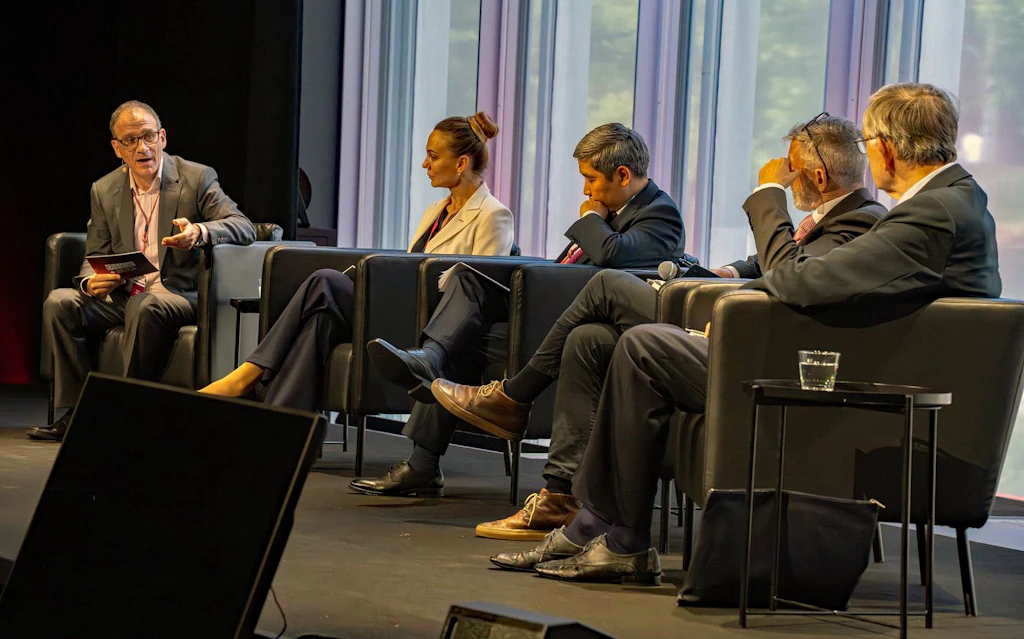
The second panel centred on the growing risks to water and energy security. The participants, Bakyt Dzhusupov, OSCE Coordinator for Economic and Environmental Activities, Tobias Siegfried, CEO of Hydrosolutions Ltd, and Danilo Türk of the Geneva Water Hub, discussed how technological innovations can help to anticipate and mitigate risks. Drawing on perspectives from Ukraine and Central Asia, the discussion explored how forward-looking approaches can strengthen resilience and prevent tensions over critical resources.
07.05.2026 – Anticipating technology and its implications for peace and security – the example of quantum computing
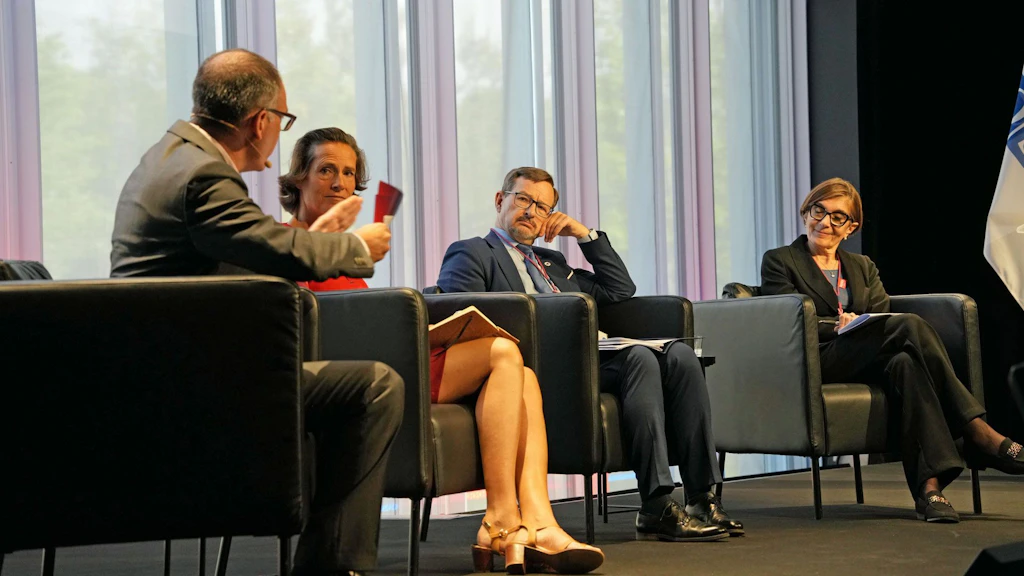
During the first panel, the participants discussed how new technologies might affect the security environment and why anticipatory action is crucial for managing risks and opportunities. Using quantum computing as an example, the discussion highlighted the potential implications for peace, stability and cooperation across the entire OSCE region.
07.05.2026 – OSCE conference in Geneva: “If we want to remain relevant, we must anticipate — not react”
The OSCE Chairman-in-Office, Federal Councillor Ignazio Cassis, opened the conference “Anticipating technologies – for a safe and humane future” at CERN in Geneva. In his speech, Ignazio Cassis highlighted the security implications of rapid technological developments. “The world is changing faster than our ability to understand it.” Questions such as “Who controls technology?”, “Who decides?” or “What remains of human agency?” are no longer philosophical reflections, but “questions of power”.
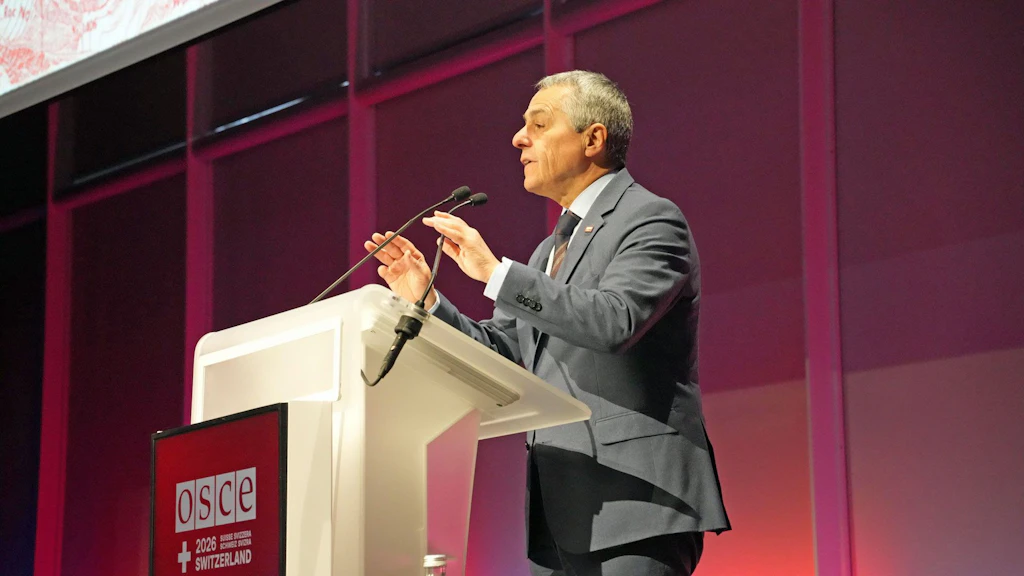
The current situation is characterised by a twofold shift: the return of geopolitical rivalry and a technological acceleration that is redefining power relations. This is giving rise to a new hierarchy between those who design technologies, regulate them or are dependent on them. Artificial intelligence, quantum computing and neurotechnology have become “strategic assets” that shape sovereignty. Without clear governance, instability looms: “If no one governs them, they will govern us.”
Technological developments are already having concrete implications for security policy: Decision-making in warfare is being accelerated and sometimes delegated; cyber security is entering a new era shaped by quantum disruption; and biology is becoming programmable – with both defensive and offensive implications. Initiatives such as the Geneva Science and Diplomacy Anticipator help to identify such developments at an early stage. Yet without effective regulation, anticipation leads to instability, and without cooperation, fragmentation looms. The key risk today lies less in technological surprises than in a political lag: a growing gap between innovation and regulation. This gap fosters escalation, miscalculation and mistrust, and undermines the predictability that has been a foundation of security until now. Without predictability, deterrence becomes unstable and cooperation fragile. Anticipation is therefore a political necessity.
Against this backdrop, the Chairman-in-Office emphasised in Geneva that technological issues should be firmly anchored within the OSCE as a cross-cutting theme. This is because technological developments are already affecting all three dimensions of the OSCE:
- The politico-military dimension – through new forms of warfare and deterrence.
- The economic and environmental dimension – through digital and technological competition.
- The human dimension – through rights, freedoms and social cohesion.
The focus is therefore on key areas of action for the international community and also for the OSCE to strengthen governance: identifying technologies at an early stage, jointly assessing risks and cooperating pragmatically. For, as the OSCE Chairman-in-Office concluded: “If we want to remain relevant, we must anticipate — not react.”
Opening address by OSCE Chairman-in-Office Ignazio Cassis
06.05.2026 – Anticipating technologies: Swiss engagement in Central Asia as operational track record
Within the framework of Switzerland's 2026 OSCE Chairpersonship, the second international conference – ‘Anticipating technologies – for a safe and humane future’ – takes place at the CERN Science Gateway in Geneva, examining how scientific and technological advances are transforming security and cooperation in Europe. One of the morning plenary sessions is dedicated to water and energy security in the digital age, drawing on insights from Central Asia. SDC has been promoting this approach for decades: the SAPPHIRE Central Asia programme modernises data and early-warning systems across five States; Blue Peace Central Asia builds water diplomacy among the five capitals. “When diplomacy seems impossible, it becomes indispensable,” Federal Councillor Ignazio Cassis stressed at the start of the chairpersonship year. The Geneva conference makes visible what stands behind this ambition: concrete Swiss experience that, in the spirit of “dialogue, trust, security,” delivers international added value.
SDC story: ‘From Helsinki to the algorithm: how Switzerland practises anticipation in Central Asia’
04.05.2026 – OSCE conference in Geneva: Anticipating technologies – for a safe and humane future
On 7 and 8 May 2026, as part of its OSCE chairpersonship, Switzerland will be hosting an international conference in Geneva on the anticipation of new technologies and their significance for security and peace in Europe. Senior figures from OSCE participating states and partner countries, science, the private sector and international organisations will discuss how opportunities can be seized, risks minimised and, through enhanced dialogue, trust and security strengthened in a rapidly changing world.

At the heart of this lies a fundamental transformation: technological developments – from AI and quantum technologies to neurotechnologies – are changing not only the economic and societal landscape, but increasingly also the foundations of international security. This drive is opening up new avenues for resilience-building and crisis management, yet at the same time harbours considerable risks – such as geopolitical shifts, growing inequalities and the targeted use of technologies for destabilisation.
Article: Anticipating new technologies – for a safe and humane future
20.04.2026 – Federal Councillor Beat Jans attends OSCE conference on trafficking in persons
The 26th OSCE Alliance against Trafficking in Persons Conference opened today in Vienna under the theme “The Rise of Forced Criminality: Addressing a Security Blind Spot”. The event brings together governments, international organizations, civil society, and the private sector to address forced criminality, one of the fastest growing and least understood forms of human trafficking. “Human trafficking for the purpose of exploitation is one of the fastest-growing forms of organized crime. In this process, the victims themselves are turned into perpetrators. We must not allow this,” said Beat Jans, Federal Councillor and Head of the Federal Department of Justice and Police of Switzerland, on behalf of the 2026 OSCE Chairpersonship.
19.03.2026 – OSCE participating States adopt 2026 Budget
The participating States of the Organization for Security and Co-operation in Europe (OSCE) today reached consensus on the Organization’s Budget for 2026, ensuring the continued implementation of its comprehensive security mandate. This ends a five-year stalemate since the last approved budget in 2021. The adoption of the budget confirms that the OSCE remains an important platform for dialogue, even in times of heightened tensions. This decision therefore also contributes to the implementation of a key priority of the Swiss Chairpersonship – ensuring the OSCE’s ability to act.
In this context, the OSCE has published a press release, which is available via the following link:
24.02.2026 – Four years of war against Ukraine
With the OSCE Chairpersonship in 2026, Switzerland assumes special responsibility for peace and security in Europe at a critical time. In this role, it continues to work inclusively for a comprehensive, just and lasting peace for Ukraine.
‘Switzerland has clearly condemned this war. It remains firmly committed to international law and the principles on which our common security is based,’ said Chairman-in-Office Ignazio Cassis today before the OSCE Permanent Council in Vienna. In his speech, Cassis looked back on his trip to Ukraine and Russia at the beginning of the month and explained that he had reminded Moscow that every participating state is responsible for complying with the Helsinki principles and emphasised that hostilities must cease.
In Kyiv (on 2 February 2026) and in Moscow (on 6 February 2026), Ignazio Cassis and OSCE Secretary General Feridun H. Sinirlioğlu, presented concrete proposals for the use of OSCE instruments: monitoring of a ceasefire, election assistance and security dialogue based on the Helsinki principles.
Last week's trilateral talks in Geneva show that there is room for dialogue. It is therefore also the task of the OSCE to be ready to support concrete progress. That is why the OSCE must act with foresight and be prepared to accompany any diplomatic initiative in accordance with international law and the Helsinki Principles that opens the way to peace.
This is the goal of the Swiss Chairpersonship: to defend the Helsinki Principles and preserve this unique platform for inclusive dialogue.
20.02.2026 – OSCE Chairman-in-Office Cassis concludes visit to Bosnia and Herzegovina
The OSCE Chairman-in-Office, Switzerland's Federal Councillor Ignazio Cassis, today concluded his visit to Sarajevo, where he met with members of the Bosnia and Herzegovina Presidency, the Minister of Foreign Affairs, and leadership of the Central Election Commission. He also visited the OSCE Mission to Bosnia and Herzegovina to discuss the Organization's ongoing work in the country.
20.02.2026 – The OSCE Chairman-in-Office, Ignazio Cassis, met with the team of the OSCE Mission to Bosnia and Herzegovina
The OSCE Chairman-in-Office, Ignazio Cassis, met with the team of the OSCE Mission to Bosnia and Herzegovina on 20 February 2025. On this occasion, he reaffirmed Switzerland’s 🇨🇭 priorities during its OSCE Chairpersonship: upholding the Helsinki principles, fostering inclusive multilateral dialogue, and ensuring the organization’s operational capacity. The Mission makes an important contribution to strengthening sustainable democratic institutions, promoting good governance, and protecting human rights.
Article: How the OSCE, under Swiss Chairpersonship, supports elections in Bosnia and Herzegovina
10.02.2026 – Kicking it Out: Combating anti-Semitism and racism in and through sport
At the third panel discussion at the OSCE Conference on Combating anti-Semitism in St. Gallen, participants exchanged experiences of anti-Semitism and other forms of intolerance and discrimination in sport.
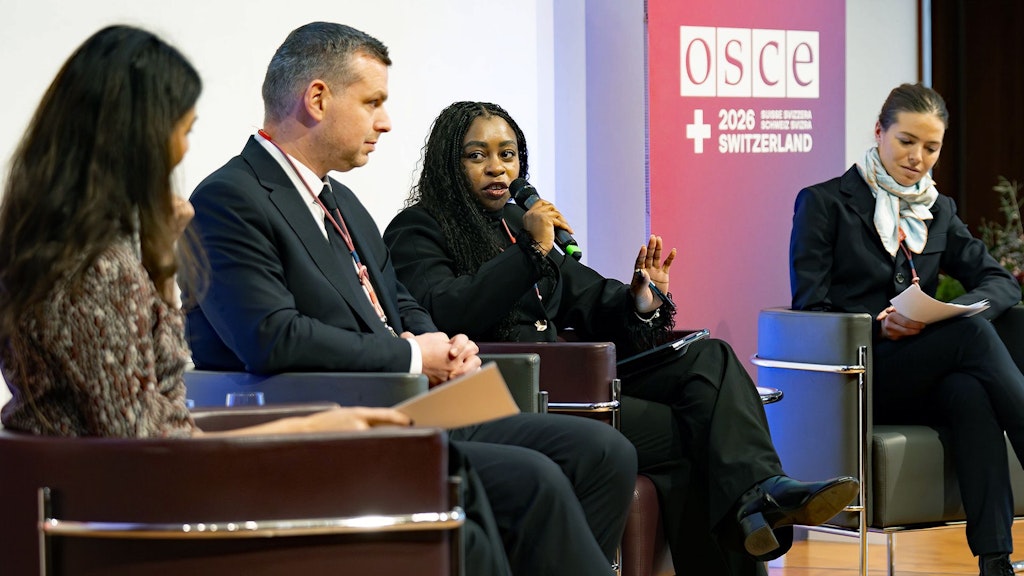
Options were presented for combating anti-Semitism and racism at sports events through political measures and practical action. An athlete and representatives of fan clubs and sports associations gave examples of how sport can serve as an innovative tool for promoting tolerance and non-discrimination.
10.02.2026 – From analysis to response: addressing current challenges in combating anti-Semitism and other forms of intolerance
The second thematic discussion at the OSCE Conference on Combating anti-Semitism in St. Gallen highlighted how anti-Semitism and other forms of intolerance manifest themselves and the challenges this poses for societies. The discussion was attended by the three personal envoys of OSCE Chairman Ignazio Cassis, representatives of the OSCE and policy makers. ‘Like all forms of discrimination based on prejudice, antisemitism is an attack on our fundamental freedoms and our collective security,’ Ignazio Cassis explained in a guest article published in various Swiss newspapers.
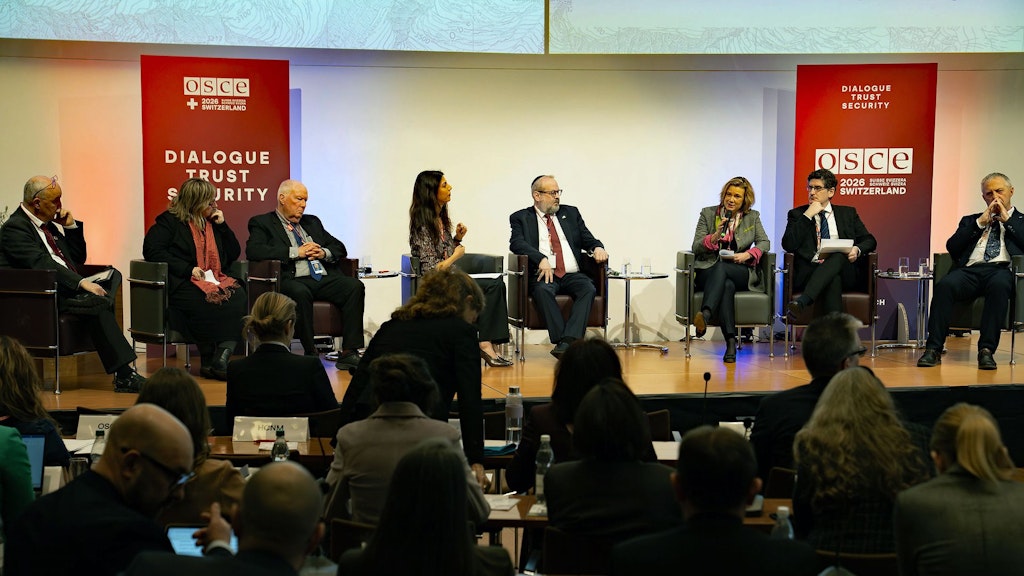
The session featured presentations of findings by the Office for Democratic Institutions and Human Rights (ODIHR) and the European Union Agency for Fundamental Rights (FRA), and reactions by the three Personal Representatives of the OSCE Chairman-in-Office on tolerance and non-discrimination and policymakers. The panelists identified a need to invest in capacity building, improve training of law enforcement and judges with involvement of affected groups, increase exchange of practices between countries, as well as improved national monitoring and data collection, in order to effectively counter contemporary forms of antisemitism. How best to regulate online platforms and strategies to prevent instrumentalization of antisemitism was also discussed during the session.
09.02.2026 – Voices from the field: Best Practice Interventions in Preventing Anti-Semitism and other Forms of Intolerance
In the first panel discussion at the OSCE Conference on Combating anti-Semitism in St. Gallen, experts from three organisations reported on various initiatives aimed at reducing prejudice and promoting dialogue, particularly involving young people.
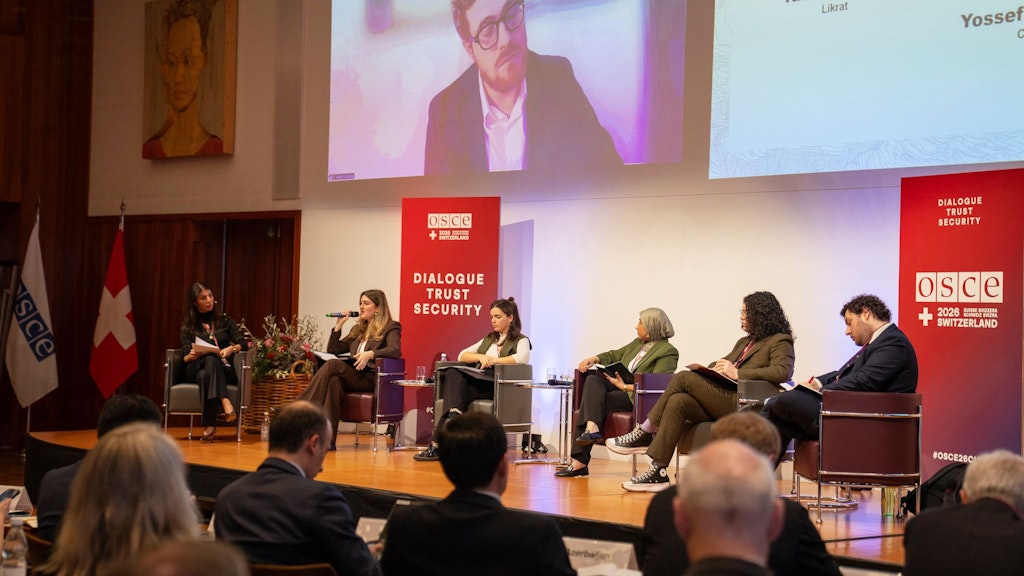
The panelists highlighted the importance of peer to peer prevention between individuals and communities, as well as inter-community dialogue, to combat prejudice and build understanding among youth. Digital and Media literacy was also pointed to as key for navigating disinformation and harmful stereotypes online.
09.02.2026 – OSCE conference in St. Gallen sends a strong message against anti-Semitism, hatred and discrimination
With an appeal to fight antisemitism, hatred and discrimination, the OSCE Chairman-in-Office, Federal Councillor Ignazio Cassis, opened the OSCE conference on ‘Combating anti-Semitism: addressing challenges of intolerance and discrimination’ on 9 February 2026.
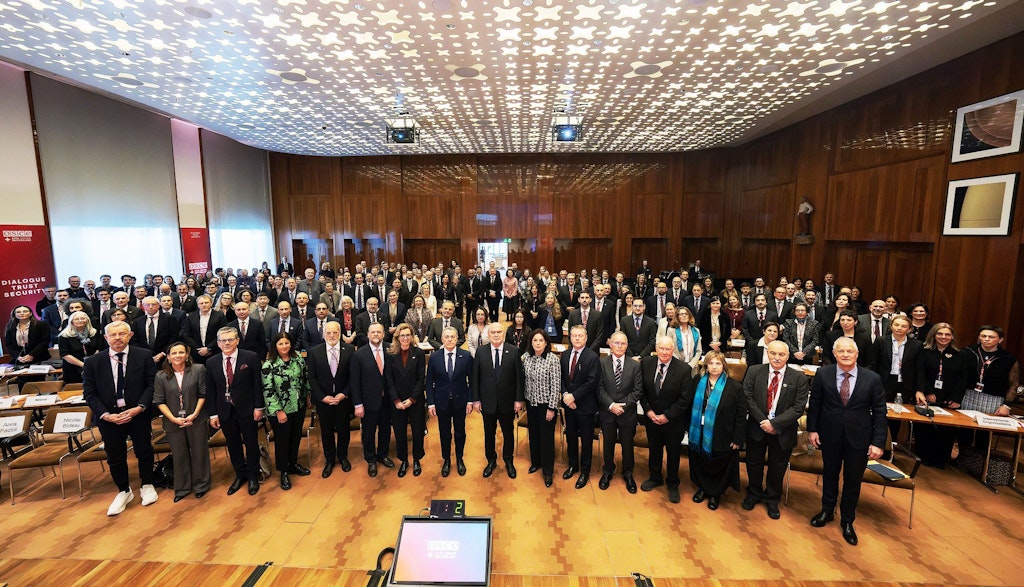
Antisemitic attacks are increasing in intensity and visibility worldwide. International developments such as the terrorist attacks carried out by Hamas on 7 October 2023 and the subsequent war in Gaza have exacerbated this trend. Recent incidents show that Switzerland is also affected. The rising number of recorded attacks in public spaces highlights the need for action. The conference in St Gallen, a city with a long tradition of interfaith dialogue, provides a forum for dialogue between OSCE participating States, international organisations, experts and civil society to address these challenges.
Role of the OSCE
With regard to the role of the OSCE, Mr Cassis reaffirmed the Swiss chairpersonship's ambition to ensure that the fight against antisemitism and intolerance has a permanent place on the political agenda. The conference builds on existing OSCE commitments, in particular the 2014 Declaration on Enhancing Efforts to Combat Anti-Semitism, which was adopted under the previous Swiss chairpersonship. The aim is to strengthen prevention, community protection and societal resilience in a targeted manner.
Prevention and avenues for political action
The first day of the conference featured high-level political exchanges followed by discussions among experts behind closed doors on preventive approaches, current threats based on new data from the Office for Democratic Institutions and Human Rights (ODIHR) and the European Union Agency for Fundamental Rights (FRA), and avenues for political action. The thematic priorities include education and dialogue, the protection of affected communities, and sport as a space for inclusion and awareness-raising.
The conference will end on 10 February 2026. The results of the technical discussions are intended to help translate existing commitments by OSCE participating States into concrete, practical measures.
09.02.2026 – OSCE Conference on Combating anti-Semitism: Opening speech by OSCE Chairman-in-Office Ignazio Cassis
The OSCE Chairman-in-Office, Ignazio Cassis, officially opened the conference on “Combating anti-Semitism: addressing challenges of intolerance and discrimination” this afternoon. In his opening speech, Mr Cassis emphasised that the resurgence of antisemitism as well as hatred and discrimination against other groups more than 80 years after the Holocaust is deeply disturbing. “We once said ‘never again’. Yet hatred persists and is once again turning into violence. This is unacceptable – for the victims, for our societies, for our security.” he said.
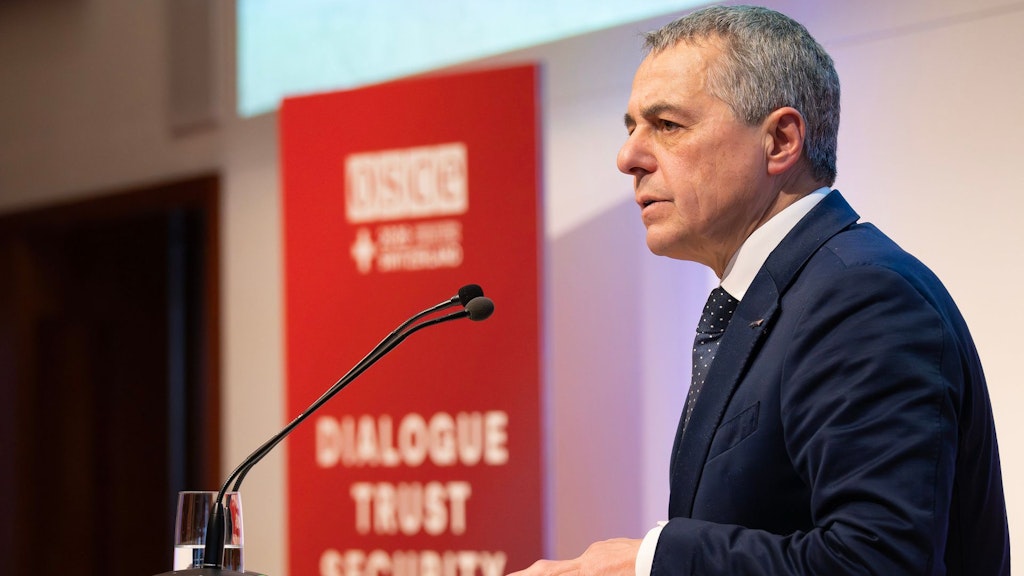
The aim of the conference in St Gallen is to better understand the spiral that leads to intolerance and discrimination in order to combat the resulting hatred more effectively. The focus is particularly on prevention among young people who are exposed to online violence, as well as in sport, where tensions and conflicts often arise. “Hatred begins with words, with stigmatisation, and with indifference,” Mr Cassis said. That is why action must be taken early on.
09.02.2026 – Launch of the OSCE Conference on Combating anti-Semitism: addressing challenges of intolerance and discrimination
The OSCE Conference on Combating anti-Semitism: addressing challenges of intolerance and discrimination will take place on 9 and 10 February 2026 in St. Gallen. It will provide a platform for analysing current developments and strengthening cooperation between OSCE participating States and civil society. The aim is to translate existing commitments into coordinated political action and concrete, practical measures.
06.02.2026 – Press conference following the trip to Ukraine and Russia
06.02.2026 – OSCE Chairman-in-Office Ignazio Cassis in Moscow
OSCE Chairman-in-Office Ignazio Cassis and OSCE Secretary General Feridun H. Sinirlioğlu held talks today with Russian Foreign Minister Sergei Lavrov. The visit – the first by an OSCE Chairperson-in-Office to the Russian Federation since 24 February 2022 – underscored the OSCE's commitment to political dialogue with all OSCE participating States.
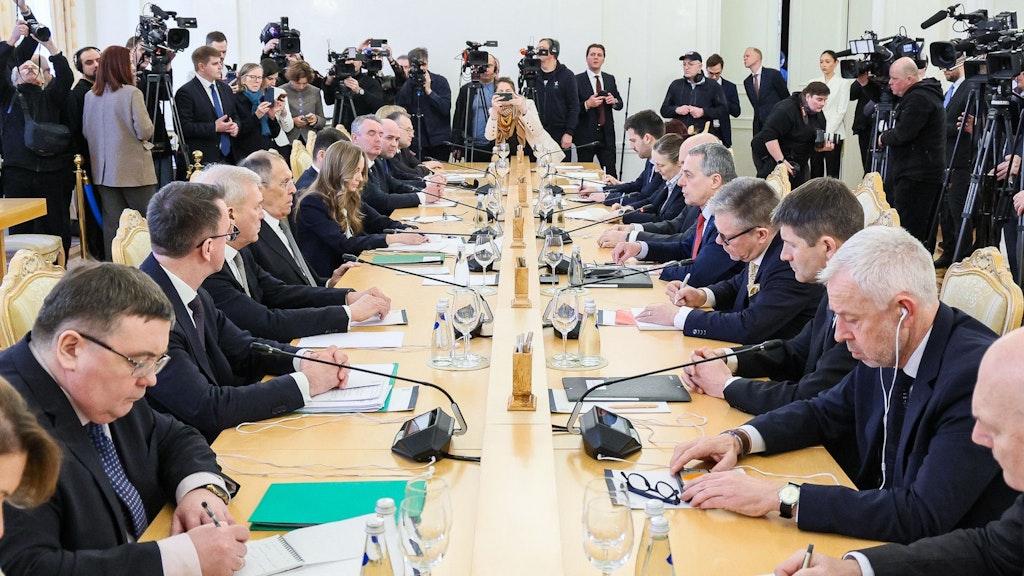
With regard to the war against Ukraine, the Chairman-in-Office emphasised in the talks with Foreign Minister Lavrov the OSCE's readiness to use its instruments, experience and expertise to support a negotiated solution and its implementation on the ground if sustained international engagement is required.
The OSCE has published a press release in connection with this trip, which is available at the following link:
06.02.2026 – Ignazio Cassis signs an OpEd in the national press against anti-Semitism
The head of the FDFA and current OSCE Chairman-in-Office Ignazio Cassis published an OpEd in the national press this morning. The publication comes ahead of the OSCE conference on Combating anti-Semitism: addressing challenges of intolerance and discrimination, which will take place on 9 and 10 February 2026 in St. Gallen.
The conference will provide a platform for analysing current developments and strengthening cooperation between OSCE participating States and civil society. The aim is to translate existing commitments into coordinated political action and concrete, practical measures.
02.02.2026 – OSCE chairman Ignazio Cassis visits Ukraine
The OSCE chairman-in-office, Ignazio Cassis, and OSCE Secretary General Feridun H. Sinirlioğlu concluded their visit to Ukraine today. In Kyiv, they met with the President of Ukraine, Volodymyr Zelenskyy, the Minister of Foreign Affairs, Andrii Sybiha, and other senior Ukrainian officials.
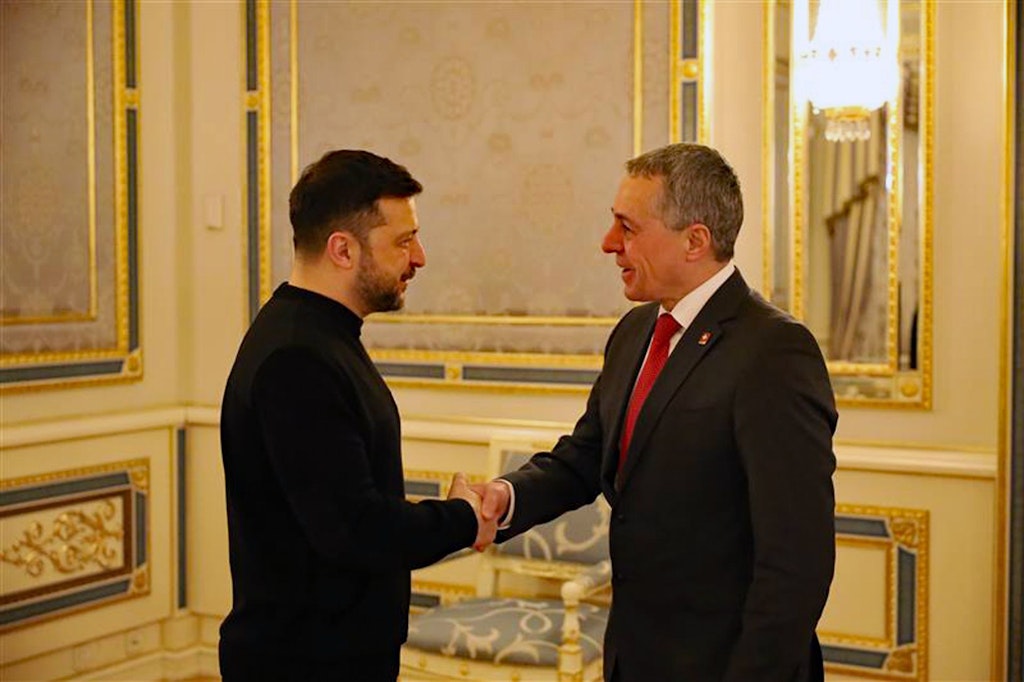
During the meetings, the chairman-in-office and the Secretary General reaffirmed the OSCE’s firm support for a just and lasting peace grounded in international law. They underlined the Organization’s readiness to act wherever international engagement is required, drawing on the OSCE’s long-standing experience in complex conflict settings and its unique role as an inclusive platform for dialogue.
Following this trip, the OSCE published a press release, which is available at the following link:
30.01.2026 – FOCUS video: Switzerland’s priorities, OSCE 2026
Since 1 January 2026, Switzerland has assumed the OSCE Chairpersonship for the third time. But what does this Chairpersonship mean in concrete terms? What role does Switzerland take on and what responsibilities does it entail?
As Chair, Switzerland coordinates key political and diplomatic processes within the OSCE. Federal Councillor Ignazio Cassis assumes this responsibility as Chairman-in-Office.
The Swiss Chairpersonship is guided by dialogue, trust and cooperation – in a challenging security environment.
In our FOCUS series, we will guide you throughout the year through the key themes and priorities of Switzerland’s 2026 OSCE Chairpersonship.
15.01.2026 – Federal Councillor Ignazio Cassis opens Switzerland's OSCE Chairmanship
The current Chairman-in-Office of the Organization for Security and Co-operation in Europe (OSCE), Federal Councillor Ignazio Cassis, officially opened Switzerland's OSCE Chairmanship for 2026 on 15 January 2026. Speaking before the Permanent Council, with its 57 participating States, the head of the FDFA emphasised that Europe once again finds itself in a situation reminiscent of 1975, the year the OSCE was founded: a fragmented continent marked by tensions and competing spheres of influence. At that time, diplomacy prevailed. ‘When instability takes hold, we can and must act with courage and clarity,’ emphasised Federal Councillor Cassis.
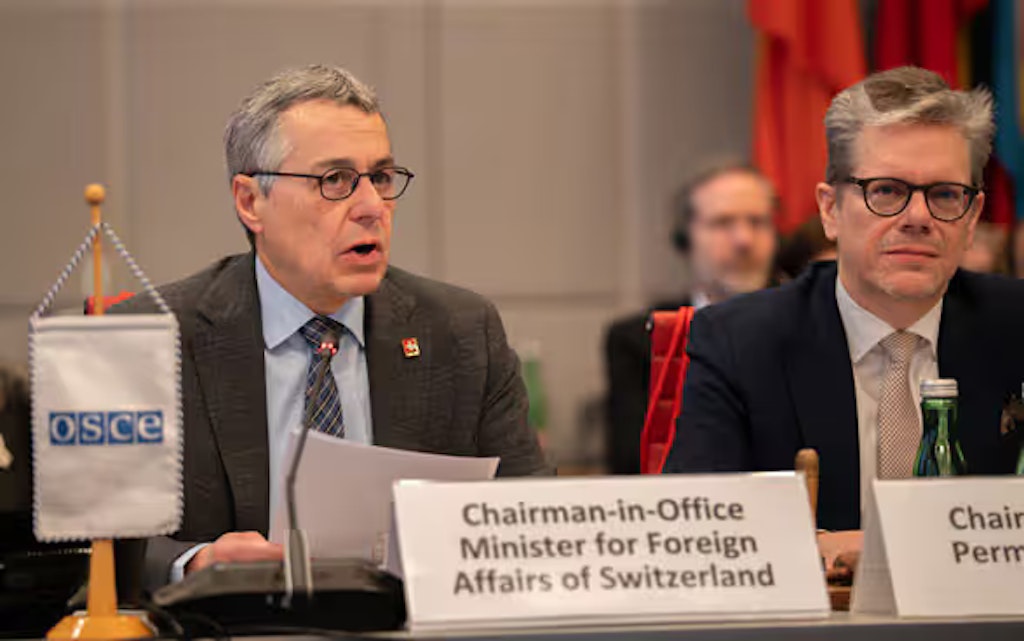
Russia's war against Ukraine has confronted the OSCE with the greatest challenge in its history. ‘Our consensus has been eroded, our capacity for action reduced, and our trust deeply damaged,’ the head of the FDFA explained in Vienna. In light of this situation, Switzerland’s OSCE Chairmanship is guided by a clear conviction: ‘The current crisis must strengthen the OSCE, not marginalise it.’
Switzerland is pursuing a clear approach for its chairmanship: the OSCE must remain effective, credible and able to act in order to seize opportunities – particularly in relation to a just and lasting peace in Ukraine – as soon as they arise. The focus is on the organisation's core competencies: serving as a platform for inclusive dialogue and promoting cooperative security. It is important to restore trust. Equally essential is the restoration of consensus in order to assume joint responsibility. The OSCE must therefore remain an inclusive forum for dialogue – even when this proves difficult – and a credible actor for peace and security.
The priority is to contribute to a just and lasting peace in Ukraine as soon as circumstances allow. The OSCE must remain part of the dialogue and be ready to play a targeted and complementary role as soon as de-escalation or a ceasefire becomes possible.
Speech by Federal Councillor Ignazio Cassis to the OSCE Permanent Council in Vienna, 15 January 2026
Brochure: Switzerland’s OSCE Chairpersonship 2026
The FDFA has published a brochure setting out the priorities of the Swiss chairpersonship and presenting the conferences that Switzerland will be organising this year.
01.01.2026 – Start of the Swiss 2026 OSCE chairpersonship
Today, Switzerland assumes the chair of the OSCE. This mandate is part of Switzerland's ongoing commitment to peace, security and stability in Europe and beyond.
Switzerland intends to promote inclusive dialogue on security among all participating states. “We are approaching our term as chair in the knowledge that the OSCE plays an essential role despite existing tensions. We will work with a simple conviction, that when diplomacy seems impossible, it becomes indispensable,” explains Federal Councillor Ignazio Cassis, chairman-in-office of the OSCE. “We will use our expertise in mediation to promote dialogue, trust and security.”
Consensus is the founding principle of the OSCE, which at the same time demands responsibility from all participating states. Last September, the head of the FDFA emphasised to the OSCE Permanent Council that Switzerland's political system is based on dialogue and listening to all parties, and that Switzerland will chair the OSCE in this spirit.
Switzerland has set out five priorities for its term as chair: the Helsinki principles for lasting peace; inclusive multilateral diplomacy; anticipatiing technologies – for a secure and humane future; democracy, the rule of law and human rights; and the OSCE's ability to act.
Press release: Switzerland takes over OSCE chair in 2026, OSCE, 01.01.2026
08.12.2025 – Programme of Switzerland's OSCE chairpersonship in 2026
Switzerland has set out five priorities for its 2026 chairpersonship: the Helsinki Principles for sustainable peace; inclusive multilateral diplomacy; anticipating technologies for a safe and humane future; democracy, the rule of law and human rights; and the OSCE's ability to act. Switzerland's priorities highlight its commitment to putting its recognised expertise in mediation, human rights, technology governance and scientific cooperation at the heart of joint security efforts.
To bring these ideas to life, four international conferences will be held in Switzerland.
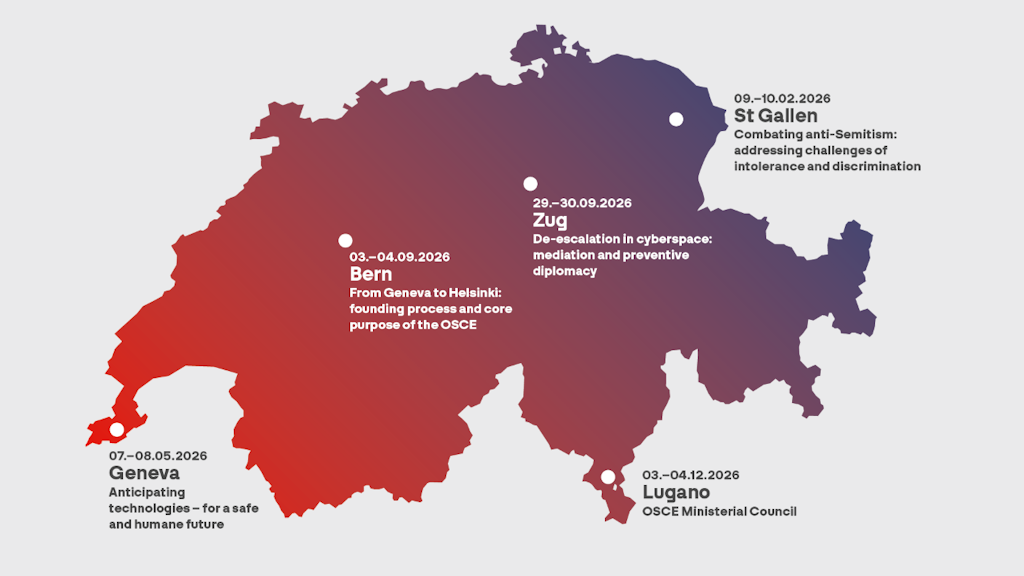
Switzerland will wrap up its chairpersonship by hosting the annual OSCE Ministerial Council meeting on 3-4 December 2026, for which it has proposed Lugano as the host city. This will be a key political event to consolidate the year's achievements and give renewed momentum to multilateral cooperation and dialogue.
A chairpersonship focused on action and fieldwork
In addition to these conferences, the Swiss chairpersonship will be particularly focused on direct engagement with key OSCE states and regions. Federal Councillor Ignazio Cassis, who will serve as OSCE chairman-in-office, will make a number of trips to various OSCE priority zones in order to support efforts to promote dialogue, stability and trust, and to support pragmatic solutions to current tensions. Furthermore, Switzerland will work to maintain the OSCE's ability to act and to secure funding for its instruments.
With 57 participating states, the OSCE is the world's leading regional security organisation. Its primary focus is on bridging differences and fostering trust among participating States. Switzerland has been a member since the Conference on Security and Cooperation in Europe (CSCE) was founded in Helsinki in 1973, later renamed the Organization for Security and Co-operation in Europe (OSCE) in 1994.
04.12.2025 – Federal Councillor Ignazio Cassis attends OSCE Ministerial Council in Vienna
Federal Councillor Ignazio Cassis is in Vienna on 3-4 December 2025 to represent Switzerland at the annual Ministerial Council of the Organization for Security and Co-operation in Europe (OSCE). The meeting provides an opportunity to discuss the challenges facing the European security architecture, particularly the war in Ukraine.
As incoming OSCE chairman-in-office, Federal Councillor Cassis emphasised in his address to the Ministerial Council that Switzerland will assume the chairpersonship in 2026 guided by a simple conviction: “When diplomacy seems impossible, it becomes indispensable. It is up to us to show that it meets the expectations by acting courageously and clearly. In an unstable world, clarity is a responsibility.”
The head of the FDFA also took this opportunity in Vienna to reiterate the five priorities of Switzerland's upcoming term of office. In the face of war in Europe, Switzerland remains committed to a just peace in Ukraine based on international law and the Helsinki principles. It will continue to foster inclusive multilateral diplomacy and security dialogue between all stakeholders. It will promote people-centred governance of new technologies by linking science and diplomacy. It will also focus on strengthening democracy, the rule of law and human rights, in particular through missions and election observation. In addition, it will work to maintain the OSCE's ability to act and to secure funding for its instruments.
At the invitation of the Finnish foreign minister, Elina Valtonen, in her capacity as current OSCE chairperson-in-office, representatives of all 57 OSCE participating states and the OSCE's 11 partners for cooperation meet in Vienna on 4 and 5 December 2025. The Ministerial Council comprises the foreign ministers of all OSCE participating states and is the organisation's central decision-making and governing body.
Address by Federal Councillor Cassis at the OSCE Ministerial Council 2025
18.09.2025 – Switzerland's priorities during its OSCE chairpersonship in 2026
On 18 September, Federal Councillor Ignazio Cassis, as future OSCE chairman-in-office, presented Switzerland's priorities to the OSCE Permanent Council. Switzerland has set five priorities for its chairpersonship:
- Helsinki Principles - for lasting peace
- Inclusive multilateral diplomacy
- Anticipating technologies – for a safe and humane future
- Democracy, the rule of law and human rights
- OSCE's ability to act
Detailed information on Switzerland's priorities
In his speech, the head of the FDFA also announced three conferences, the first on combatting anti-Semitism at the beginning of the year, followed by a second on forward-looking diplomacy and finally a conference on cyber security.
In his speech, Federal Councillor Cassis emphasised the relevance of the OSCE: “However, despite these roadblocks, the OSCE remains indispensable: because it takes concrete action on the ground, because it brings all the actors to the same table, and because it remains the only forum where Europe, the United States and Russia still talk to each other about security.”
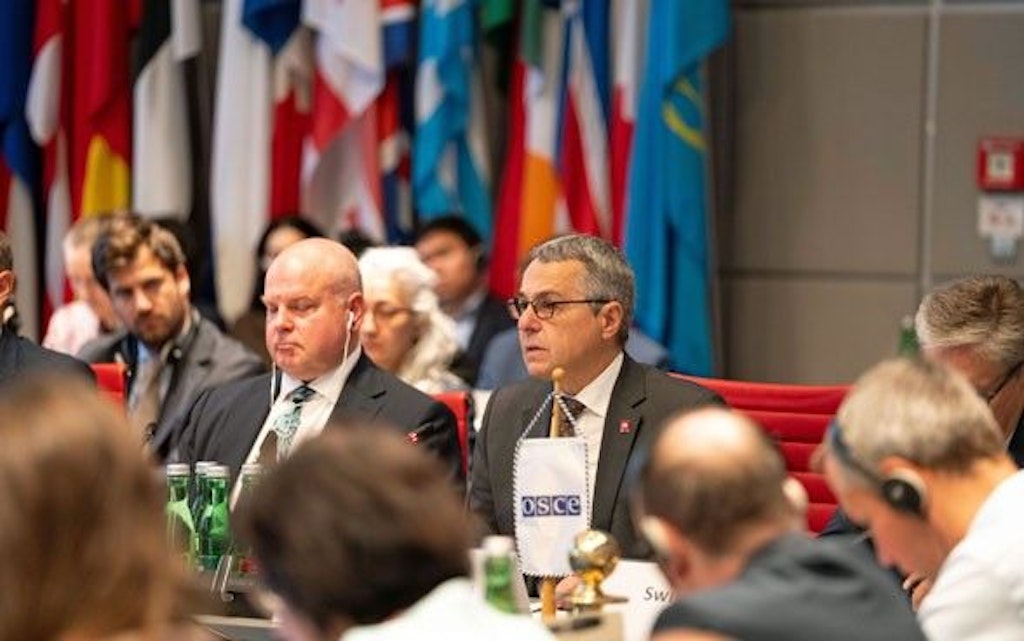
By assuming the OSCE chairpersonship, Switzerland is fulfilling its responsibility for peace and security in Europe and underlining the importance of dialogue, inclusion and cooperation in overcoming crises and conflicts. This is in line with the objectives of the Foreign Policy Strategy 2024–2027.
23.05.2025 – Lugano proposed as location for OSCE Ministerial Council meeting
During his meeting with the Ticino State Council, Federal Councillor Ignazio Cassis confirmed to the cantonal authorities the FDFA's intention to hold the annual OSCE Ministerial Council meeting in Lugano at the beginning of December. The head of the FDFA emphasised, the event will enhance the profile of Italian-speaking Switzerland and highlight Switzerland's strength in peacefully bringing together different cultures and languages – an important signal given the current geopolitical situation. In addition, the experience gained by the canton of Ticino and the city of Lugano at the Ukraine Recovery Conference 2022 can be put to good use in planning and implementing the meeting.
21.05.2025 – Switzerland sets priorities for OSCE chairpersonship
At its meeting on 21 May 2025, the Federal Council defined the thematic priorities for Switzerland's term as chair of the OSCE in 2026. The five priorities include complying with and promoting the principles laid down in the Helsinki Final Act for lasting peace in Europe and strengthening inclusive dialogue among the 57 OSCE participating states. Switzerland also intends to promote proactive science diplomacy with a view to ensuring cooperative security and supporting democracy, the rule of law and human rights. A further priority is to maintain the OSCE's ability to act – a concern shared not just by European countries, but also by the US and Russia. The foreign affairs committees of the National Council and Council of States will now be consulted and the issues discussed with other OSCE participating states.
Federal Councillor Ignazio Cassis will present Switzerland's final priorities for its upcoming term as chair to the OSCE Permanent Council in mid-September.
24.01.2025 – Swiss expert becomes OSCE Special Representative for South Caucasus
The chairperson-in-office of the Organization for Security and Co-operation in Europe (OSCE), Finland's foreign minister Elina Valtonen, has appointed Christoph Späti as the Special Representative of the Finnish OSCE Chairpersonship for the South Caucasus. The Swiss expert, who most recently served as programme manager for the South Caucasus in the FDFA's Peace and Human Rights Division (PHRD), took up the post of Special Representative on 21 January 2025.
Press release (French, German)
22.01.2025 – Switzerland has taken up its work within the Troika
Yesterday, Switzerland took part in its first meeting as a member of the Troika, alongside Finland (2025 chairpersonship) and Malta (2024 chairpersonship). The meeting provided an opportunity to discuss the first initiatives of the Finnish chairpersonship, in particular the visit of the OSCE chairperson-in-office, Elina Valtonen, to Ukraine and Moldova. The Troika also discussed the Finnish chairpersonship's introductory day and the annual meeting planned with the heads of OSCE field missions, which will take place on 23 and 24 January.
The leadership of the OSCE is usually ensured by a troika consisting of the preceding, the current and the succeeding chair. Switzerland will therefore form the troika together with Malta and Finland from January and will be primarily responsible for relations with the Mediterranean states outside the OSCE in 2025. The tasks of the troika also include personnel decisions.
30.12.2024 – Dialogue and cooperation with all participating States are essential
Switzerland is taking over the chairpersonship of the OSCE at a time when the organisation has little room for manoeuvre owing to geopolitical developments and Russia's war against Ukraine. In assuming the chairpersonship, Switzerland underscores how essential it is to ensure dialogue and cooperation with all participating states, especially in politically difficult times. Several participating states had asked Switzerland beforehand to stand as a candidate.
Having chaired the OSCE in 1996 and 2014, Switzerland has already gained the experience required for the chairpersonship role. Switzerland also faced numerous challenges during both previous chairpersonship years. These included the conflicts in Bosnia and Herzegovina and in Chechnya, as well as the political upheavals in Ukraine following the Maidan revolution.
Chairpersonship in 2014: focus on Ukraine
After Flavio Cotti in 1996, in 2014 the head of the FDFA and president of the Swiss Confederation, Didier Burkhalter, became the second Swiss national to chair the OSCE.From the outset, Switzerland's chairpersonship was shaped by the Ukraine crisis. The Swiss approach was characterised by active, bridge-building diplomacy. Thanks to Mr Burkhalter’s dual role as OSCE chairman-in-office and president of the Swiss Confederation, Switzerland was able to establish key contacts with the highest authorities of all the main actors in the crisis. Dialogue was fostered both in Vienna, at the OSCE headquarters, and within Ukraine.
The Swiss OSCE chairpersonship's involvement in the Trilateral Contact Group, where senior representatives from Ukraine, Russia, and the OSCE sought solutions to the crisis, was also pivotal.Within this framework, the Minsk agreements were signed with the aim of serving as a foundation for de-escalation in eastern Ukraine.
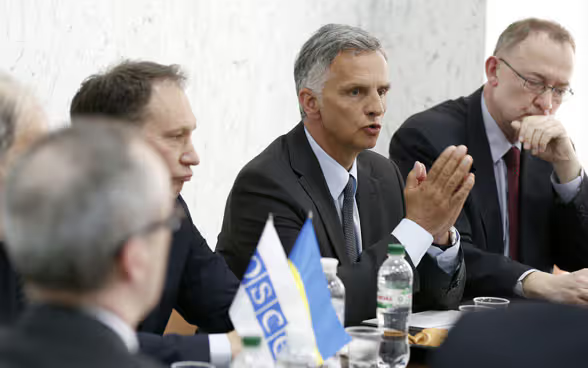
Under the Swiss chairpersonship, a consensus was reached for the first time in over a decade on launching new OSCE field missions: an observation mission at two Russian border posts and the Special Monitoring Mission to Ukraine (SMM). This mission became a key instrument for advancing de-escalation efforts in Ukraine.
Chairpersonship in 1996: organisation of free and fair elections in Bosnia and Herzegovina
Switzerland held its first OSCE chairpersonship in 1996. After the war between Bosnia and Herzegovina and Serbia ended in 1995, the OSCE was tasked with overseeing the preparation and conduct of free and fair elections in the war-ravaged country, as well as monitoring the human rights situation. The OSCE mission in Bosnia and Herzegovina helped the parties to establish the framework for the elections: a politically neutral environment, the right to vote by secret ballot without fear of intimidation, and the right to freedom of expression.
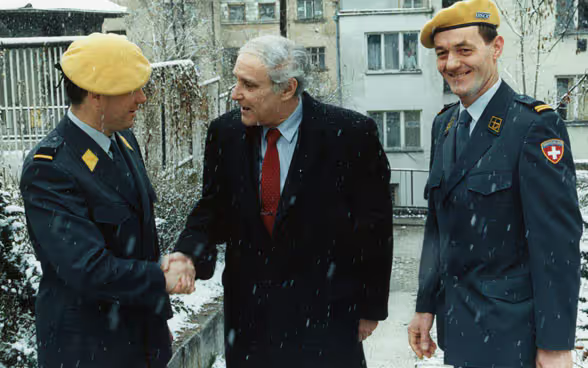
Switzerland's efforts in both advocating for an appropriate election date and ensuring the successful organisation of the elections were widely recognised at the international level at the time. A contingent of Swiss Yellow Berets provided logistical support to the OSCE in organising the first elections after the war.
Another notable achievement for Switzerland in 1996 was overseeing the OSCE mission to Chechnya under the leadership of Swiss diplomat Tim Guldimann. As head of the mission, Mr Guldimann played a key role in the peace agreement during the first Chechen war. The mission in Grozny successfully facilitated contacts between the parties to the conflict.

Switzerland and the OSCE: working together for peace and security in Europe
Three examples of trust in political institutions, elections and human rights illustrate how Switzerland collaborates with the OSCE to foster peace and security in Europe.
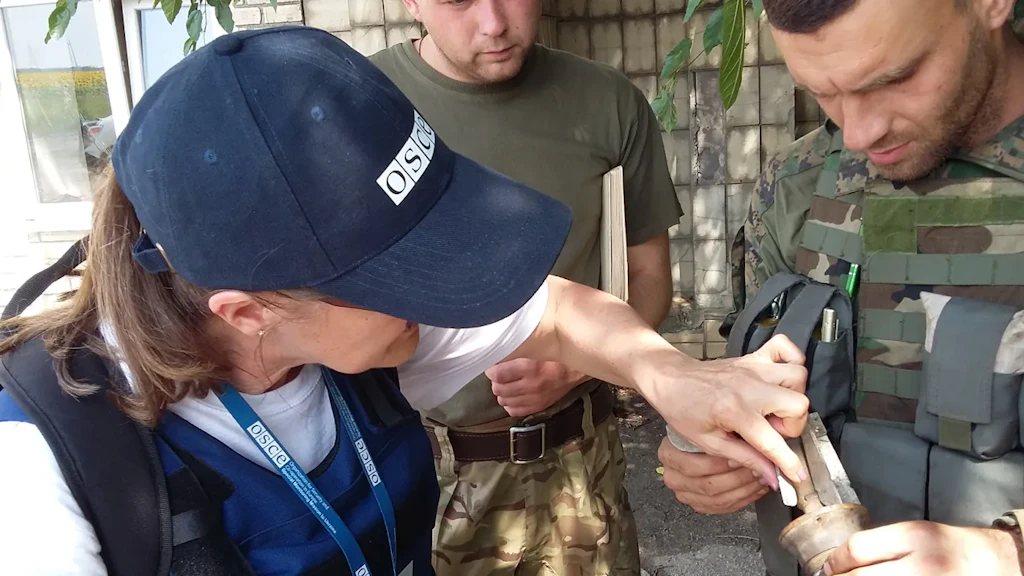
OSC...eh?
What is the Organization for Security and Co-operation in Europe (OSCE) exactly? Find out here.

«It is essential in the medium term to bring everyone to the table»
The Ministerial Council of the Organization for Security and Co-operation in Europe (OSCE) is focusing on its approach to Russia, says Ambassador Raphael Nägeli.
Contact
General Secretariat GS-FDFA
Federal Palace West
3003 Bern