
«Switzerland doesn't just abandon people»
One year after the Taliban's abrupt return to power, living conditions for many people – particularly women and girls – have deteriorated under the new regime. Although the Swiss cooperation office in Kabul was forced to close its doors due to security reasons, the SDC is still active in Afghanistan and can rely on its existing networks there, says Walburga Roos.
Ms Roos, the Taliban returned to power in Afghanistan a year ago. At the time, the FDFA made every effort to evacuate everyone working at the Swiss cooperation office. Can you tell us whether they are all still safe?
Yes, they are. The Taliban takeover was surprisingly quick – both for the international community and local people in Afghanistan. For three weeks, we had around 80 people working in Switzerland and abroad to evacuate our local staff under extremely difficult conditions. Now, all of our former local colleagues and their closest family members are safe in Switzerland.
What can the SDC actually do in Afghanistan if the cooperation office in Kabul is closed?
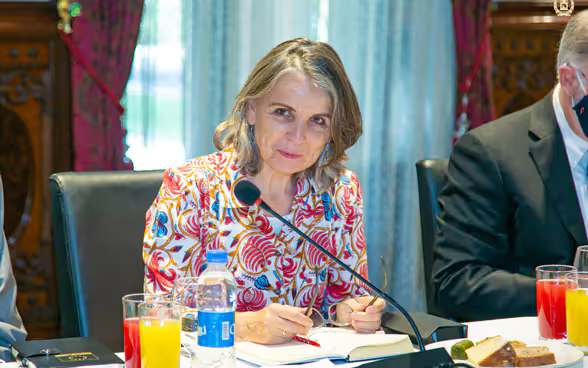
Only the office was closed for security reasons. The SDC remains active in Afghanistan and is also involved in international donor coordination. Afghanistan remains one of our international cooperation priority countries. SDC staff responsible for Afghanistan have continued to work from Bern throughout this period, supporting people on the ground together with local partners and other international organisations.
SDC staff have continued to work from Bern, supporting people on the ground together with local partners and other international organisations.
How does that work in practice? How can the SDC, working in Switzerland, help people in Afghanistan?
Working over such a distance is of course much more difficult. And we need local expertise without having local staff to rely on. It's also a lot more challenging to build networks if you're not actually on the ground. But when it comes to international cooperation, Switzerland often works in fragile contexts and we have the flexibility it takes to still be able to act even in times of crisis. In Afghanistan, for example, we were able to modify some of our projects within a very short space of time.
When it comes to international cooperation, Switzerland often works in fragile contexts and we have the flexibility it takes to still be able to act even in times of crisis.
We had to stop some projects right away because they were based on the reform efforts of the previous government and required close cooperation with different ministries. Other projects could be continued but needed to be modified as they could no longer be carried out through government ministries. These projects are now being run with a focus on strengthening civil society and local communities. Existing projects with local partners and NGOs are still being implemented. And we are also supporting new initiatives of course.
What particular challenges are there in Afghanistan in terms of international cooperation, i.e. Switzerland's efforts in this area?
Until August 2021, Afghanistan was one of the countries most dependent on foreign aid, which accounted for around 75% of its state budget. This international helpline was abruptly stopped on 15 August 2021. Most of the new Taliban ministers are on international sanctions lists, so the whole country is de facto under sanction. Afghanistan's financial system has collapsed and confidence in the banking sector has been shaken. For the SDC, it means we have to be even more careful in all our financial transactions so that we do not violate any regulations on sanctions, money laundering or terrorist financing. In this regard, being able to rely on our existing local network is especially important.
How can international cooperation activities be carried out in practice?
In the first few months following the evacuation this was, of course, very hard: the situation was not only confusing but also uncertain. Exchanges with our local and regional partners could only take place online. Since the start of this year, we've been able to start making short trips to Afghanistan again. These visits are extremely important for us. First, they help us understand all the different elements of what's actually happening on the ground, what people's living conditions are like, and what the needs and possibilities are. Second, they're invaluable opportunities to meet with local and regional organisations in order to discuss and initiate projects. These networks and the control mechanisms we've been setting up mean that we can ensure our help is really getting through, even from a distance.
In Afghanistan, our primary goal has always been to save lives and fight poverty.
The SDC uses a combination of emergency aid and longer-term support. What is your main task right now?
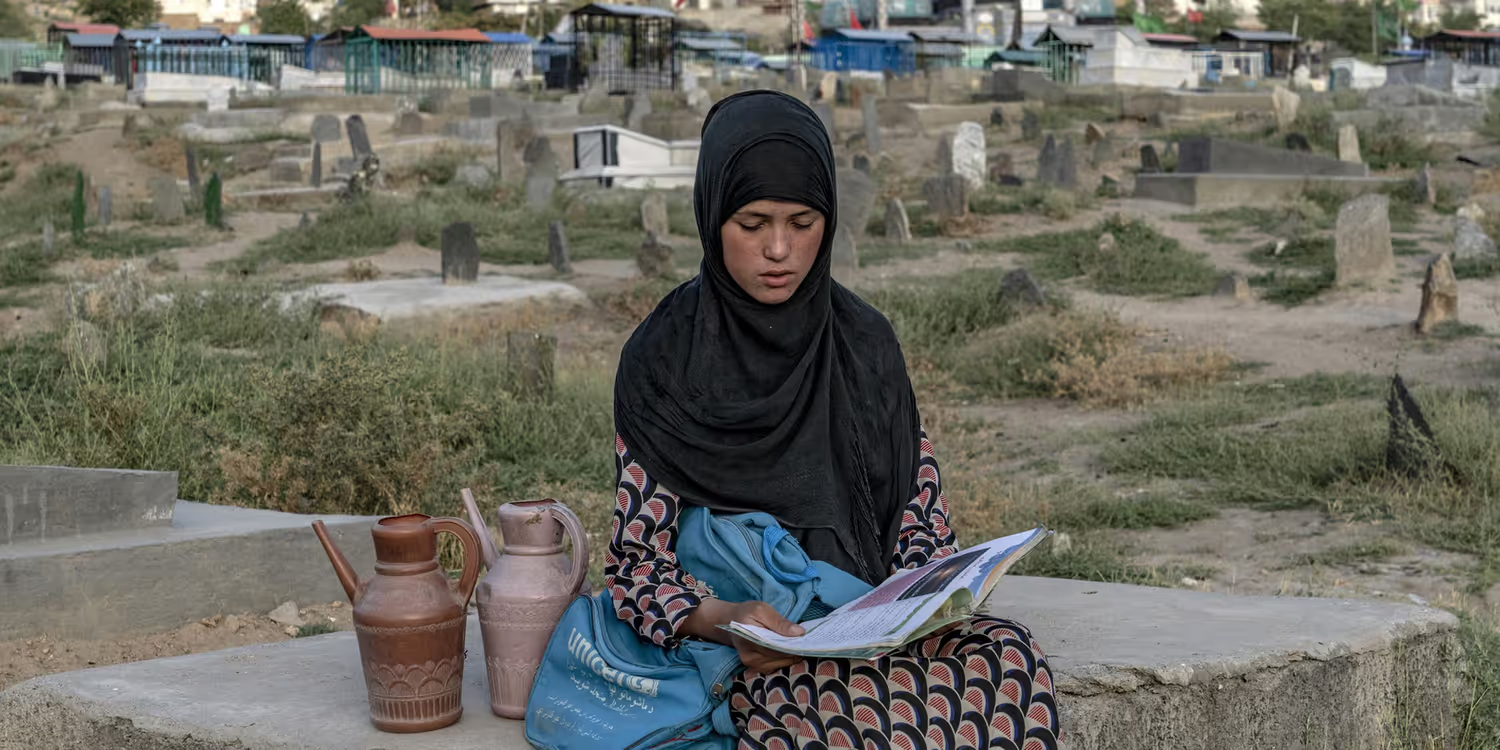
In Afghanistan, our primary goal has always been to save lives and fight poverty. We also used to invest in building strong state structures, but have had to put this type of work on hold for the time being. Switzerland doesn't just abandon people however. That's a principle for us. Right now, our main goal is to try and put a break on the downward spiral and preserve the achievements of the last two decades. We're also committed to funding projects that mitigate the negative impact of climate change on people's livelihoods.
What are you focusing on in particular?
In primo piano ci sono i diritti umani, il sostegno psicosociale, l’approvvigionamento di generi alimentari, l’istruzione e l’aiuto medico. Bisogna sapere che la metà della popolazione afghana non riesce più a procurarsi di che vivere da sola. Un numero molto elevato di economie domestiche sono fortemente indebitate e spende l’80% del proprio denaro per acquistare cibo. La situazione umanitaria in loco è catastrofica.
The humanitarian situation on the ground is catastrophic.
What is Switzerland doing to help address these acute needs?
The Federal Council decided as early as 8 September 2021 to scale up Switzerland's humanitarian engagement for people in need in Afghanistan and the wider region. To support this work, at the end of 2021 Parliament approved an additional CHF 23 million in funding – bringing Switzerland's total contribution to Afghanistan to CHF 60 million last year. For this year, Switzerland has raised CHF 30 million to help Afghanistan's suffering population.
So Switzerland's priority in Afghanistan is humanitarian aid?
Right now, people in Afghanistan need very basic things – and urgently. But Switzerland is still working to improve the situation in the country for the medium and long term. The challenges facing Afghanistan are long-standing and are likely to remain so in the years to come. If the impact of climate change cannot be mitigated, for example, the country will remain food insecure. Almost 80% of the population live directly or indirectly from agriculture. Land and water management must become sustainable and adapted to climate change, otherwise the humanitarian situation will not get better. That's why Switzerland is supporting projects that provide people with food and promote sustainable production at the same time.
Switzerland speaks out at various fora to condemn the Taliban's decision to stop girls over the age of 12 from going to school.
The Taliban have failed to deliver on many of the promises they made when they came to power – restricting the rights of women and girls, for example. What does that mean for the SDC and your partner organisations? Is it still possible to work effectively in Afghanistan?
The Taliban have severely restricted the rights of women and girls. Switzerland speaks out at various fora to condemn the decision to stop girls over the age of 12 from going to school. In this way, Switzerland is not only highlighting the importance of human rights but is also emphasising the fact that women have a central role to play in the social, political and economic development of a country. That's also why we make an extra effort to support projects run by local women's organisations as far as possible, and work closely together with UN Women.
The Swiss cooperation office in Kabul is still closed. Is anything being done to reopen it and, if so, under what conditions?
The FDFA has continued to monitor the situation during this time. Right now we're considering transferring a team to Pakistan until it's possible to resume work in Kabul. Until then, SDC staff will continue to work from Bern. We remain fully engaged in our efforts to advance international cooperation goals for and with the people on the ground.
I'm saddened that the fate of the Afghan people has already disappeared from the international radar.
You yourself also had to be evacuated from Kabul a year ago. What has your personal experience of the developments in Afghanistan been like since then?
It's shocking to have to see how the deterioration of living conditions for people in Afghanistan has been so fast and seemingly unstoppable. I'm also saddened by the fact that the fate of the Afghan people has already disappeared from the international radar and been overtaken by other headlines. What's happening in Afghanistan right now – what has in fact been happening for almost 50 years – cannot create the conditions people need for peaceful coexistence or real prospects in life. This makes our work even more urgent and important for the people living there.
Contact
General Secretariat GS-FDFA
Federal Palace West
3003 Bern