Switzerland to play an active part in advancing the future of Africa
Approved by the Federal Council, the Africa Strategy 2025–28 is rooted in a long-term partnership between Switzerland and Africa. The dynamics at play on the continent impact directly on Europe and on Switzerland. Conscious of the economic potential of many countries in the region, Switzerland is also open to providing its good offices and to acting as a bridge-builder.
«A prosperous Africa is of enormous interest to Switzerland and to Europe in general, not just for economic reasons, but also with regard to global security and stability,» according to Federal Councillor Ignazio Cassis. The Federal Council approved the new strategy in its entirety. Africa is a continent of contrasts. It is one of expanding economic opportunities and is rich in natural resources, but also has a background of major political and security-related challenges. Indeed, while it is experiencing strong economic growth, driven primarily by a young and dynamic population, it is also vulnerable because of political volatility in a number of regions, fragile states and multiple regional conflicts, such as currently in the Sahel region. In response, Switzerland must develop strategies to manage this instability not only with a humanitarian approach, but also to act in a preventive capacity and thus help African states exercise their own responsibility.
A prosperous Africa is of enormous interest to Switzerland and to Europe in general, not just for economic reasons, but also with regard to global security and stability.
Federal Councillor Ignazio Cassis
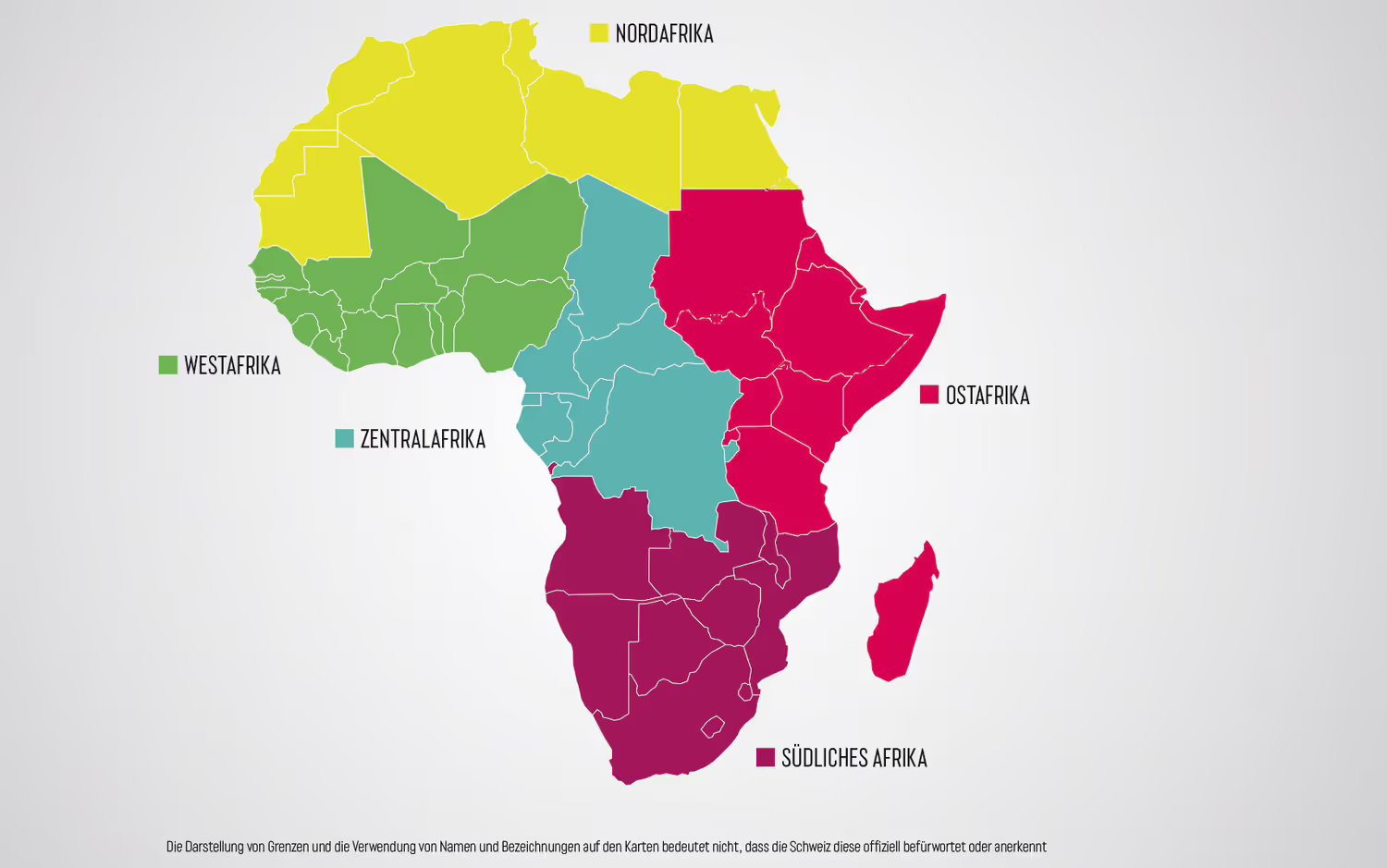
With this in mind, in its strategy the Federal Council has defined four thematic priorities and five distinct geographical regions. The Africa Strategy follows on from the Sub-Saharan Africa Strategy 2024–27 and complements the MENA Strategy that is still in effect. It is also important to have all of the continent's regions covered by a single strategy to improve the coherence of Swiss policy towards Africa.
Switzerland's four thematic priorities
The Africa Strategy 2025–28 is structured around the four priorities defined in the Foreign Policy Strategy 2024–27: peace and security, prosperity and competitiveness, the environment, and democracy and governance.
Promoting peace and stability on the African continent is one of Switzerland's key interests, also in terms of safeguarding its own security. Continuing its policy to date, Switzerland helps to prevent, manage and resolve conflict in its capacity as a credible mediator.
Many African countries, especially south of the Sahara, are suffering political instability, exacerbated by armed conflict and violent extremism. Combined with other factors, such as ailing state institutions and ethnic discrimination, these challenges create a vicious circle of political and regional fragility. Severe humanitarian crises are the result. Civilians often find themselves caught in the crossfire and suffer the direct and indirect consequences of conflict.
In its civilian peacebuilding efforts, Switzerland emphasises its impartiality, extensive experience and recognised capabilities. It takes a flexible approach to its peace policy that is aligned with its interests and values. Swiss humanitarian aid is a further central pillar of Switzerland's activities in Africa.
Swiss businesses are showing an increasing interest in Africa, despite the differences that exist between the 50 countries that make up the continent. Some of these businesses are already active in Africa. Together, Switzerland and its enterprises are helping to generate positive economic momentum.
Africa is a continent of expanding economic opportunities, characterised in part by a growing population and a wealth of natural resources. Its large economies are major players in the global economy while continuing to face economic and social challenges.
African societies are becoming younger, larger, more digital and more urban. In fact, Africa has the fastest rate of population growth in the world. Its youth is a possible driver of change and growth and represents a sizeable market with great potential.
Africa is particularly hard hit by the effects of climate change. Its climate is warming faster than the global average, leading to more frequent and more intense extreme weather events such as droughts, heatwaves and flooding. Changing precipitation patterns exacerbate water scarcity and reduce agricultural productivity. This can jeopardise livelihoods and food security.
Escalating competition for natural resources in already fragile contexts is a huge challenge to stability, security, and the living conditions of local people. In this regard, climate change acts as a risk multiplier that intensifies existing political, social, economic and ecological stress factors.
Switzerland's efforts in Africa include conserving ecosystems and reducing greenhouse gas emissions. In various regions it also supports measures to manage the risk of natural disasters and to promote renewable energies with a view to building the resilience of local communities.
Switzerland is committed to enhancing its profile in the promotion of democracy. Its overarching aim is to strengthen the resilience of democracies overall and to consolidate and protect democratic values, processes and institutions in African states where they already exist, albeit in a vulnerable state. To achieve this, Switzerland encourages bilateral and multilateral dialogue to foster mutual exchange and to explore potential avenues for cooperation.
The past four years have been marked by negative trends in democracy and the rule of law in the region. Political leadership in Africa has undergone a series of unconstitutional changes of power, frequently unfair and non-transparent election processes, and some contentious constitutional amendments allowing ruling powers to remain in office for extended periods. Autocratic tendencies are presently gaining ground in many countries. These processes of change have often also led to a deterioration in human rights and to political instability.
The Africa Strategy 2025–28 differs from the two previous strategies that the Federal Council approved for the African continent. In implementing the Sub-Saharan Africa Strategy 2021–24 it became clear that Sub-Saharan Africa cannot be dissociated from North Africa. Examples here include economic ties, migration routes, transboundary rivers, cooperation within the African Union, efforts towards peace and security in the Sahel region and Sudan, and interests surrounding the Red Sea. A strategy for the entire continent takes these ties into account.
West Africa is characterised by enormous cultural, linguistic, ethnic and religious diversity. Switzerland has wide-ranging interests in West Africa that are closely linked to its geographical proximity to Europe. The precarious security situation and violent extremism in the Sahel also pose a risk to Europe. Switzerland enjoys a high degree of credibility in the region. For over 50 years, its activities have covered diplomacy, development cooperation, humanitarian aid and peacebuilding. Switzerland is also valued as an independent and reliable partner.
A large number of East African countries are undergoing a process of political and economic transition. This holds out the prospect of a better medium and long-term future for the people of these countries, but may also heighten existing tensions and competition for resources. To support this process of transition, the rule of law must be strengthened, corruption must be fought, and deeply rooted ethnic conflicts must be addressed appropriately.
Switzerland has many strategic interests in East Africa. The region presents opportunities in terms of geographical economic diversification and expansion into new markets. Migration from and through the region, in particular, affects Switzerland directly. Switzerland has a well-established profile in East Africa, with a dense network of representations and a dedicated team for the Horn of Africa. It offers its services as a bridge-builder and is committed to compliance with international humanitarian law and the rule of law.
Central Africa is a region marked by ongoing internal and cross-border conflict that hinders its economic and social development. Poor governance in some countries and battling over natural resources produce a climate of insecurity. Economically, the region has experienced remarkable average growth in recent years. The benefits of this growth to the population are limited, however. Numerous inequalities persist and the region's infrastructure is still underdeveloped, while high levels of corruption further impede sustainable development.
Promoting peace is one of Switzerland's priorities in Central Africa, especially in the Great Lakes region. Given its impartiality and expertise in mediation, it can play a key role in resolving conflicts. Development cooperation and humanitarian aid are established pillars of Swiss action in Central Africa. In the face of repeated crisis, Switzerland works to meet people's needs by implementing projects relating to health, nutrition, the protection of civilians, and civic engagement.
Southern Africa is relatively stable at present. That said, many states are facing major social, economic and ecological challenges. Switzerland is committed to the continuing stability of Southern Africa, and not only with regard to its long-standing relations with the states of the region. In this context, it attaches great importance to sustainable activities that are compliant with both international law and human rights. Given its potential in terms of natural resources and renewable energies, the region offers opportunities for new forms of cooperation. To build that cooperation on solid ground, Switzerland has a particular interest in good governance and the prevention and combating of corruption.
The countries of North Africa recognise their status as a gateway to the rest of Africa for European markets, as well as their strategic importance to economic growth throughout the African continent. Many Swiss companies wishing to expand in sub-Saharan Africa are present in North Africa. Yet there is more to it than that.
The interests and added value associated with Switzerland's presence in North Africa also extend to areas such as peace and security, especially in connection with the neighbouring Sahel region. Switzerland contributes to peacebuilding and conflict prevention, as well as to the protection of basic rights, respect for international humanitarian law, and upholding the rule of law. North African states' geographical location south of the Mediterranean makes them priority partners in Switzerland's foreign policy on migration, which is why Switzerland cultivates close relationships in this area.
Strengthening multilateral cooperation
In the future, African institutions and the African Union (AU) in particular will play a more important part in the continent's development. According to its Agenda 2063, the African Union aims to create an integrated, prosperous and peaceful Africa. In recent years the AU – and many of its agencies such as the African Peace and Security Architecture (APSA) and the Peace and Security Council (PSC) – have launched new initiatives towards closer cooperation in areas such as health, the economy, the climate and humanitarian affairs.
Switzerland is accredited as an AU observer in Addis Ababa. The growing importance of African multilateralism is also reflected in the AU's geographic spread and widening network. In addition, AU initiatives have a bearing on various Swiss foreign policy priorities. Africa accounts for more than a quarter of UN member states, and these countries are aligned with Switzerland in their positions on certain issues. In parallel, Africa is building its influence in alternative multilateral groups of states. Beyond the expansion of the BRICS countries to include Egypt and Ethiopia, the AU has now been admitted to the G20. States increasingly expressing their own views on global developments underlines Africa's general claim to have a greater voice on such matters. Furthermore, many African states are coordinating more closely within bodies such as the International Organisation of La Francophonie (IOF) and the Arab League.
Agility and flexibility of the Africa Strategy 2025–28
It is still essential to safeguard Switzerland's fundamental interests while remaining flexible in the way in which foreign policy instruments are applied. Where appropriate, this means making adjustments and enabling the strategy's strategic orientation to evolve. Anticipation is integral to implementing the Africa Strategy 2025–28, allowing the volatile context to be taken into account and ensuring a balance between the interests of African countries and those of Switzerland.
Switzerland implements its strategy in a spirit of partnership. It safeguards its interests and promotes its values by working with a range of Swiss actors in accordance with the ‹whole of Switzerland› approach. It encourages the establishment of partnerships and networks with governments, businesses, academia and civil society organisations.

.avif?auto=format)