
Switzerland's commitment to women's rights worldwide
This was the visionary agenda of the 4th World Conference on Women in Beijing, 25 years ago. But the many challenges highlighted back then continue to be relevant today. The UN Commission on the Status of Women is currently conducting a review at its 64th session in New York – in a reduced format because of the COVID-19 outbreak. Switzerland is taking an active part. Read on for an overview of its work to promote gender equality and women's rights.
The priority of the United Nations Commission on the Status of Women (CSW) this year is to review and evaluate the implementation of the Beijing Declaration and Platform for Action.
These two documents, which were adopted in September 1995, were the first to convey the message that the issues addressed by women's rights are actually universal in scope.
The progress that has been made in the last 25 years has been considerable, but so are the challenges that remain. That is why the states meeting in New York have agreed on a political declaration which underlines their determination to fulfil the commitments made in Beijing.
Twelve critical areas
The Beijing Platform for Action is divided into twelve key areas. It invites states to undertake specific measures relating to health, education and legal reform, for example. It identifies the urgent steps that need to be taken to ensure greater gender equality and eliminate all forms of discrimination against women.
Switzerland's firm belief that gender equality and respect for women's rights are fundamental is enshrined in its constitution. It also considers gender inequality to be one of the main barriers to sustainable development.
Four main targets
At the international level, Switzerland strives to reduce inequalities and promote women's rights via multilateral forums, bilateral dialogues and international cooperation efforts.
The Federal Department of Foreign Affairs (FDFA) introduced a strategy three years ago to guide its actions in this field and ensure coherence in its foreign policy towards areas relating to gender equality and women's rights.
In addition to introducing gender mainstreaming in all its activities and projects, the FDFA has identified four targets in line with the Beijing Platform for Action where it can make a concrete contribution. Illustration through specific projects.
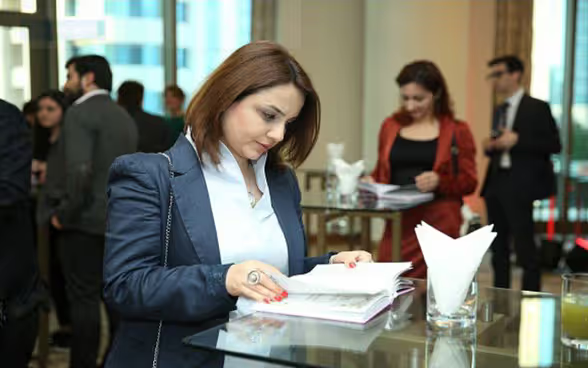
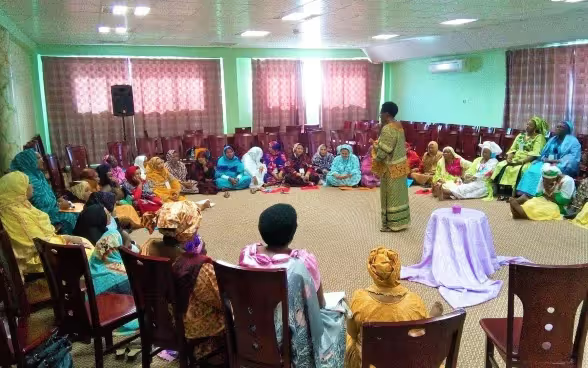
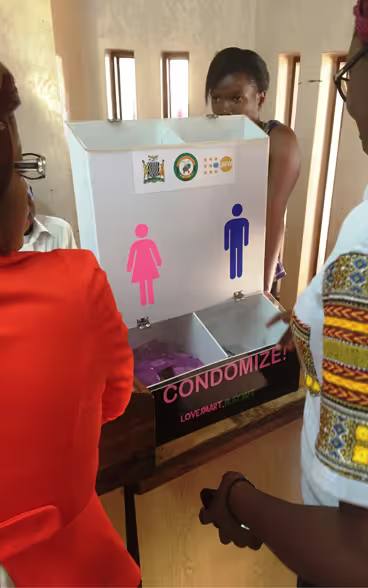
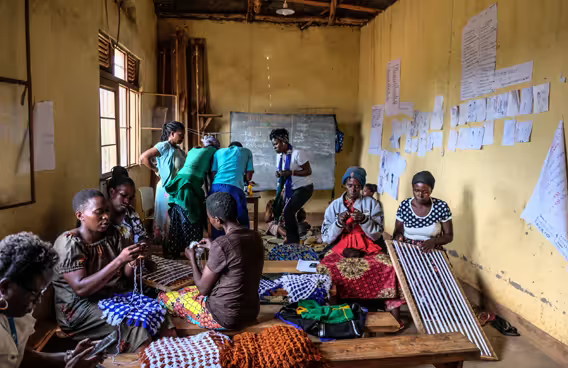
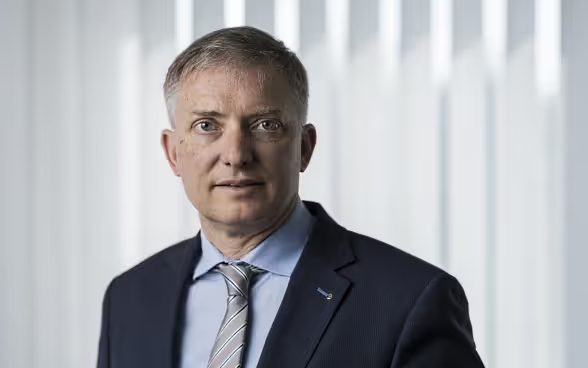
The Federal Department of Foreign Affairs works at the operational level to ensure that women and men enjoy the same rights and conditions in all countries of the world. FDFA Secretary General Markus Seiler assesses what further progress needs to be made.
What are the Swiss delegation's objectives for the 64th session of the CSW?
Switzerland's main foreign policy concerns peace, security, prosperity, respect for human rights and sustainable development affect women and girls as much as men and boys. Gender equality has become a key pillar of Swiss foreign policy, but the norms that have been achieved in terms of gender equality and women's rights are being increasingly challenged by certain states at the multilateral level. That's why our main objective is to defend these standards.
Can Switzerland really have an impact at the global level in terms of achieving gender equality and protecting women's rights?
Switzerland has valuable expertise in specific areas such as women's empowerment, combating all forms of violence against women including domestic violence, participation in economic, political and social life, as well as access to healthcare. We also have an excellent reputation as a bridge-builder at the multilateral level, which creates trust among the stakeholders involved in Swiss projects.
Following on from Switzerland's national action plan to implement UN Security Council resolution 1325 on women, peace and security, we are also working to ensure that women are able to contribute actively to conflict prevention and peace processes as well as post-conflict state reconstruction and reconciliation processes. Switzerland is also committed to better protection for women worldwide, particularly against sexual violence.
Switzerland aims to combat gender inequality worldwide, particularly via its international cooperation work. Will this also be part of the Dispatch on International Cooperation 2021-24?
Gender equality has been one of Switzerland's international cooperation priorities for a number of years and has long been mainstreamed in the organisation and programmes of the units working in this area mainly, the Swiss Agency for Development and Cooperation (SDC), the Human Security Division (HSD), and the State Secretariat for Economic Affairs (SECO).
The previous international cooperation dispatch (2017-20) was the first to state the explicit aim of strengthening gender equality and the rights of women and girls. Switzerland is also committed to implementing the 2030 Agenda for Sustainable Development including goal 5, which is to achieve gender equality and empower all women and girls. And because gender equality is also fundamental to a world free of poverty, this aspect has been included in the new international cooperation dispatch.
What does the CSW do?
The United Nations Commission on the Status of Women (CSW) is the world's main intergovernmental body that focuses exclusively on promoting gender equality and empowering women.
It was created in 1946 on the basis of a United Nations Economic and Social Council (ECOSOC) resolution.
The CSW drew up the first international conventions on women's rights such as the 1953 Convention on the Political Rights of Women, which was the first international instrument to recognise and protect women's political rights. It also drafted the first international agreements on women's rights relating to marriage.
The CSW meets once a year in New York. Member states adopt what are known as agreed conclusions on a priority theme as well as a series of practical recommendations for governments, intergovernmental bodies and civil society actors.
In 2019, the CSW addressed the theme of ‹Social protection systems, access to public services and sustainable infrastructure for gender equality and the empowerment of women and girls›.
In 2020, CSW was held in a reduced format because of the COVID-19 epidemic. The member states adopted a political declaration to reaffirm the commitments made in Beijing.
Switzerland was elected as a member of the CSW for the 2020¬24 period.
Contact
General Secretariat GS-FDFA
Media
Federal Palace West
3003 Bern