
Switzerland's good offices – mediation as a bridge to peace
From quiet rooms in Geneva to talks in faraway conflict zones: how Switzerland acts as an impartial mediator on the world stage and contributes to peace.
.avif?auto=format)
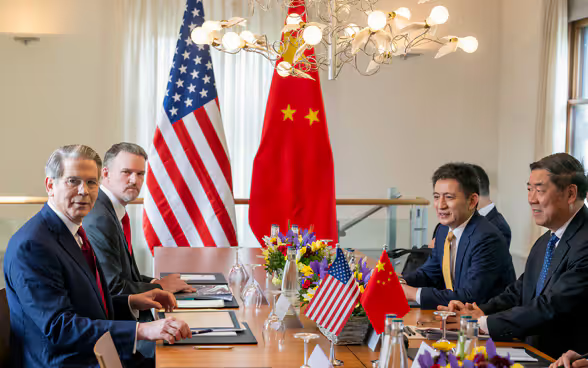
When conflicts escalate and positions are entrenched, mediators who enjoy trust, possess expertise and have no hidden agendas are needed. This is precisely where Switzerland's good offices come into play. They are a key instrument of Swiss foreign policy and an expression of its humanitarian tradition and impartiality. Swiss good offices thus make a concrete contribution to a more peaceful and stable world.
What are the good offices?
The good offices refer to all activities undertaken by Switzerland to help reduce international tensions and facilitate dialogue. They are divided into three main areas:

Mediation – a core element of peacebuilding
Mediation, as understood and practised by Switzerland, is more than just a round-table discussion with an impartial moderator. It is a profound, long-term process in which trust is built, compromises are reached and sustainable solutions are found.
One example is Mozambique, a country that, after a bloody civil war in the 1990s, found itself once again on the brink of armed conflict in 2013. Between 2017 and 2019, Switzerland played a decisive role in the negotiations between the government and the opposition RENAMO. Working closely with church actors and maintaining the strictest discretion, a peace agreement was negotiated. Switzerland provided expert knowledge, helped to structuring the negotiation process, maintained contact with both parties and thus ensured an environment in which both sides could negotiate on an equal footing.

In another context, Colombia, Switzerland has been committed to a sustainable and inclusive peace process for more than 20 years. It supported the negotiation of the 2016 peace agreement with the FARC-EP rebel group and has been helping to implement it ever since. At the request of the government and the parties involved, Switzerland is supporting the peace negotiations between the Colombian government and the rebel group ELN (Ejército de Liberación Nacional), as well as those with the EMBF FARC-EP (Estado Mayor de los Bloques y Frentes) and those with the CNEB (Coordinadora Nacional Ejército Bolivariano). Swiss mediators are present at all negotiations, support the parties in their search for solutions and provide technical expertise on request, for example in the areas of ceasefire and process design.
Why Switzerland?
What makes Switzerland a sought-after mediator? It is not just its impartiality. It is also its culture of consensus, which is deeply rooted in its political structure. The Federal Council makes decisions collectively, minorities are involved, and four national languages and different religious traditions form the foundation of a society that sees diversity not as a burden but as a strength.
In addition, Switzerland has a worldwide presence: with 170 representations in more than 100 countries, it has a dense diplomatic network. In around 20 of these countries, so-called Human Security Advisers are active – specialists in peace promotion who are very familiar with local conditions and accompany peace processes on the ground.
The Peace and Human Rights Division at the FDFA in Bern is the hub for coordinating Switzerland's foreign policy peace efforts. Experts on conflicts around the world work there to develop tailor-made solutions and support Swiss representations with their expertise on issues such as ceasefires, power-sharing and dealing with the past.
Mediation in all its forms
Swiss mediation is not a rigid format, but comprises flexible instruments that can be adapted to the specific dynamics of a conflict on the ground.
Switzerland can thus...
- act as a mediator, i.e. lead the peace process and work with the parties to develop concrete solutions;
- provide support, for example by offering technical expertise in processes led by the UN or the African Union;
- prepare negotiations by coaching the parties to the conflict and advising them on negotiation strategies;
- structure dialogues to prevent misunderstandings and promote mutual understanding.
Switzerland pursues a pragmatic and principled approach: discretion, patience, impartiality, intercultural sensitivity and commitment to international law are the cornerstones of Swiss mediation efforts. The involvement of women and civil society actors is also particularly important – an aspect that is central to the sustainability of peace agreements in many contexts.
Geneva – a centre for peace
International Geneva – this is not just a term, but a reality. The city on Lake Geneva brings together many important players in one place: UN organisations, NGOs, think tanks and diplomatic missions all create an ecosystem that enhances the chances of successful mediation. Geneva is not only logistically well equipped, but also neutral ground where trust can flourish.
Peace as a mission and an attitude
According to studies, three out of four Swiss citizens want our country to do more for peace. Good services, and mediation in particular, show how this is achieved in practice – through listening, expertise and perseverance. Through its good offices, Switzerland also fulfils a mandate set out in the Federal Constitution and thus contributes to the peaceful coexistence of nations, which in turn benefits the stable international structures on which Switzerland, as an export-oriented country, depends.
In a world full of tensions and uncertainties, Switzerland is a quiet but powerful player for peace. Not through grand speeches, but through quiet talks, workable compromises and sustainable solutions. This is precisely what makes its role so valuable.
FDFA Communication
3003 Bern