
Switzerland's membership of the UN Security Council: a look back and a look ahead
For the UN Security Council, 2023 was a year of multiple crises. Barely any of the world's conflict hotspots failed to make the agenda of its virtually daily meetings, from Haiti and Sudan to Ukraine and the Middle East. Over the past year, Switzerland has focused on the four priorities defined by the Federal Council, which it intends to build on during the second half of its Security Council term in 2024.
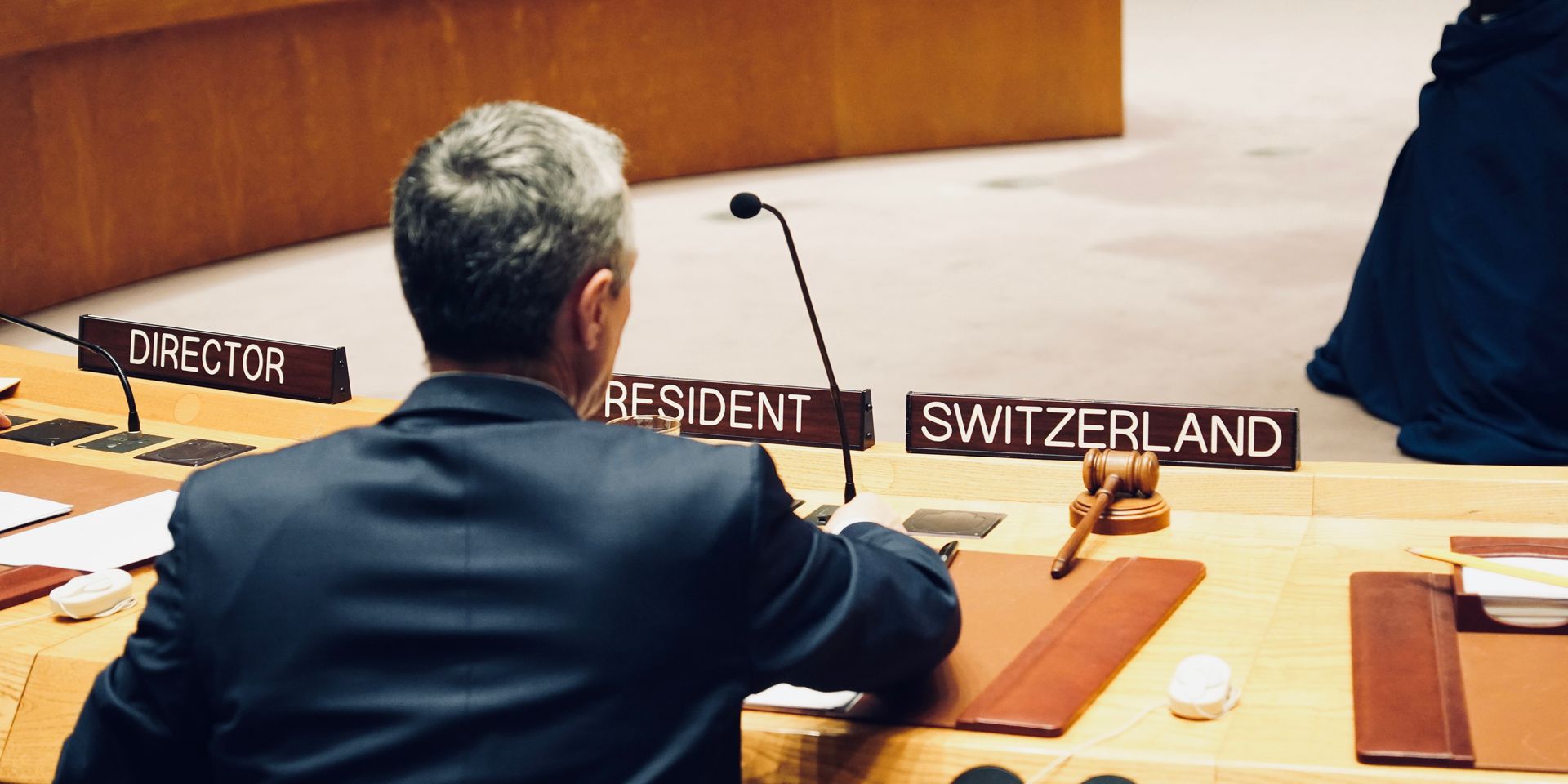
Switzerland's membership of the UN Security Council comes at a time when the world feels increasingly out of joint. The war against Ukraine, which has been going on for almost two years, the violent escalations in the Middle East, Nagorno-Karabakh and Sudan, and the coups in Niger and Gabon have further increased global instability. The tensions and mistrust between world players that accompany these crises and conflicts are also reflected at the Security Council table, with the major powers becoming less and less willing to work together to find common solutions. One example is the Security Council's handling of the conflict in the Middle East since 7 October. Out of a total of six draft resolutions, the Council has only adopted one, a resolution aimed at the humanitarian protection of children. But despite these challenges, the Council continues to make important decisions on many issues, in contexts as diverse as Afghanistan, Yemen and Somalia.
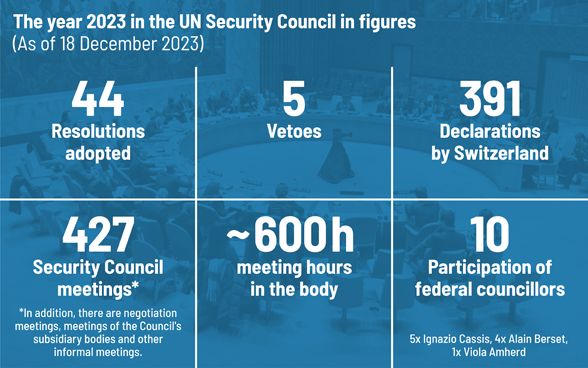
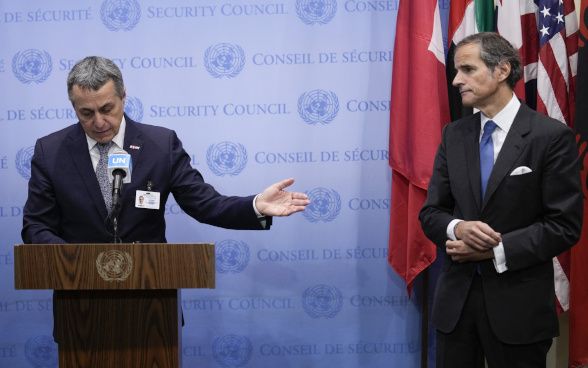
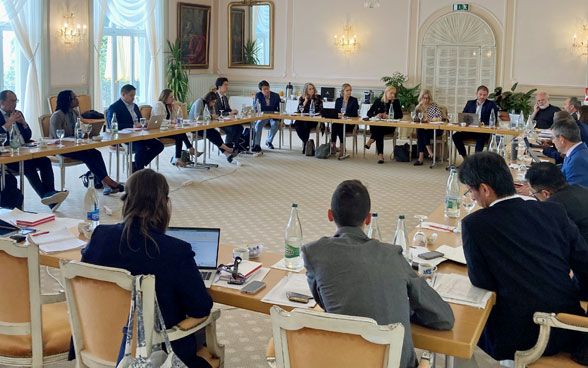
Over the past year, Switzerland has established itself as an active and constructive Council member while promoting its four thematic priorities ("Building sustainable peace", «Protecting civilians», «Addressing climate security» and "Enhancing the effectiveness of the Security Council"). This was achieved in part thanks to its chairmanship and penholder roles during its first presidency in May, but also in behind-the-scenes negotiations. Championing its own values and interests was vital in this context. These include, among other things, its mandate under the Federal Constitution to work for the peaceful co-existence of peoples, strengthening international humanitarian law and human rights, and building bridges in order to promote problem-solving within the UN body. Examples of specific areas on which Switzerland focused in 2023 are set out below for each priority:
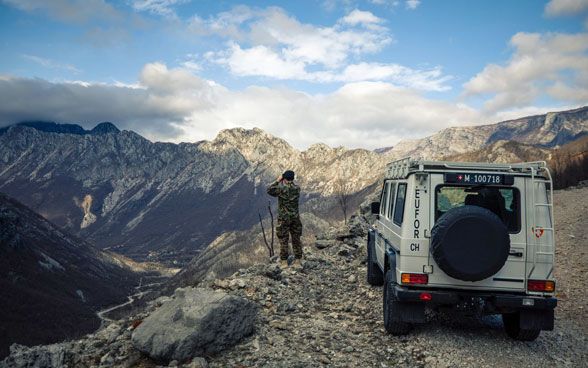
A look ahead to the second half of Switzerland's term on the Council
«I am confident that, in the coming year, Team Switzerland will succeed in building on previous successes and promoting its priorities with a lasting effect,» says Thomas Gürber, head of the UN Division and deputy state secretary at the FDFA.
There are plenty of avenues to pursue. For its priority of building sustainable peace, Switzerland aims to strengthen and promote the role and use of recognised scientific data, among other things. This ties in directly with the flagship event chaired by Federal Councillor Ignazio Cassis during the Swiss presidency of the Security Council in May 2023. On that occasion, Mr Cassis underlined the importance of science in building mutual trust for the benefit of peace and security in the world.
Regarding the protection of civilians, the Geneva Conventions celebrate their 75th anniversary next year. They are the centrepiece of international humanitarian law and must be respected. Switzerland, as their depositary state, will continue to advocate strongly to this end in its foreign policy as well as its work in the Security Council.
I am confident that, in the coming year, Team Switzerland will succeed in building on previous successes and promoting its priorities with a lasting effect.
On climate security, Switzerland will keep up its efforts next year to ensure that the Security Council continues to address this challenge. Climate change remains the greatest systemic threat to humanity, with civilians in conflict regions particularly affected. The inclusion of climate issues in resolutions on geographical contexts will therefore remain a focus of Switzerland's work in the Council.
The same applies to enhancing the effectiveness of the Security Council. At a time of omnipresent crises and conflicts, it is important that the Council can fulfil its mandate for peace and security in the world. Switzerland will therefore continue to work for consensus and cooperation among all Council members in 2024. In addition, it would like, among other things, to give more emphasis to the rule-of-law aspect of the Council's sanctions measures. With this in mind, Switzerland will continue to do everything it can in 2024 to be «a plus for peace» – the slogan of its candidacy.
Contact
General Secretariat GS-FDFA
Federal Palace West
3003 Bern