
The European Free Trade Association (EFTA) and the European Economic Area (EEA)
The EFTA is an intergovernmental organization set up for the promotion of free trade and economic integration to the benefit of its four Member States: Iceland, Liechtenstein, Norway, and Switzerland. The Association is based on the EFTA Convention and a worldwide network of free trade and partnership agreements.
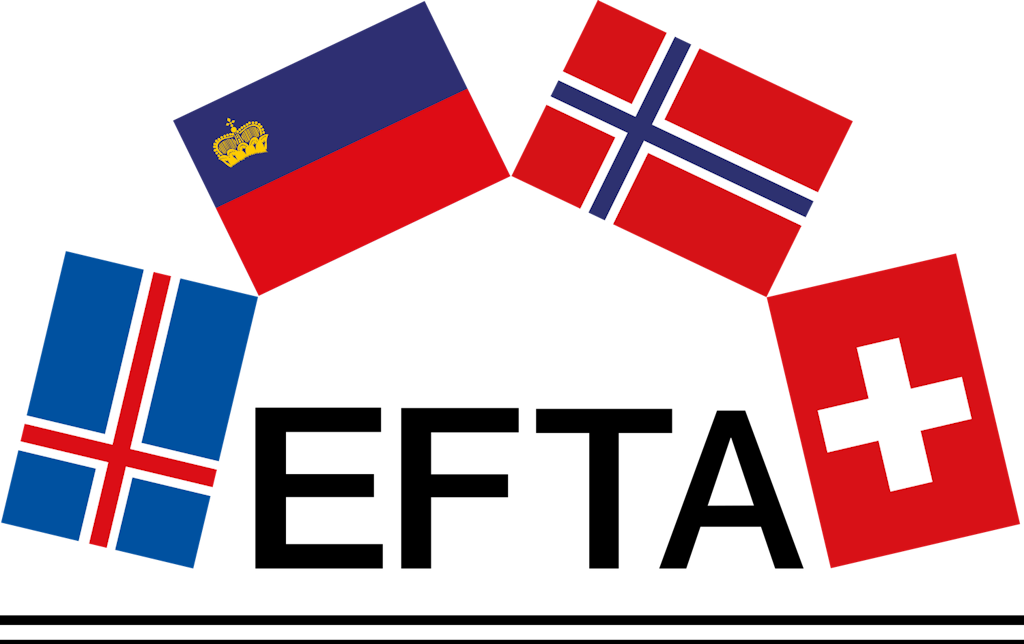
EFTA was founded in Stockholm in 1960 to facilitate trade between the Member States by eliminating the customs duties levied on industrial products. The 2001 renewal of the EFTA Convention integrated, among other things, new provisions for trade in services, movement of capital, and the protection of intellectual property.
Since the 1990s, the EFTA Member States have been using the organization as a platform to negotiate free trade agreements with third countries outside of the EU. In 2025, EFTA had a network of 31 such agreements with 41 partners. Further agreements are continuously being negotiated.
Unlike the EU, EFTA is not a customs union. This means that EFTA member states can set their own customs tariffs and other foreign trade policy measures with non-members.
EEA and the EFTA
To enable the EFTA Member States to participate in the EU internal market, the EFTA States and the EU States negotiated the European Economic Area (EEA) Agreement. In 1992, Switzerland rejected accession to the EEA Agreement in a referendum. The contracting parties to the EEA Agreement today are the so-called EEA/EFTA States of Norway, Iceland, and Liechtenstein as well as the EU Member States. The former EFTA Member States of Finland, Austria, and Sweden became EU members shortly after the negotiation of the EEA Agreement.
The EEA Agreement is regularly revised to bring it in line with developments in the relevant EU law. An EFTA surveillance authority and an EFTA court were established to implement EEA obligations.
Switzerland and its relations to the EEA/EFTA States
Since 2001, the EFTA Convention between Switzerland and the other EFTA states has established legal relations comparable to those set out in the seven bilateral agreements concluded between Switzerland and the EU in 1999. It is regularly amended to take account of developments in relations between Switzerland and the EU. The aim is to ensure that relations between the EFTA states themselves and between the EFTA states and the EU develop as parallel as possible.
As an EFTA Member State, Switzerland enjoys observer status in the EFTA pillar of the EEA. This enables Switzerland to closely monitor and follow developments both in the EEA and in EU law.
Links
Contact
State Secretariat for Economic Affairs SECO
efta@seco.admin.ch