
Why and how Switzerland operationalizes women’s participation in peace processes
How can women’s meaningful participation in peace processes be safeguarded at a time of growing backlash against women’s rights? This question was at the heart of the second in-person meeting of the Swiss Women in Peace Processes (SWiPP) network, held this week in Geneva, where participants explored how expertise, networks and institutional courage can translate into more durable peace outcomes.

Interview with Sibylle Obrist, Deputy Head of the Peace and Human Rights Division of the Federal Department of Foreign Affairs (FDFA)
The Swiss Women in Peace Processes (SWiPP) network, supported by the Federal Department of Foreign Affairs, in collaboration with the Center for Security Studies ETH Zurich and Swisspeace, brings together practitioners from government, academia, and civil society to strengthen Switzerland’s expertise and cooperation on women’s participation in peace processes.
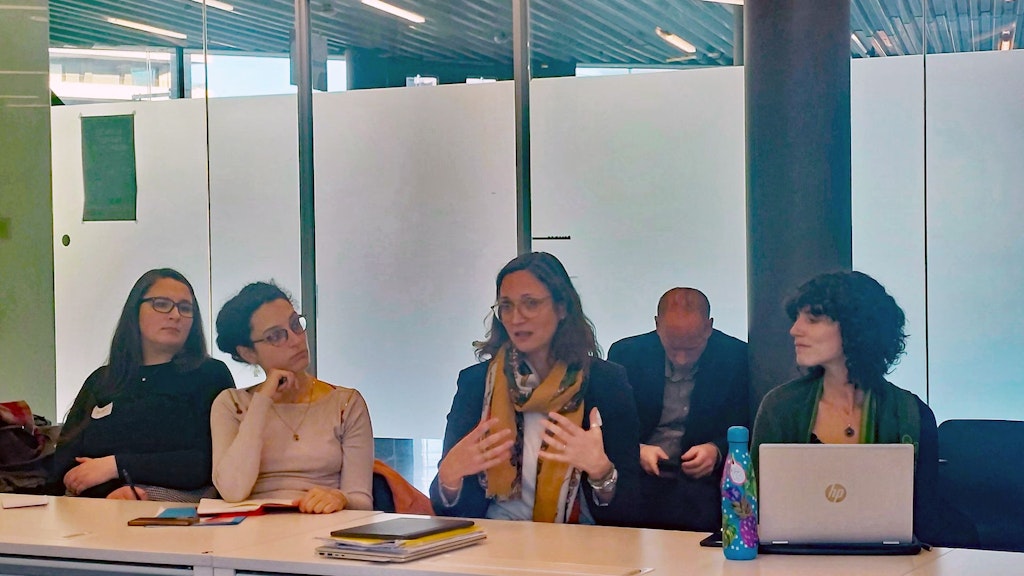
You just delivered the closing remarks of the second SWiPP in person meeting, a full day of discussions about the role of women in peace processes, specifically the role of Swiss women in peace processes. What stood out most to you from today’s discussions?
Sibylle Obrist: What struck me most was the clarity with which participants and speakers described the current moment. There is a very real and tangible backlash against women’s rights, including in contexts where peace processes are taking place. But alongside this, I also sensed a strong determination. The discussions showed that even in a more constrained political environment, there is space for strategic engagement, institutional courage, and deliberate choices to ensure women’s meaningful participation in peace processes. Not because of some ideological factors but because we know that results of inclusive processes, with women’s participation, are more sustainable.
The event brought together a wide range of actors. Why is this diversity important for Switzerland’s engagement on Women, Peace and Security?
Switzerland’s strength lies in its ecosystem and expertise. Bringing together governments, civil society, academia, and field practitioners allows us to look at challenges from multiple angles. But this alone is not enough. What matters is how well these perspectives are connected and translated into practice. The SWiPP network plays an important role in doing exactly that—by fostering exchange, building trust, and helping us act more coherently across institutions.
You emphasized that meaningful participation is a political issue rather than a technical one. What does that mean in practice?
It means acknowledging that inclusion does not happen automatically. It requires intentional design of peace processes, conscious decisions about who is consulted and whose knowledge is valued. Meaningful participation is about influence, not presence. This is as true at formal negotiating tables as it is at the local level, where peace is often built and sustained. In today’s world, peace tend to be very “man to man” and transactional, we need to propose other avenues.
What role do you see for the SWiPP network going forward?
My expectation is that SWiPP continues to be a space that not only reflects on challenges, but actively helps shape responses. A network that speaks honestly to institutions, including the FDFA, generates ideas, and challenges complacency when needed. From the side of the Peace and Human Rights Division, we see SWiPP as a partner—one that helps us think better, act more strategically, and remain ambitious in advancing women’s participation in peace processes.
What is the added value of networks? Is it not just talk among the converted?
Networks bring added value to diplomacy and peacebuilding because they create trusted and spaces where diverse voices can connect, exchange, and collaborate. They function as hubs of expertise — gathering practitioners, policymakers, and advocates who can draw on one another’s experiences to find innovative responses to complex political challenges.
For women peacebuilders in particular, networks play an especially powerful role. They act as bridges to power centres and as entry points into decision-making processes that have too often been closed to women. They provide safety nets — points of contact and solidarity that women can turn to in times of challenge or risk. Networks also nurture collective learning and intergenerational co‑leadership, empowering new generations of peacebuilders to carry forward and expand on the progress achieved.
In peace processes, women’s networks are still an underappreciated factor in ensuring that agreements are effectively implemented. Their collective advocacy helps sustain momentum, hold institutions accountable, and keep communities engaged in building lasting peace. In short, networks are not only engines of expertise and connection — they are also flexible diplomatic tools that strengthen inclusion, resilience, and innovation across the peace and security landscape.
Finally, what message would you want participants take away from this event?
I hope colleagues and partners left with a renewed sense of responsibility. Advancing this agenda is not a peripheral issue—it is central to sustainable peace and a priority for Switzerland. Today’s exchanges showed that Switzerland has the expertise and the partnerships to make a difference. The challenge now is to carry this momentum forward and translate it into concrete action.
Contact
General Secretariat GS-FDFA
Federal Palace West
3003 Bern