
Foreign policy: strategies and key aspects
Foreign policy aims to promote Switzerland's interests, including its values. The Federal Constitution is the starting point. The Foreign Policy Strategy is the overarching foreign policy document for both the geographical and thematic follow-up strategies. This method, referred to as a “cascading foreign policy strategy”, contributes to the coherence of Swiss foreign policy. The strategies are renewed each legislative period.
A foreign policy based on the Constitution
In our polity governed by the rule of law, the Federal Constitution is the starting point for any Foreign Policy Strategy. Two articles are particularly relevant in relation to foreign affairs. The core mission is rooted in Article 2 of the Federal Constitution. It centres on Switzerland's security, welfare and independence.
With respect to foreign affairs, Article 54 paragraph 2 of the Constitution stipulates non-exhaustively
Since 2011, the Federal Council has set out its priorities for the current legislative period every four years in a Foreign Policy Strategy. The Foreign Policy Strategy 2024-27 is the latest of these. In addition to the provisions of the Federal Constitution, this strategy is based on the Federal Council's legislative programme and an assessment of the international context in which Switzerland operates.
Foreign policy is about interests. This includes promoting values, as interests and values are interdependent.
Cascading strategy
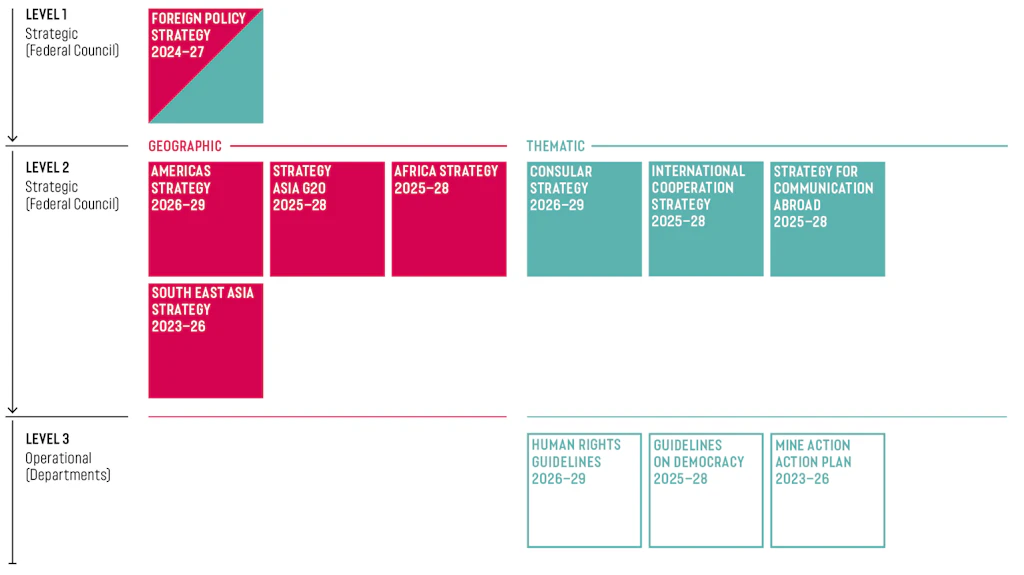
The Foreign Policy Strategy 2024–27 is the overarching foreign policy document – and occupies the highest level of the cascading strategy. The various geographical and thematic follow-up strategies adopted by the Federal Council in line with its plans for the legislative period constitute the second level of the cascading strategy process. Under all these strategies, the Federal Council sets priorities and specifies the applicable policy objectives and measures over a four-year period.
At the third level of the process, the departments translate the Federal Council strategies into operational implementation plans. In particular, these may take the form of guidelines, action plans or cooperation programmes.
Foreign policy coherence
Effective foreign policy requires coherence in policy-making. All departments deal with foreign policy issues today. The current change in the political environment shows how important coherence is. Faced with crises and positioning issues, Switzerland needs to act and communicate in a unified way in order to safeguard its interests.
Progress was made regarding coherence in the 2019–23 legislative period. For the first time, the Federal Council adopted a series of geographical and thematic follow-up strategies, enabling it to flesh out the Foreign Policy Strategy more specifically. This new approach is referred to as a ‘cascading foreign policy strategy’ and has helped address the issue of coherence.
FDFA guidelines and action plans
Foreign Policy Strategy 2024–27
The Foreign Policy Strategy 2024–2027 sets out the objectives and priorities of Swiss foreign policy in a changing international environment.
Geographical strategies
The Federal Council has fleshed out certain areas of the Foreign Policy Strategy in a series of geographical and thematic follow-up strategies.
Thematic strategies
The Federal Council specifies individual areas of the Foreign Policy Strategy in a series of geographical and thematic follow-up strategies.
Guidelines and action plans
To implement Federal Council strategies, departments can issue their own documents such as guidelines, mission statements, or action plans - the third level of the cascade.
Contact
State Secretariat STS-FDFA
Federal Palace West
3003 Bern