
International humanitarian law
International humanitarian law (IHL) is a set of rules, which seeks to limit the effects of armed conflicts. It regulates the conduct of hostilities and protects the victims of armed conflicts. It is applicable to all types of armed conflicts, international and non-international, regardless of the legitimacy or the motives invoked to justify the use of force.
Obligations for parties to a conflict under international humanitarian law
- Attacks directed against civilians and civilian objects are prohibited. Parties to a conflict must at all times distinguish between ‘military objectives’ and civilians and civilian objects.
- Attacks on military objectives are prohibited if they are likely to involve excessive casualties among the civilian population or disproportionate damage to civilian objects or the environment. When attacking, the parties to a conflict must take all feasible precautions to protect the civilian population and civilian objects.
- It is prohibited to use civilians as human shields.
- It is prohibited to misuse the emblems of the Geneva Conventions.
- Weapons that are indiscriminate or cause unnecessary suffering or severe damage to the environment are prohibited. This includes biological and chemical weapons, blinding laser weapons or expanding bullets.
Legal sources of international humanitarian law
- The four Geneva Conventions and their Additional Protocols protect persons who are not, or no longer, participating, in hostilities. Civilian internees, prisoners of war and other vulnerable persons must not be mistreated and the wounded must be taken in and cared for.
- Additional Protocol I of 1977, the Hague Convention of 1907 and the Convention on Certain Conventional Weapons of 1980 and its Protocols restrict the means and methods of warfare.
- Most of the obligations regarding the conduct of hostilities are of a customary nature.
Applicable norms according to the type of conflict
In a situation of armed conflict, including occupation, all parties, whether state forces or non-state armed groups, must respect international humanitarian law:
- Armed conflicts between states (international armed conflicts) are subject to the rules set out in the four Geneva Conventions, Additional Protocol I of 1977, the Hague Convention of 1907 and the relevant customary law.
- A more limited range of treaty-based norms applies to non-international armed conflicts. Only common article 3 to the Geneva Conventions and Additional Protocol II of 1977 apply, as well as the relevant customary law.
War crimes
Not only the parties to a conflict, but also but also by each individual who takes part in it, must comply with international humanitarian law. As a rule, grave breaches of international humanitarian law are war crimes. Examples of war crimes include:
- torture and inhuman treatment of detainees
- rape
- attacks on the civilian population
- unlawful displacement of the civilian population
- taking hostages
- recruiting child soldiers
In the event of grave breaches of the Geneva Conventions, every state has a duty to either prosecute the suspected perpetrators in a criminal court or to hand them over to another state or an international criminal tribunal for prosecution (principle of aut dedere aut judicare).
Index
Links
- Press release, Switzerland is working to strengthen the implementation of the principle of precaution in armed conflicts, 20.04.2026
- Database of the International Committee of the Red Cross on customary international law (ICRC)
- Treaty database of the International Committee (ICRC)
- Strategy for the Protection of Civilians in Armed Conflicts
- Humanitarian Access in Armed Conflicts: Handbook on the Normative Framework
- Humanitarian Access in situations of armed conflict
- International Institute of Humanitarian Law in San Remo
- Academy of International Humanitarian Law and Human Rights, Geneva
Documents
State Expert Meeting on International Humanitarian Law: Implementing the Principle of Precaution in Armed Conflicts
Background document
75 years of the Geneva Conventions
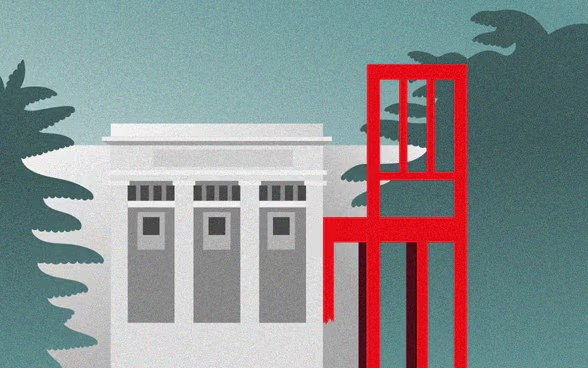
Graphic representation of the “Broken Chair” in front of the Palais des Nations in Geneva, a wooden sculpture by Swiss artist Daniel Berset, as a memorial against anti-personnel mines.
International Humanitarian Law in the Security Council: Switzerland’s Lessons learned and How to strengthen IHL while serving on the Council
The ABC of International Humanitarian Law
The ABCs of International Humanitarian Law is essentially a glossary of terms explaining the key concepts of international humanitarian law, which is also known as the law of armed conflict. The brochure offers, beside the glossary, a short introduction on the development and area of application of this special field of international law.
ABC of International Law
.png)
Kontakt
Kochergasse 10
3003 Bern