
Disarmament and non-proliferation
At the international level, Switzerland advocates the complete elimination (disarmament) and non-proliferation of weapons of mass destruction. To achieve this, it participates in almost all international arms control and disarmament instruments available to it, with the aim of alleviating suffering in armed conflicts and strengthening international security.
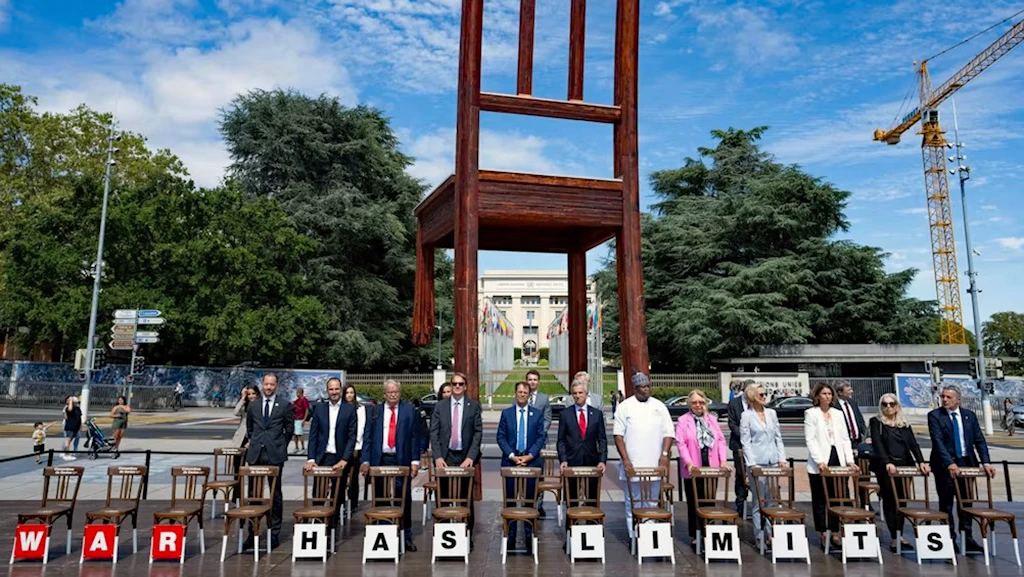
Arms control, disarmament and non-proliferation are central pillars of Swiss foreign and security policy, which has as its main objective to increase national security by controlling and reducing global arsenals, increasing international stability and strengthening transparency and trust between states. While tensions between countries have steadily increased in recent years, including between states with nuclear weapons, Switzerland continues to advocate a ban and the elimination of all categories of weapons of mass destruction. Switzerland reaffirms its conviction that a nuclear war cannot be won and must never be waged.
As a neutral state, Switzerland has a strong interest in ensuring that compliance with international law takes precedence over political or military power considerations. In keeping with its humanitarian tradition and fundamental principles, it is committed to multilateral agreements that not only promote security, stability and peace, but also aim to achieve the following:
- strengthen respect for international humanitarian law and human rights;
- reduce the suffering caused by armed conflicts;
- provide effective protection for civilians;
- comprehensively promote human and global security
Arms control and disarmament are currently facing turbulent times. On the one hand, new global power structures – particularly the geopolitical rivalry between major powers – are making cooperation more difficult. On the other hand, new technologies are fundamentally changing the nature of conflicts and the management of crises.
Switzerland is committed to ensuring compliance with existing agreements – both weapons-specific (e.g. the Biological Weapons Convention) and general international treaties (e.g. the Geneva Conventions). That is why, with few exceptions, it participates in all legally binding arms-control, disarmament and non-proliferation instruments open to it. At the same time, it pursues a restrictive arms export policy. It participates in confidence-building measures, such as the UN Register of Conventional Arms, which creates transparency regarding conventional weapons.
Current conflicts, for example in the Middle East and Ukraine, not only show the increasing use of new technologies and new developments in warfare, they also highlight the importance of respecting the limits of warfare and the corresponding agreements.
Documents
Swiss Statement at the Second Meeting of the States Parties to the Treaty on the Prohibition of Nuclear Weapons, 29.11.2023
multilingual: French, English
Swiss Statement at the First Meeting of States Parties to the Treaty on the Prohibition of Nuclear Weapons, 22.06.2022
French
Report of the Working Group to analyse the Treaty on the Prohibition of Nuclear Weapons
Übereinkommen über Streumunition: Bericht über das Ergebnis des Vernehmlassungsverfahrens
german
TREATY ON THE NON-PROLIFERATION OF NUCLEAR WEAPONS
german
Abkommen über das Verbot biologischer Waffen
german
Chemical Weapons Convention
Comprehensive Nuclear-Test-Ban Treaty
Topics
Nuclear disarmament
Switzerland supports multilateral forums on nuclear disarmament in order to realise the long-term goal of a world without nuclear weapons.
The Treaty on the Non-Proliferation of Nuclear Weapons (NPT)
The Treaty on the Non-Proliferation of Nuclear Weapons (NPT) is the cornerstone of nuclear arms control. Switzerland ratified it in 1977.
Treaty on the Prohibition of Nuclear Weapons (TPNW)
Since 2021, the Treaty on the Prohibition of Nuclear Weapons is in force. For Switzerland, reasons against joining outweigh the potential benefits.
Nuclear non-proliferation
Switzerland uses various instruments (IAEA, CTBT, NPT) to prevent the transfer of nuclear weapons to state or non-state actors.
Biological weapons
The Biological Weapons Convention prohibits the acquisition, production and possession of biological weapons. Switzerland ratified it in 1976.
Chemical weapons
Due to the implementation of the Chemical Weapons Convention, all declared chemical weapons stocks have been destroyed since 1997.
Conventional weapons
International humanitarian law bans certain weapons to limit conflict effects. Autonomous weapons must likewise comply with these humanitarian rules.
Weapon delivery systems and space security
The militarisation of space poses a threat to security in space and on Earth. Switzerland is committed to stricter rules governing the use of space.
Conventional arms control and confidence-building in Europe
Within the framework of conventional arms control, the Vienna Document and the Open Skies Treaty promote transparency and trust between states.