"Colombia is also a country of hope"

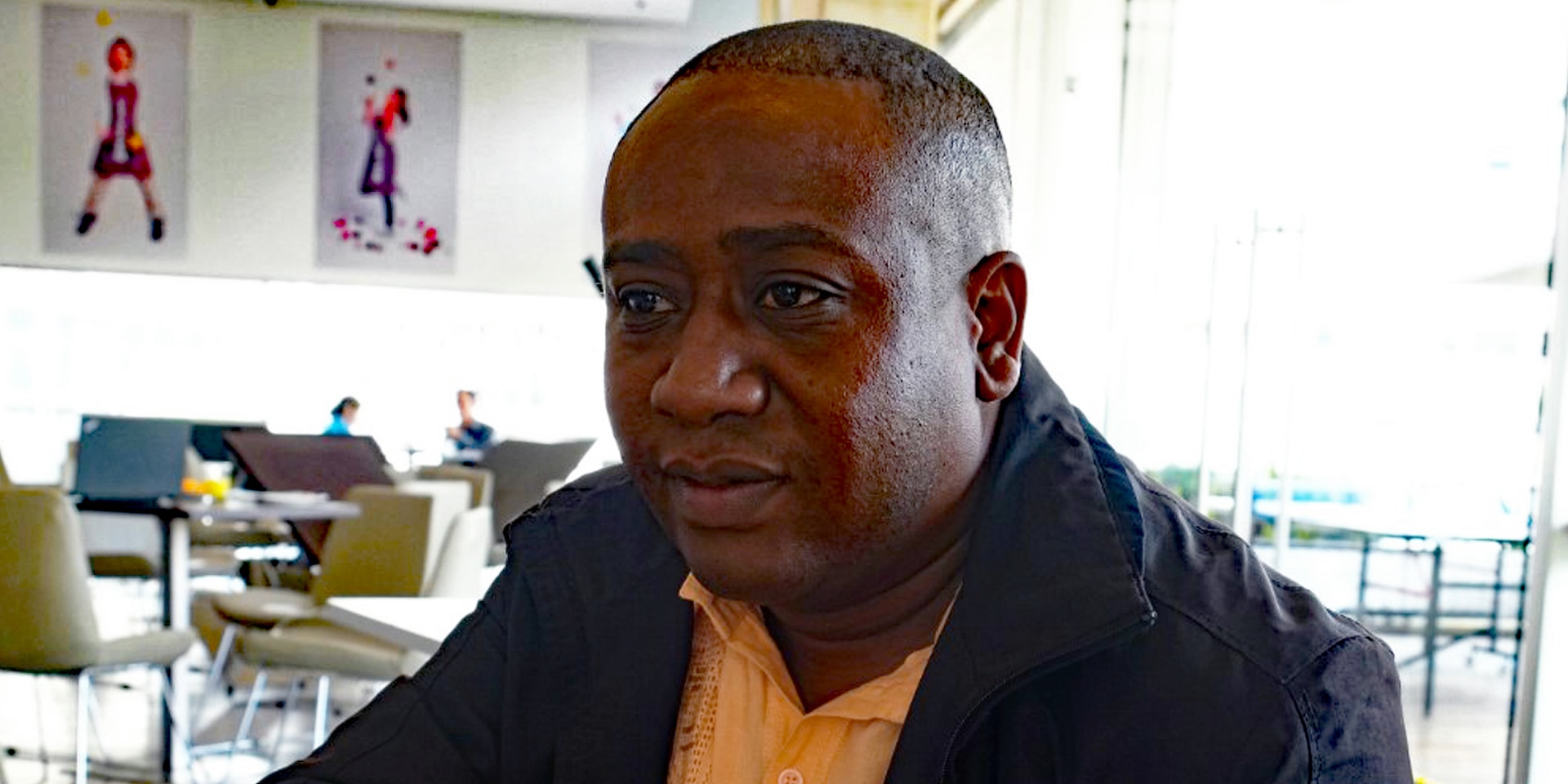
On 10 December 2025, a digital backup copy of the Colombian Truth Commission's archive was handed over to Switzerland. The files document human rights violations that took place during the armed conflict and contain 29,000 testimonies collected by the Truth Commission, which also received support from the FDFA. In this interview, former commission member Leyner Palacios talks about Colombia's search for the truth.

In this interview, former commission member Leyner Palacios talks about Colombia's search for the truth.

In this interview, former commission member Leyner Palacios talks about Colombia's search for the truth. ​© La Silla Vacía

Colombia has been facing a complex armed conflict spanning six decades due to persistent inequality in the country. Starting in the 1960s, different rebel groups began to emerge – such as the Fuerzas Armadas Revolucionarias de Colombia – Ejército del Pueblo (FARC-EP) and the Ejército de Liberación Nacional (ELN) – which engaged in armed conflict with the state security forces and paramilitary groups. Over 10 million people have fallen victim to Colombia's conflict. 

In 2016, the Colombian government and FARC rebels signed a peace agreement. 

2016 peace agreement

On 30 November 2016, the Colombian Congress ratified a revised version of the peace agreement, which includes eliminating the root causes of the conflict. In addition to structural reforms in rural regions, promoting political participation, disarming FARC-EP, combating illegal drug trafficking, security guarantees and reintegrating former FARC members into society, the agreement also centres on the right to know, the right to justice and the right to reparation as well as guarantees of non-recurrence. 

Integrated system for dealing with the past

The right to know, the right to justice and the right to reparation as well as guarantees of non-recurrence – an essential component of the peace agreement – include peaceful coexistence by means of reconciliation and dealing with the past. Colombia's comprehensive system for truth, justice, reparation and non-recurrence created by the 2016 agreement consists of three institutions: the Truth Commission, the Special Jurisdiction for Peace (JEP) and the Search Unit for Missing Persons (UBPD). Together they are known as the 'sistema integral' or integrated system. 

Truth – clarification – recognition

The aim of the Truth Commission was to shed light on the events of Colombia's decades-long armed conflict. The framework for dealing with the past contributes to recognition of the suffering endured. The commission interviewed 29,000 survivors living in Colombia and abroad. 

The FDFA's Peace and Human Rights Division lent its strategic and technical expertise to support this process, helping to strengthen confidence-building in key segments of society and promoting the involvement of victims both in exile and the conflict-affected regions. The division also advocates the implementation of the Truth Commission's recommendations on non-recurrence and actively contributed to the preparation of the archive. 

Truth commissions

Truth commissions are a relatively new instrument for dealing with violations of human rights and international humanitarian law. The idea originated in South America, where a number of military dictatorships were in power until the 1990s. The aim was to disclose crimes, come to terms with the past within society as a whole, and prevent lasting political divides by fostering dialogue between former opponents.

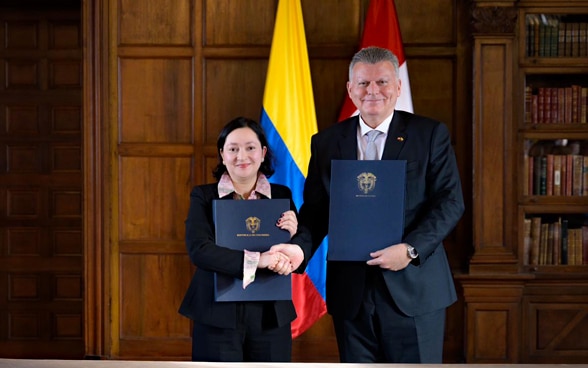
Eric Mayoraz, Swiss Ambassador to Colombia, and Olga Lucía Arenas, Deputy Foreign Minister of Colombia, signed the document.
Signing of the document symbolically transferring the digital backup copy of the documents held by the Truth Commission. Eric Mayoraz, Swiss Ambassador to Colombia, and Olga Lucía Arenas, Colombia's Deputy Foreign Minister, signed the document. © Cancilleria Colombia

Questions for Leyner Palacios, former member of the Colombian Truth Commission

Leyner Palacios was a member of the Colombian Truth Commission, which between 2018 and 2022 analysed the causes of the conflict, gave voice to the different segments of Colombian society, and drew up recommendations for the state and civil society aimed at preventing future escalations of violence. In this interview, he talks about the commission's methodological approaches, the importance of the archive and his hopes for Colombia's future. 

When you look back on the commission's work today, what do you think were the key achievements or findings?

All findings are key, because everything is connected. One central issue was the problem of security. The total failure of the Colombian security system was clear: more than six decades of armed conflict, 10 million victims, 16,000 child soldiers forcibly recruited, 4,000 massacres and 800,000 deaths. Another main point was the notion of 'wounded Colombia' – the fact that every murder victim left behind a family and that the suffering caused by loss, displacement and psychological damage has left its mark on society as a whole. More than 80% of the population were affected directly or indirectly. 

In terms of key achievements, I would mention the tools developed by the commission to help people overcome their fears of talking about the past, which is what made it possible to even draw up the report. I also particularly appreciate some of the key methodological decisions the commission made during the process. For example, the decision to use a differentiated approach meant that the report also had to include a section dedicated to clarifying the impact of the armed conflict on Colombia's various ethnic groups. This was very important in terms of recognising the country's ethnic and cultural diversity. 

What momentum do the commission's findings give to the ongoing process of truth, justice and reconciliation?

The commission also made recommendations concerning the future, calling for far-reaching changes in Colombian society. In this way, the report doesn't get stuck in the country's painful past but looks beyond it, offering prospects for a new future. 

It's also a central document for strengthening Colombia's transitional justice system, for example in relation to the search for missing persons. Even though it can't be used to assign accountability, the report can be used to reconstruct and supplement the legal truth. 

The commission leaves Colombia with the country's largest human rights archive. Switzerland is keeping a digital backup in the Swiss Federal Archives at Colombia's request. What is the significance of this archive? 

It is an archive of memory, of violations of human rights and international humanitarian law. It is also an archive of unique importance, containing not only institutional information but statements by civil society organisations and the victims themselves – more than 29,000 people, 14,000 interviews, thousands of hours of recordings, as well as documents and photos, covering the 1960s to 2016. 

It is an extensive collection of records on the worst atrocities that occurred during the conflict, but it is also a record of the resistance with which society met this tragedy. The documents must be preserved for the future generations, who now have access to invaluable tools enabling them to understand what happened in our country and how it happened to us.

What is the role of the digital backup being stored in Switzerland? 

Having a copy guarantees that the truth cannot be erased, neither by cyberattacks nor political change. It is a guarantee for the victims and for the future. 

Because Colombia is a country in transition, I think it's essential to have such a digital backup of the Truth Commission's archive in case of potential political fluctuations. 

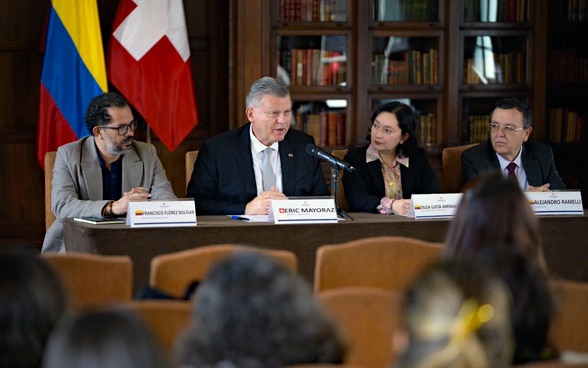
Francisco Flores, Eric Mayoraz, Olga Lucía Arenas and Alejandro Ramelli at a press conference.
From left to right: Francisco Flores, Director of the National Archives, Eric Mayoraz, Swiss Ambassador to Colombia, Olga Lucía Arenas, Deputy Foreign Minister of Colombia, and Alejandro Ramelli, Judge and President of the Special Jurisdiction for Peace. © Cancilleria Colombia

What do you make of the international community's role in peacebuilding in Colombia?

The 2016 peace agreement would never have come into being without the international community, which provided Colombia with political, technical and financial support. We were also given support at the Truth Commission – accompanied on our field missions to the different regions and provided with technical assistance. 

Switzerland played a particularly important role here, providing largely discreet but crucial support when it came to confidential dialogues or accompanying victims, as well as in its role as a mediator. 

How important is it for truth commissions in general to have an international partner like Switzerland?

Very important. First, it gave us legitimacy – particularly as the public were critical at the time. Having the international community's ongoing support gave us the necessary credibility, which was vital at both the societal and global level. And having Switzerland as a partner at our side also helped ensure that the victims were ready to take part in the commission's work. 

What hopes do you have for Colombia's future?

I hope Colombia understands that life is sacred. That children are allowed to live. That women no longer have to bury their husbands. I would like to see a strengthened democratic system that can overcome violence. 

Colombia is also a country of hope. In spite of everything, the commission's report demonstrates our capacity to name our suffering and seek ways towards reconciliation and peace. And that is valuable indeed. 

Dealing with the past

The right to know is one of the four Joinet principles, originally developed by Louis Joinet for the then UN Commission on Human Rights. The principles recognise the rights of victims and define the obligations of the state. The right to know includes both the individual right of the victims and their families as well as the collective right of society to a clarification of the events and human rights violations that occurred. The aim is to prevent a repetition of such crimes and to enable social reconciliation

Sustainable peace process

Switzerland was asked by the Colombian government to keep a digital backup of the Colombian Truth Commission's archive, which contain information on human rights violations as well as witness statements. In 2023, an international agreement between Switzerland and Colombia was signed stipulating the storage of the digital backup in Switzerland. 

Final report of the Truth Commissionn

The Truth Commission presented its final report on 28 June 2022 in Bogotá. The report is divided into ten sections describing the most serious human rights violations such as forced displacement, torture, murder and abductions. The commission also drew up a number of recommendations including a new strategy to combat drugs, agricultural reforms and the establishment of a ministry for peace and reconciliation.

Promoting peaceful social coexistence through reconciliation and dealing with the past is one of the three goals of Switzerland's peace policy in Colombia. Switzerland has been working for sustainable peace in Colombia for 25 years. It supports the implementation of the 2016 peace agreement and, within the framework of official mandates, several ongoing peace negotiations between the Colombian government and armed groups. It also promotes civic participation with a view to strengthening democracy. The FDFA's Peace and Human Rights Division is responsible for implementing Swiss peace policy. This falls under the 2025–28 joint cooperation programme with the Humanitarian Aid Department of the Swiss Agency for Development and Cooperation (SDC) and the State Secretariat for Economic Affairs (SECO).

Start of page